The U.S. Federal Reserve has a dual mandate. It aims to keep the inflation rate steady at around 2% per year, as measured by the core Personal Consumption Expenditures Price Index (PCE), and to keep the economy running at full employment, although policymakers don’t have a specific target for the unemployment rate.
The Fed will adjust the federal funds rate (overnight interest rate) to achieve those goals. It has cut rates six times since September 2024, for example, because core PCE declined significantly from its 2022 peak. However, that progress is now in jeopardy.
The core PCE recently ticked higher for two straight months to an annualized rate of 3.1%. While it was above 3% as recently as April 2024, it was trending lower back then. It hasn’t broken the 3% barrier to the upside since April 2021 — and if this trend continues, the Fed might be forced to raise interest rates.
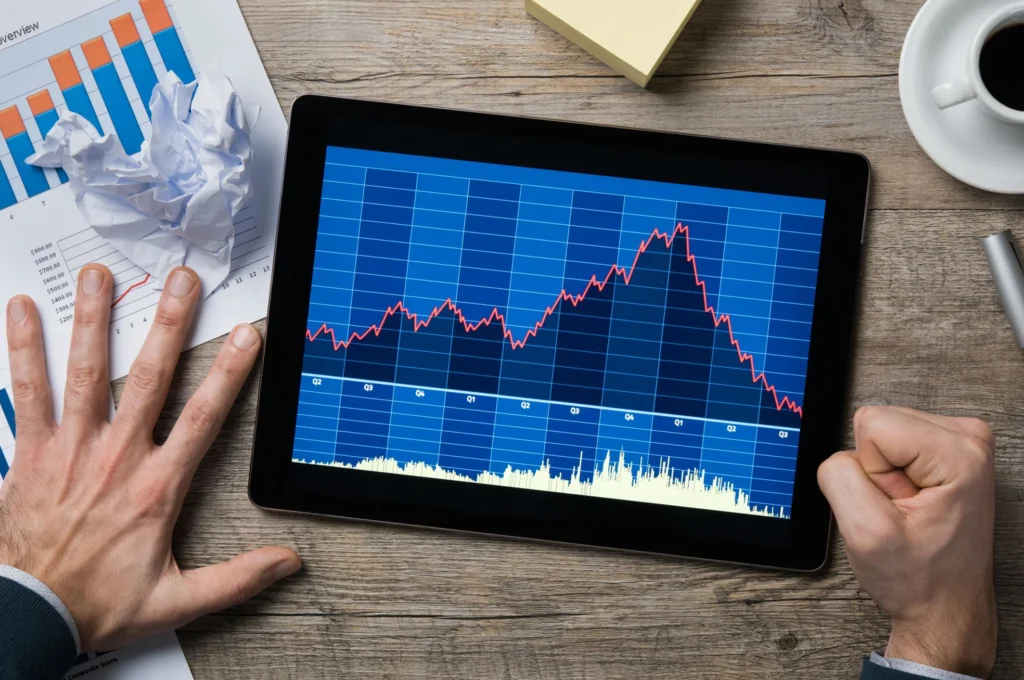
The last time the Fed embarked on a campaign to raise interest rates, the S&P 500 (^GSPC +0.62%) stock market index plunged into bear territory with a decline of more than 20%. Here’s what could happen next.
Image source: Getty Images.
The perfect inflationary storm
The U.S. economy has been incredibly resilient over the past year, and the Fed’s interest rate cuts were likely a big contributing factor. However, three issues could stoke a further rise in inflation and potentially force the Fed to rethink its monetary stance:
- The conflict in Iran, which has caused a sharp increase in oil prices. The price of a single barrel of West Texas Intermediate (WTI) oil has doubled since the beginning of 2026 and trades at $115 as I write this. Higher oil prices increase the cost of every single product that travels by land, air, and sea, so this poses a significant upside risk to inflation.
- Soaring fiscal spending. The U.S. government ran a $1.8 trillion budget deficit in fiscal 2025 (ended Sept. 30), and it’s on track for another trillion-dollar deficit in fiscal 2026. As a result, the U.S. national debt recently hit $39 trillion, and prominent investors like Paul Tudor Jones are worried the government will try to “inflate away the debt” through large increases in money supply.
- Tariffs. The Trump administration has imposed levies on imported goods from a variety of industries to make domestic manufacturers more competitive on the global stage, which typically increases prices.
The ongoing geopolitical tensions in the Middle East likely pose the greatest threat to inflation in the near term. Around one-third of the world’s fertilizer and one-fifth of the world’s oil and natural gas sail through the Strait of Hormuz, where shipping is currently at a standstill due to the raging conflict in the region. If traffic doesn’t start flowing soon, price increases could deal a catastrophic blow to consumer spending in the U.S.
Federal Reserve chairman Jerome Powell recently said policymakers try to “look through” short-term supply shocks like the recent rise in oil prices. Interest rate adjustments take time to work their way through the economy, so a hike probably wouldn’t have the desired effect for several months, when the geopolitical tensions in the Middle East might already be resolved.
That sounds like good news, but there was a similar increase in oil prices in 2022 when the Russia-Ukraine conflict began. It’s one of the reasons core PCE spiked to over 5%, triggering one of the most aggressive campaigns to hike interest rates in the Fed’s history. Policymakers increased the federal funds rate from a historic low of 0.1% to a two-decade high of 5.3% in the span of just 18 months between March 2022 and August 2023.
Wall Street is already adjusting its expectations on the back of the Middle East tensions. Michael Feroli, chief economist at J.P. Morgan, thinks the Fed will keep rates on hold for the remainder of 2026, but he predicts the central bank’s next move will be a hike toward the end of 2027.
Rising interest rates spell bad news for the stock market
Rising interest rates are bad for stocks for a few reasons. First, they prevent American companies from borrowing as much money to fuel their growth. Second, higher interest costs directly reduce corporate earnings — and earnings drive stock prices. Finally, rising rates are like a handbrake on consumer spending, which negatively impacts corporate financial performance overall.
As displayed in the chart, stock market investors earned zero return during the 18-month stretch in which the Fed last raised interest rates. And within that period was a decline of more than 20% in the S&P 500, constituting a technical bear market.
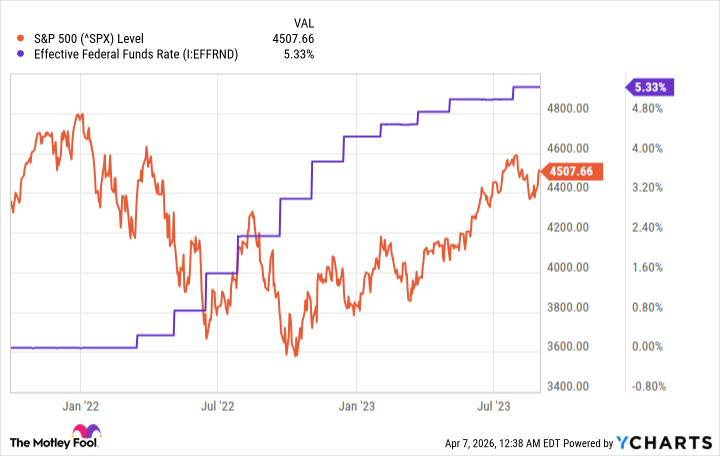
The federal funds rate is starting from a much higher base this time around, so even in a worst-case scenario, the magnitude of interest rate hikes probably won’t be as severe as it was in 2022 and 2023. That could result in a lesser decline in the stock market, but with the S&P 500 already sinking by 5% from its recent all-time high, investors are clearly treading with caution.
The best thing investors can do right now is zoom out and focus on the long term. The 2022 bear market proved to be the ultimate buying opportunity, because the S&P 500 nearly doubled from the low point in the years that followed. So, if stocks continue to fall, making consistent purchases with a five-to-10-year time horizon could yield spectacular results.