Welcome back to the latest episode of The Future of Automotive on CBT News, where we put recent automotive and mobility news into the context of the broader themes impacting the industry.
I’m Steve Greenfield from Automotive Ventures, and I’m glad that you could join us.
This week on The Future of Automotive,
The pressure from the Chinese automaker continues. And there’s a growing sense of unease inside one of the world’s most established OEMs.
Honda—like many of its peers—is facing a series of difficult, high-stakes decisions. The company has recently pulled the plug on several major electric vehicle programs, including its 0 SUV and 0 Sedan, along with a planned revival of the Acura RSX. The financial impact is significant—up to $15.8 billion in losses. Even its much-publicized partnership with Sony, which aimed to bring Afeela-branded EVs to market, has now been shelved.
It’s not just a setback. It’s a signal—one that raises deeper questions about whether traditional automakers can build a profitable future around electric vehicles.
But Honda’s challenges go well beyond EVs.
In China, the world’s largest auto market, the company is losing ground—fast. Sales have dropped sharply, from a peak of 1.62 million vehicles in 2020 to just 640,000 in 2025. Production capacity is now running at roughly half of what’s considered sustainable for profitability. And projections for 2026 suggest things could slip even further.
Against that backdrop, Honda’s CEO, Toshihiro Mibe, traveled to China earlier this year, looking for answers.
What he found was sobering.
Touring a highly automated supplier facility in Shanghai—one that also serves Tesla—Mibe saw a system operating with almost no human labor on the factory floor. From procurement to logistics, the entire process was streamlined, efficient, and fast.
His takeaway was blunt: “We have no chance against this.”
It’s a stark admission. But it reflects a broader reality.
Chinese automakers are moving at a pace the rest of the industry is struggling to match. New models can go from concept to production in as little as 18 to 24 months—roughly half the time it takes many legacy manufacturers. And they’re doing it with lower costs, high automation, and consistent quality.
The result is what some now call “China Speed”—a relentless cycle of rapid development and launch that’s reshaping the competitive landscape.
Still, Mibe insists this isn’t surrender—it’s a wake-up call.
After returning to Japan, he urged his teams to accelerate. Honda is now restructuring its research and development operations, shifting engineers into a more independent unit designed to move faster and operate with fewer internal constraints.
And Honda is not alone in sounding the alarm.
Ford CEO Jim Farley has warned that China already has enough production capacity to supply the entire North American market. Former Toyota CEO Koji Sato has gone even further—telling suppliers that without major changes, the company’s survival could be at risk.
When the world’s largest automaker speaks in those terms, it’s hard to ignore.
What’s emerging is a clear picture: China is no longer just a major player in the auto industry—it’s becoming the defining force.
The global legacy automaker have now recognized China as an existential threat. In order to effectively compete with the Chinese, they need to pursue the herculean task of figuring out how to both build cars cheaper and faster.
For legacy automakers, the challenge now is not just to compete—but to adapt. That may mean rethinking decades-old processes, accelerating development timelines, or even forming new partnerships.
Because in this race, speed—and flexibility—may matter more than legacy.
And as the industry confronts this moment, it reminds me of the famous quote by Charles Darwin.
It’s not necessarily the strongest companies that will survive. Or even the smartest.
It’s the ones that can change the fastest.
So, with that, let’s transition to Our Companies to Watch.
Every week we highlight interesting companies in the automotive technology space to keep an eye on. If you read my weekly Intel Report, we showcase a company to watch, and take the opportunity here on this segment each week to share that company with you.
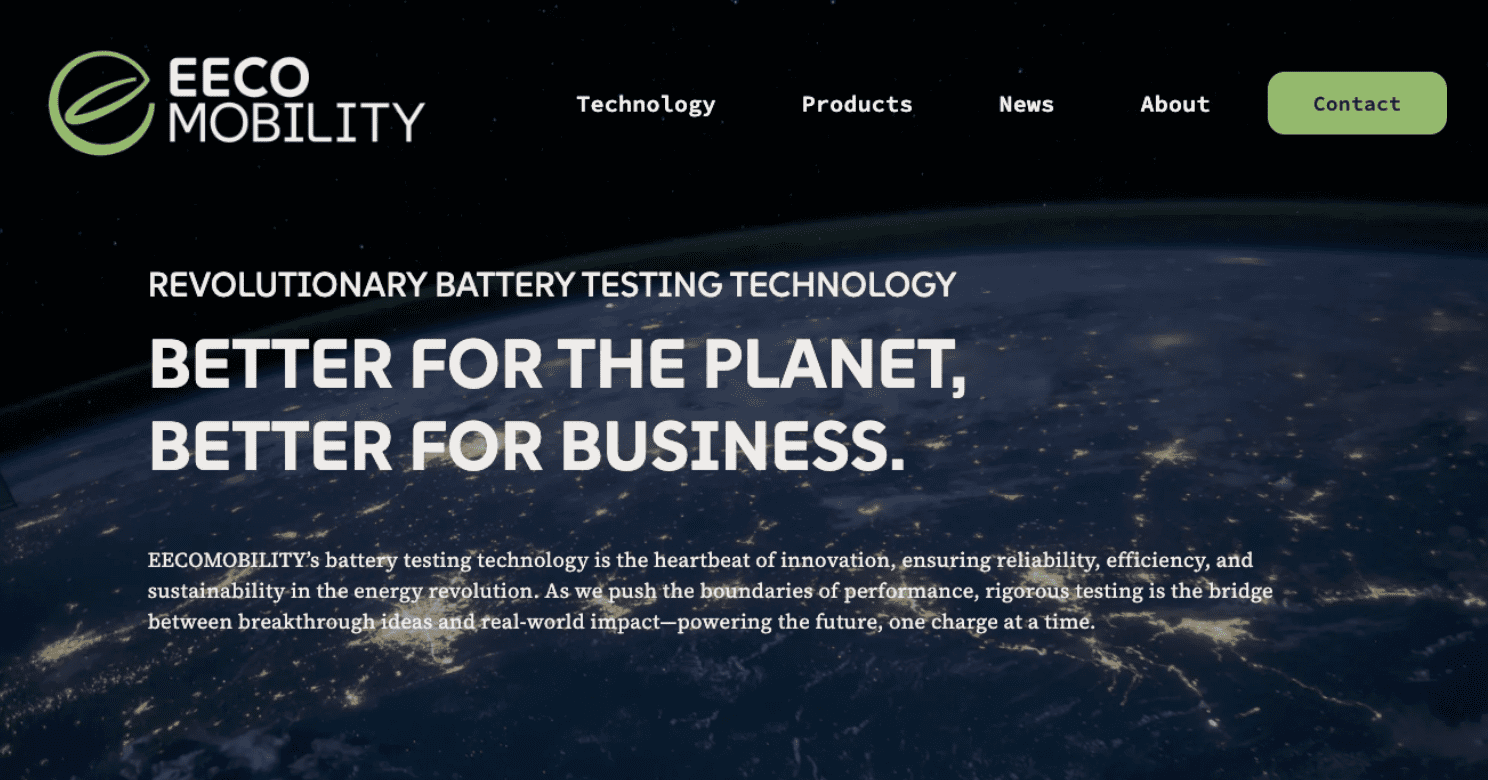
Today, our new company to watch is Eecomobility.
EECOMOBILITY, has developed cutting-edge AI software tailored for both the automotive and energy storage segments.
As battery production scales, chemistries diversify, and safety expectations continue to rise, the limiting factor is no longer measurement capability — it is decision velocity. The ability to extract meaningful insight early, reliably, and at scale is rapidly becoming a defining competitive advantage.
Its flagship product line, EECOPower, whichi is now used by customers globally, delivers rapid battery cell and module testing and characterization systems.
By applying intelligence-dense testing earlier in the production lifecycle, manufacturers gain the ability to intervene before defects propagate, reducing scrap, improving consistency, and strengthening long-term performance outcomes.
If you’d like to learn more about Eecomobility, you can check them out at www.eecomobility.com
So that’s it for this week’s Future of Automotive segment.
If you’re an AutoTech entrepreneur working on a solution that helps car dealerships, we want to hear from you. We are actively investing out of our new Mobility Fund.
Don’t forget to check out my two books, The Future of Automotive Retail and The Future of Mobility, both available on Amazon.com.
Thanks (as always) for your ongoing support and for tuning into CBT News for this week’s Future of Automotive segment. We’ll see you next week!