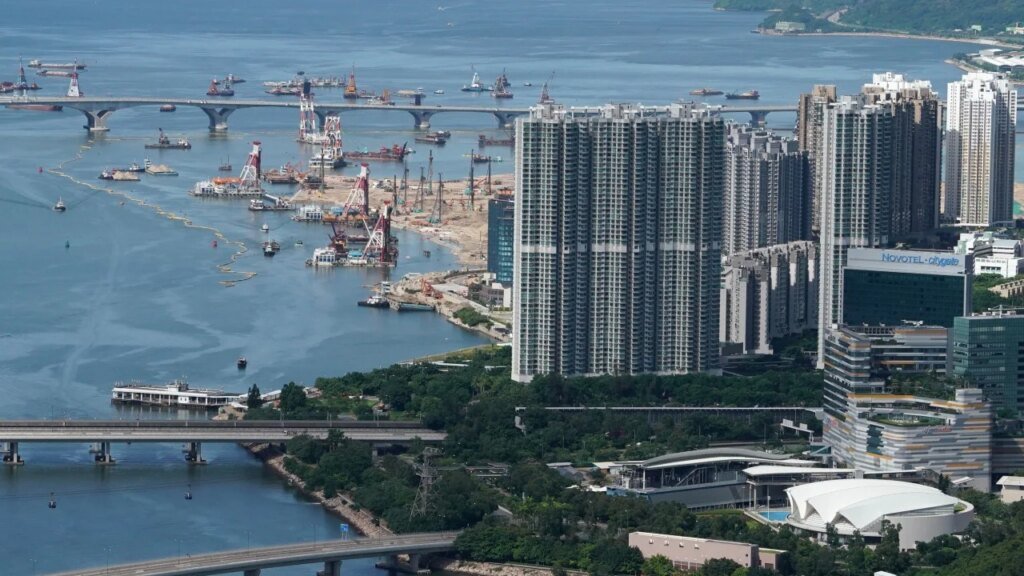
An aerial view of Kowloon, Hong Kong Special Administrative Region Photo: VCG
The Hong Kong Stock Exchange (HKEX) market delivered an impressive performance in the first quarter of 2026, with initial public offerings (IPOs) generating HK$110 billion ($13.3 billion) in proceeds, a record high for a single quarter since the second quarter of 2021, according to a Securities Times report.
Analysts said that the surge signals renewed investor confidence in tech IPOs despite profitability headwinds, as well as investors’ confidence in the Chinese mainland’s capital market, mainly driven by technological advancements. The figure hits a 5-year high, as AI-driven listings continue to attract global capital, according to analysts and media reports.
The report cited figures from financial data provider Wind that as of March 31, 40 companies had completed IPOs on the HKEX market, a year-on-year increase of 150 percent. Total first quarter fundraising reached nearly HK$110 billion, up 489 percent year-over-year.
In comparison, there were 16 IPOs in the Hong Kong stock market in the first quarter of 2025, raising HK$18.669 billion.
Meanwhile, according to HKEX’s data, over 400 listing applications were pending as of January 30.
During the first quarter, Hong Kong recorded 23 IPOs raising $4.7 billion and 15 secondary listings worth $8.5 billion. High-tech firms accounted for $7.6 billion (36 percent of total equity capital markets activity), according to the MENA Fintech Association.
By sector, tech hardware and software firms took the lead in this year’s Hong Kong IPO data, highlighting Hong Kong’s strategic role as an offshore financing hub for mainland companies, the Wallstreetcn reported.
The robust performance by tech firms is also evident in the secondary market. Notably, China’s leading large model companies Zhipu AI and MiniMax recorded gains of over 400 percent year-to-date gains post-listing, according to Wallstreetcn.
Hong Kong’s AI-driven capital market resurgence demonstrates that investor appetite for high-growth tech remains robust despite external uncertainty, Wang Peng, an associate researcher at the Beijing Academy of Social Sciences, told the Global Times.
Wang also said this trend indicates that the AI wave is reshaping the Hong Kong stock market’s financing landscape. With the continued development of China’s AI industry, more mainland AI companies are expected to get listed on the Hong Kong stock market. The outstanding performances of Zhipu AI and MiniMax not only set a benchmark for subsequent IPOs but also inject new momentum into the long-term development of the Hong Kong stock market.
Active trading
Paul Chan, financial secretary of the Hong Kong Special Administrative Region (HKSAR) government, on Sunday gave an overview of Hong Kong’s first-quarter economy, highlighting active trading despite a market correction, strong IPO activity, and indications of improvement in the real economy, the Xinhua News Agency reported.
Chan said that external factors dragged the Hong Kong stock market into a correction in the first quarter, with the Hang Seng Index down about 2 percent year-to-date, according to a press release on the HKSAR government’s website.
However, he said, trading was active, with the average daily turnover in the first two months exceeding HK$260 billion, up 17 percent year-on-year. Entering March, market activity increased further, with average daily turnover surpassing HK$300 billion, more than 8 percent higher than the same period last year.
This reflects increased asset allocation to Hong Kong amid uncertainty, with investors viewing the city as a reliable safe haven, while also benefiting from the mainland’s stable economic growth and the influx of high-quality enterprises listing in Hong Kong, which provide abundant investment opportunities, he said.
Chan said that the IPO market continued its strong momentum from last year. Hong Kong’s listing platform plays a key role in financing frontier technologies such as AI.
As of March 27, fundraising had exceeded HK$103 billion, ranking first globally. Including follow-on financing, the total fundraising scale reached about HK$237 billion. At present, over 500 applications are awaiting approval to get listed in Hong Kong.
According to analysts, the Hong Kong IPO market in 2026 is likely to maintain the robust activity seen in 2025, particularly evidenced by the influx of hard-tech companies and the rising popularity of the “A+H” dual listings, which allow the mainland companies to expand their international footholds and increase the number of international investors.
“A+H” dual listings are a major feature of the ongoing IPO craze in the first quarter. Of the 40 newly listed companies, 15 were “A+H.” Among the top 10 companies in terms of fundraising size, 7 were already listed on the A-share market, with a combined fundraising amount exceeding HK$52 billion, accounting for nearly half of the total IPO fundraising in Hong Kong in the first quarter, according to the mainland-based Securities Times.
Wang said this highlights the strategic position of the Hong Kong stock market as a crucial hub for overseas financing for mainland enterprises.
Looking ahead, as various systems designed to enhance the competitiveness of Hong Kong’s listing mechanism continue to improve, more high-quality new economy companies will get listed in Hong Kong, further solidifying Hong Kong’s core position as an international financial center and making it a crucial platform for mainland companies to expand overseas and for global investors to benefit from China’s high-quality economic growth, Wang said.
This year’s “A+H”dual listings in Hong Kong are marked by their large scale and high quality, Yang Delong, chief economist at Shenzhen-based First Seafront Fund, told the Global Times on Monday.
Leveraging the policy benefits of deepening interconnectivity between the two capital markets and improved listing rules and regulatory coordination, these companies can integrate capital and industrial resources from both locations, facilitating the companies’ global expansion and enhancing their international influence, Yang said.
He added that the shift among “A+H” listed entities from traditional manufacturing to strategic emerging industries such as high-end manufacturing, semiconductors, and new energy aligns precisely with the trend of domestic economic transformation and upgrading.