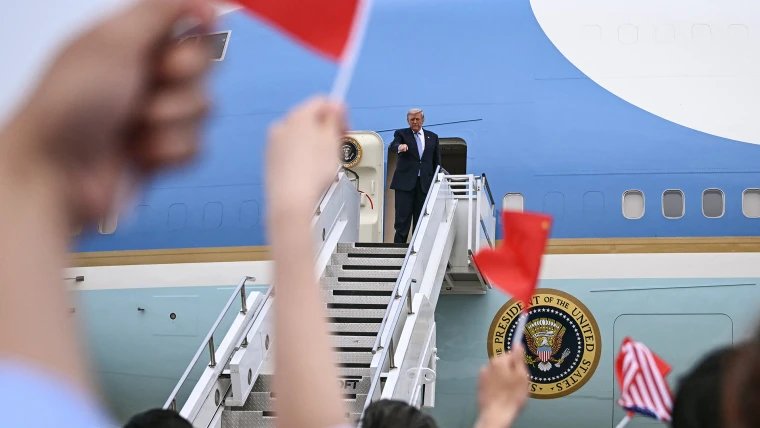
American soldiers are more pro-Nato than US president Donald Trump, but if he quit the alliance, European forces could still deter Russia, two former Nato insiders have said.
“They [US soldiers] would obey if an order came to pull back, but it’s certainly not something they would concur with … they don’t share president Trump’s opinion,” said retired Italian admiral Gianpaolo di Paola.
“The American military, if not the secretary of war [Pete Hegseth], know that the real power of the US in the world rests on its alliance with those who share their fundamental values,” he added.
“They are on the ground in Europe, they live here [in Europe], and beside any brotherly feeling they have [toward European soldiers], they know that what makes America stronger vis-à-vis Russia and China is Nato,” said Di Paola, who chaired the Nato Military Committee of national armed-forces chiefs until 2011 and who is now at the Italian Institute for International Political Studies in Rome.
Trump’s latest anti-Nato outburst came after France, Italy, and Spain declined to let him use their airspace to attack Iran.
But the military understood why US allies were so “frustrated” that even the UK also “distanced itself” from the Iran war, said Di Paola.
“There was no consultation [on Iran], no exchange of views whatsoever with allies, and that was very different from the Bushes in Iraq 1 and Iraq 2,” he said, referring to the Gulf War in 1990 and the Iraq War in 2003 under former US president George Bush and his son, George W. Bush.
For his part, Jamie Shea, a former Nato official, also said: “US military officers serving in Europe … undoubtedly appreciate the value of the alliance to the US”.
But he added: “The US military is conservative in values and political outlook and no doubt many voted for Trump”.
And “the military don’t have a culture of speaking out — contrary to dissenting diplomats — and express their views publicly only after they retire”.
“They have seen Hegseth’s Pentagon fire many senior military officers who were considered woke or not sufficiently loyal. So speaking for Nato is risky,” he said.
“The Pentagon is now pulling US officers out of the Nato command structure and replacing them with Europeans, which means even fewer future US military leaders with personal experience of Nato. Not ideal,” added Shea, who was Nato’s deputy assistant secretary general for emerging security challenges until 2018 and who now teaches war studies at Exter University in the UK.
Trump’s anti-Nato tirades have posed the question of whether he would honour its Article V obligation if Russian president Vladimir Putin attacked a European ally even while the US was still nominally in the club.
But Di Paola and Shea said Putin could not do so until the Ukraine war had ended and US troops had left frontline positions in Nato battalions in the Baltic states, Poland, and Romania.
“Putin will pour himself an extra glass of vodka and feel encouraged”, by this week’s Trump anti-Nato outburst, said Shea, “but he [Putin] is still bogged down in Ukraine”.
Di Paola said: “Putin is in trouble in Ukraine, so starting another adventure in Europe is not thinkable in any short time frame”.