Many North Carolina students are still using their phones in class despite a new state law banning their use during instructional time, according to data presented Tuesday to state lawmakers.
An ongoing study of middle school students conducted by UNC-Chapel Hill showed only 60.7% said they were following school policy since the new state ban on using phones in class went into effect. In addition, students said nearly 40% of schools weren’t always enforcing the phone policy and many kids said their parents still contact them on the phone while at school.
“We are seeing that there are notable minorities of students who are reporting that teacher and staff are not necessarily enforcing these policies fairly and notable minorities who are reporting that classmates are using their phones when they’re not supposed to,” said Kaitlyn Burnell, director of research, at UNC-Chapel Hill’s Winston Center on Technology and Brain Development.
”When it comes to asking the students directly about policy enforcement, we are again seeing notable minorities saying that the school does not always enforce the policy that’s in place.”
Burnell presented the findings to the Joint Legislative Education Oversight Committee.
Sen. Kevin Corbin said it may be time for lawmakers to take the next step and ban phones from bell to bell — meaning no student use is allowed during the school day. Corbin said he had been asked by some school board members in his Western North Carolina district to make that change since state law only requires phones to be off during instructional time.
“They’re allowed to use them at different times during the day,” said Corbin, a Macon County Republican. “That’s very difficult to police when you start that.”
Students spend one-third of school day on phones
The addictive nature of social media, especially among young people, has been a growing concern. It’s led to lawsuits against social media companies by states, including North Carolina, and many school districts.
Last week, a Los Angeles jury found that Meta and YouTube were negligent for designing addictive features on their social media platforms that harmed the mental health of a California woman.
Another study that UNC’s Winston Center published this month confirmed just how addictive social media can be. That study, published in the Journal of the American Medical Association, found that North Carolina students were checking their phones dozens of times during the school day before the statewide ban went into effect.
In that study, UNC researchers tracked the smartphone use of 79 North Carolina middle school and high school students between 2021 and 2024.
Researchers found that the students were using their phones every hour of the school day. On average, students spent more than two hours on their phones while in school — nearly a third of the school day.
More than 70% of the screen time during school hours was spent looking at social media and entertainment.
“This pattern suggests that smartphone use is a continuous and pervasive source of distraction, underscoring how embedded smartphones have become in adolescents’ daily lives, even in structured academic contexts,” according to the pre-ban study.
The study found that students who checked their phones more frequently showed poorer cognitive control.
State bans phone use in class
Amid the backdrop of the concerns, state lawmakers passed the school phone ban with near unanimous support in June.
The new law gave school districts and charter schools a Jan. 1 deadline to pass policies prohibiting students from using, displaying or having a personal wireless communication device turned on during instructional time. The law also requires schools to teach social media literacy skills to students.
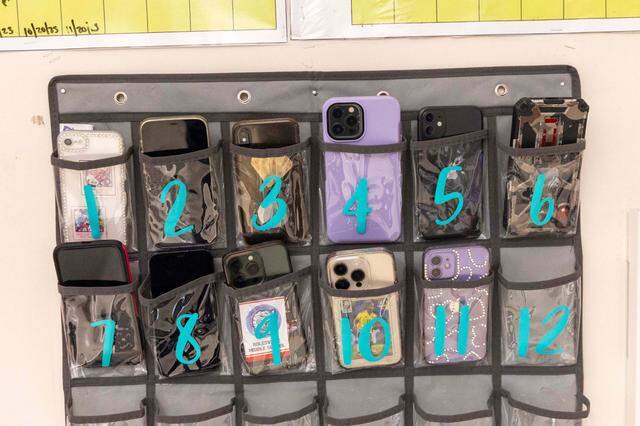
The law has exemptions, such as allowing students to use their phones in class if they have their teacher’s permission or if it’s part of their special education or health plan.
Schools are required to establish the consequences for violations of the wireless communication policy. This could include confiscation of devices and disciplinary measures.
Are students following the new law?
To determine if the law is having an impact, the General Assembly commissioned a “North Carolina Phones and Tech in Schools” study.
UNC researchers are surveying 2,299 middle school students and 293 middle school teachers throughout the school year.
“Young people’s digital technology use represents a major public health concern,” Burnell told lawmakers. “There’s growing alarm about the negative effects of such use. Alarm is especially heightened in educational context, where teachers and administrators often report unregulated digital device use.”
On Tuesday, researchers presented findings from the first round of surveys:
- A plurality of 40.7% of students said their school’s policy should be a little less strict. The percentage who disagree with the policy jumps to 63.6% if you include students who said the policy should be a lot less strict.
- 39.7% of students said they sometimes or never followed their school’s phone or used other devices as a workaround.
- 62.9% of students said their school always follows the device policy.
- More than 30% of students said they often use their phone in class when they’re bored.
- 34% of students reported using workarounds to access content that should be blocked by school filters or firewalls.
- 67.5% of students said their parents still contact them on the phone at school.
- 53.5% of teachers experienced moderate, some or little stress from their students’ personal device use during instructional time.
The students and teachers will be surveyed again in April and October.. A final report with recommendations will be presented next winter.
Rep. Hugh Blackwell, a Burke County Republican, pointed to the recent Los Angeles verdict to say school boards need to look at how they’re enforcing the phone ban.
“With the dramatic verdict there for social media damage to individual students, I would think school board members would be well advised to discuss with their attorney whether they might want to be a little cautious and enforce the policy,” Blackwell said.
This story was originally published March 31, 2026 at 3:08 PM.

T. Keung Hui
The News & Observer
T. Keung Hui has covered K-12 education for the News & Observer since 1999, helping parents, students, school employees and the community understand the vital role education plays in North Carolina. His primary focus is Wake County, but he also covers statewide education issues.