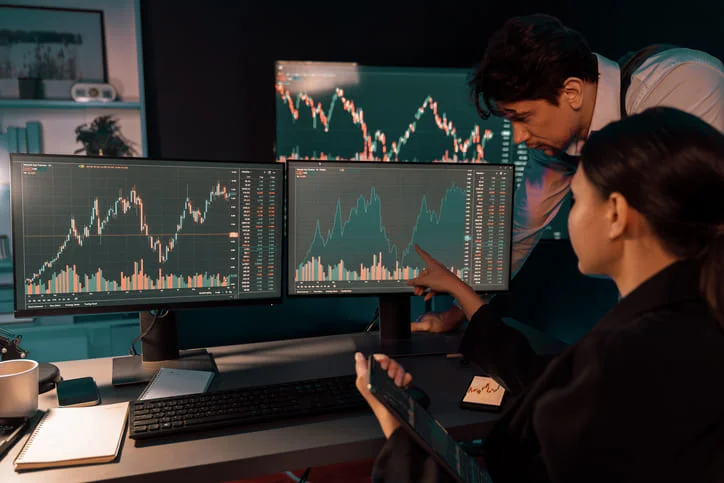
Forex trading has a reputation problem. For many business professionals, it sits in the same mental category as sports betting or casino gambling — something speculative, reckless, and best avoided. This perception is not entirely unfounded. The industry has its share of aggressive marketing, unrealistic promises, and poorly educated retail participants who treat currency markets like a slot machine.
But dismissing forex entirely means overlooking the largest financial market in the world. With over $7.5 trillion traded daily, the foreign exchange market underpins global commerce, shapes monetary policy outcomes, and offers legitimate opportunities for those who approach it with the same discipline they would apply to any serious business endeavour.
The gap between perception and reality is worth examining — particularly for entrepreneurs, executives, and finance professionals who already possess many of the skills that successful trading demands.
The Business Case for Understanding Currency Markets
Even if you never place a single trade, understanding how forex markets operate is increasingly relevant for business decision-makers. Companies with international revenue streams, import-dependent supply chains, or overseas investments are directly exposed to currency risk. The euro-dollar exchange rate, the pound’s post-Brexit trajectory, or the yen’s response to Bank of Japan policy — these are not abstract financial concepts. They directly impact profit margins, procurement costs, and competitive positioning.
A growing number of CFOs and treasury teams actively hedge currency exposure using the same instruments available to individual traders. Understanding the mechanics of how currencies move, what drives volatility, and how to interpret central bank communications is no longer optional knowledge for globally minded business leaders.
For professionals who do choose to trade actively, forex offers structural advantages that align well with a business mindset. The market operates around the clock from Sunday evening to Friday night, accommodating any schedule. Transaction costs are transparent and low compared to most asset classes. And the ability to trade in both directions — profiting from a currency’s decline as easily as from its rise — provides flexibility that equity markets do not.
Why Most People Fail — And What It Has to Do With Business
The statistics on retail forex trading are sobering. Depending on the jurisdiction and the broker, between 70 and 80 percent of retail traders lose money. This figure is often cited as evidence that forex is inherently unprofitable. But a closer look reveals that the problem is not the market itself — it is how people approach it.
Most retail traders fail for reasons that would be immediately recognisable to any experienced business operator. They start without a plan. They risk too much capital on a single outcome. They make emotional decisions under pressure. They chase losses instead of cutting them. They lack a systematic process for evaluating what works and what does not.
In other words, they fail because they treat trading as gambling rather than as a business. The traders who succeed over the long term approach the market with the same rigour they would apply to launching a product, managing a project, or scaling a company. They define their edge, manage their risk, track their performance, and iterate based on data.
This is precisely why risk management in trading deserves more attention than any strategy or indicator. Position sizing, drawdown limits, risk-per-trade rules, and stop-loss discipline are the operational controls of a trading business. Without them, even a statistically profitable strategy will eventually produce catastrophic losses — just as a profitable company can fail through poor cash flow management.
The Parallels Between Entrepreneurship and Trading
The overlap between entrepreneurship and trading is more substantial than most people realise. Both require operating under uncertainty with incomplete information. Both demand emotional resilience and the ability to take calculated risks. Both involve managing capital, measuring performance, and adapting to changing conditions.
Successful entrepreneurs are comfortable with the concept of expected value — the idea that individual outcomes are less important than the aggregate result of many decisions made with a positive edge. This is exactly how profitable trading works. No single trade matters. What matters is whether your decision-making process produces positive results over hundreds or thousands of repetitions.
The discipline of reviewing failures without emotional attachment is another shared trait. In business, post-mortems and retrospectives are standard practice. In trading, maintaining a detailed journal and regularly reviewing losing trades is what separates professionals from amateurs. Understanding the psychological side of trading — from managing fear and greed to avoiding revenge trades — is just as critical as any technical or fundamental analysis. Both practices require intellectual honesty and a willingness to confront uncomfortable truths about your own decision-making.
There are also practical skills that transfer directly. Financial statement analysis, macroeconomic awareness, statistical thinking, and pattern recognition — all of these are applicable to currency trading. Business professionals who decide to explore forex often find that their existing knowledge base provides a meaningful head start compared to complete beginners.
The Infrastructure Decision
One area where business professionals tend to make better decisions than typical retail traders is infrastructure. Just as a serious business invests in the right tools, systems, and partners, a serious trading operation requires thoughtful choices about execution platforms, data providers, and brokerage relationships.
The brokerage decision in particular deserves careful consideration. Brokers differ significantly in their regulatory status, execution quality, fee structures, platform offerings, and client protections. A broker regulated by a tier-one authority such as ASIC, the FCA, or CySEC operates under strict rules regarding client fund segregation, leverage limits, and transparency — protections that are absent with unregulated or offshore providers.
Taking the time to understand how to evaluate and choose a forex broker based on objective criteria rather than promotional claims is an essential due diligence step. It is the trading equivalent of vetting a business partner or evaluating a SaaS vendor — a decision that has long-term implications for operational quality and risk exposure.
Execution quality is particularly relevant for business professionals who value efficiency. The difference between a broker that fills orders at the requested price and one that regularly slips or requotes can meaningfully impact results over time. Transparent pricing, competitive spreads, and reliable platform uptime are not marketing features — they are operational requirements.
A Different Approach to Market Education
The forex education space is flooded with courses promising quick profits, secret strategies, and financial freedom in thirty days. Business professionals should be naturally sceptical of these claims. If a strategy reliably generated outsized returns, there would be no economic incentive to sell it in a course for a few hundred dollars.
Genuine market education looks quite different. It focuses on building foundational knowledge — understanding how exchange rates are determined, what role interest rate differentials play, how liquidity varies across trading sessions, and why risk management matters more than entry signals. It is methodical, transparent about limitations, and honest about the learning curve involved.
The best educational approach mirrors how business professionals learn any complex skill: start with fundamentals, practice in a controlled environment, seek feedback through performance data, and gradually increase commitment as competence develops. In trading terms, this means starting with a demo account, progressing to small live positions, and scaling only after demonstrating consistent results over a meaningful sample size.
The Time Investment
A common concern among business professionals considering forex is the time commitment required. The image of a day trader glued to multiple screens for eight hours is not appealing — and fortunately, it is not necessary.
Swing trading and position trading styles require as little as thirty minutes to an hour per day, focused on analysing higher timeframe charts and managing existing positions. These approaches align well with the schedules of busy professionals and tend to produce better results for part-time traders because they reduce the noise and emotional intensity associated with shorter timeframes.
Automation also plays an increasingly important role. Algorithmic trading strategies can be developed and tested during dedicated research time, then deployed to execute automatically based on predefined rules. This approach appeals to analytically minded professionals who prefer systems-based decision-making over real-time discretionary judgment.
Realistic Expectations
Perhaps the most important mindset shift for business professionals entering forex is calibrating expectations. Consistent annual returns of 15 to 30 percent with controlled drawdowns represent genuinely strong performance. This may seem modest compared to the screenshots of 500 percent monthly returns that circulate on social media, but those figures are either fabricated, unsustainable, or achieved with reckless leverage that will eventually produce total account loss.
Compounding modest but consistent returns over time is how real wealth is built in trading — exactly as it is in business. A well-managed trading account that compounds at 20 percent annually will double in under four years. Applied to meaningful capital, this represents a significant income stream or wealth-building mechanism.
The professionals who succeed in forex are those who treat it with the same seriousness, discipline, and patience they apply to their primary business activities. They invest in education before they invest capital. They build systems before they take risks. And they measure success not by individual trades but by long-term, risk-adjusted performance.
For business professionals willing to make that commitment, forex trading is not gambling — it is a skill-based discipline with genuine potential for those who respect its complexity.
This article is for informational purposes only and does not constitute financial or investment advice. Forex trading carries significant risk, and past performance does not guarantee future results.
Disclaimer: This article contains sponsored marketing content. It is intended for promotional purposes and should not be considered as an endorsement or recommendation by our website. Readers are encouraged to conduct their own research and exercise their own judgment before making any decisions based on the information provided in this article.