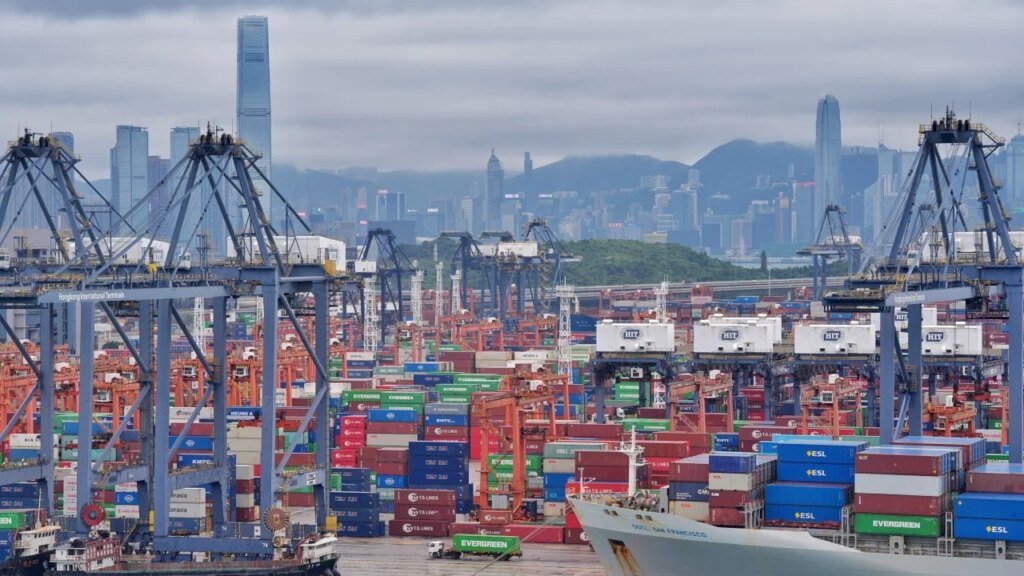
Traders in Hong Kong have adopted a more cautious stance amid mounting global economic uncertainties, but analysts say the local-export sector may be able to cushion some of the trading risks and disruptions, buoyed by its highly diversified operations and the resilient global demand.
The Hong Kong Trade Development Council (HKTDC) on Tuesday released its Export Confidence Index for the first quarter of 2026. The latest data showed that the Current Performance Index slipped to 46.5, down from 51.4 in the previous quarter.
Another key gauge, the Expectation Index, also slumped, to 46.9, a level indicating a pessimistic outlook that “reflects caution among survey respondents in light of the uncertain external environment”, the council said.
The findings, based on a survey conducted in January and February, partly mirrored traders’ subdued approach to the export performance during the Chinese New Year period, the council said.
ALSO READ: Growing HK-Brunei economic ties highlighted at biz seminar
It added that the results did not reflect the effect of the United States Supreme Court ruling that overturned the Trump administration’s tariffs on US imports, imposed last year, nor the Middle East tensions that flared up in late February.
Wing Chu, the HKTDC’s deputy director of research, warned that the rising oil and energy prices could drive up merchandise costs and dampen market sentiment in the coming quarter.
“But this remains to be seen. We still need to observe how the situation unfolds,” he said. Local exporters have in recent years extended their reach across multiple markets and channels to spread risks amid the volatile geopolitical environment, he added.
Kenneth Lee, head of the special project and business advisory section at HKTDC Research, said market diversification remains a crucial strategy for traders to mitigate risks. He pointed out that an increasing number of companies are turning to e-commerce platforms, aiming to boost sales and enhance business resilience in uncertain times.
READ MORE: HK’s significance to rise amid global fragmentation
A separate survey conducted by the HKTDC during the same period found that 46 percent of about 500 responding traders were already engaged in cross-border e-commerce, while a further 20 percent said they plan to enter the sector within the next year.
Among firms already engaged in cross-border e-commerce, the Chinese mainland was the biggest sales destination, accounting for about 24 percent, followed by the European Union and United Kingdom (17 percent), and Canada and the US (15 percent). The Association of Southeast Asian Nations (ASEAN) market, meanwhile, accounted for 14 percent.
“We’re seeing emerging markets gradually taking up a similar share to traditional destinations in Europe and North America,” Lee said. “We believe emerging markets like ASEAN hold significant untapped potential that merits deeper exploration.”
In February, the total values of goods exports from the Hong Kong Special Administrative Region rose 24.7 percent year-on-year, data from the Census and Statistics Department showed.
READ MORE: 15th Five-Year Plan, gold market among key themes of HK’s AFF
Exports to Asia as a whole climbed 23.4 percent, with shipments to most major destinations posting notable gains, particularly Malaysia and Singapore, up 121.9 percent and 69.8 percent respectively.
The value of exports across most principal commodity categories also increased in February, as exports of electrical machinery, apparatus and appliances, and electrical parts thereof surged by HK$48.9 billion ($6.24 billion), or 30.8 percent, compared with the same period last year.
HKTDC Research Director Bruce Pang said that although the market outlook has moderated somewhat, the underlying demand — especially for electronics and other consumer sectors — remains resilient.
“Hong Kong’s trade prospects should stay positive, yet remain cautious pending the further easing of global geopolitical conflicts,” he said.
Contact the writer at gabylin@chinadailyhk.com