It was the week that may have marked the end of the market’s “Trump put.”
Dealing with whiplash and conflicting messages about a potential peace deal with Iran, investors dumped stocks to cap off a volatile week. Oil continued to churn higher as Donald Trump’s reassurances failed to calm nerves.
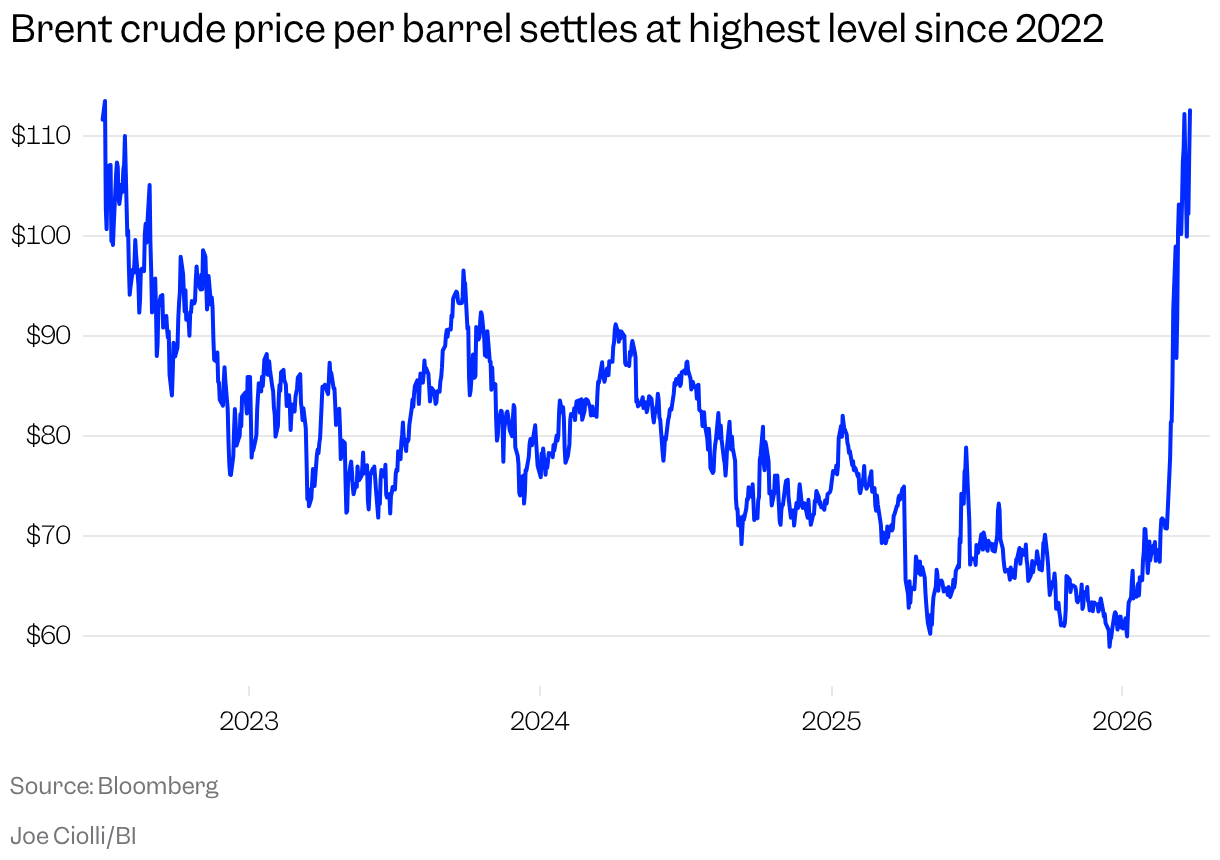
Trump’s latest announcement that he would put off bombing Iran’s energy infrastructure did little to soothe market jitters on Friday. Major indexes capped off their worst week of the war so far, while Brent crude rose settled at nearly $113 per barrel, the highest level since 2022.
“Constant flip-flopping and headline fatigue is starting to undermine the [Trump] put efficacy,” Barclays analysts wrote on Friday ahead of the day’s heaviest selling. “Meanwhile, the war goes on, and the longer the oil shock, the more severe the stagflationary shock.”
Here are three particularly grim milestones that summarize the stock market’s rough week:
1. Nasdaq 100 and Dow enter correction territory
Two of the major indexes are halfway to a bear market as of Friday.
The Dow teetered for most of the day at the edge of a correction — defined as a more-than-10% drawdown from a recent peak — before officially entering one by the session’s end.
The Nasdaq 100 slid into a correction earlier in the session, with tech’s woes from earlier in the year now being exacerbated by the war.
“It’s not surprising for the Nasdaq to be entering correction territory sooner than the broader S&P 500 as the tech sector was facing pressure even before the Iran war began on worries about high valuations in the space and questions about AI’s return on investment,” Glen Smith, chief investment officer at GDS Wealth Management, said.
Tech was hammered earlier in the year by a rotation out of high-flying AI stocks and into value shares, and more recently, by a sharp sell-off in memory stocks.
2. Five straight losing weeks for the S&P 500
Looking at the correction in the Dow and the Nasdaq 100, it might be easy to say the market’s pain is relatively contained, but the broad S&P 500 also isn’t far from a correction.
The benchmark index has suffered five straight weeks of losses and is just shy of a correction from its January closing peak of nearly 6,980.
The market is nearing the point at which BCA Research said Trump would be “guaranteed” to pivot from his Iran strategy.
“We believe that the S&P 500 would have to correct by more than 10% to practically guarantee a put,” the firm wrote earlier this month. “We are open minded that it could occur before; it could also occur later. But a double-digit stock price decline will certainly be a greater motivator.”
3. Oil keeps rising, settles at highest level since 2022
Brent crude settled at its highest level since 2022 on Friday, rising 4% to about $112 a barrel.
The 2020s are shaping up to be a decade marked by oil shocks, with the Iran war producing the second shock in less than five years. Brent touched the highest level since shortly after the Ukraine war, with shipping through the critical Strait of Hormuz remaining effectively cut off.
On Friday, Chinese container ships were turned away from the Strait, highlighting the continued closure and sparking a fresh spike in oil prices early in Friday’s session.
The International Energy Agency said this week that the Iran war shock is the largest ever recorded, equal to the 1970s disruption and the Ukraine war in terms of the amount of oil removed from the market.
The group also warned earlier this month that the disruptions aren’t limited to oil.
“The closure of the Strait is also forcing export-oriented refineries to cut runs or shut completely as product storage tanks top up.”
A more optimistic take
Yet, not everyone in the market is in the bear camp as the war drags on. Apollo’s top economist Torsten Sløk said on Friday that the market has been overreacting. Sløk, who flipped from bearish to bullish at the end of last year, thinks the period of volatility brought on by the war will be brief, ultimately giving way to a longer period of stability and US economic growth.
“The bottom line is that the Iran shock is not big enough to offset the strong tailwinds to the US economy from AI spending, the industrial renaissance and the One Big Beautiful Bill,” he said.