Hawaiʻi Gov. Josh Green spared few details as he laid out his case to President Donald Trump this week while seeking approval of a federal disaster declaration to unlock hundreds of millions of dollars in aid for the islands.
In a four-page letter, Green told Trump about the two massive storms that struck the islands back-to-back causing widespread devastation. The total cost is estimated to be more than $1 billion, but that figure could rise as officials continue to assess the damage.
Now it’s up to Trump to decide whether he’ll declare the disaster and how much the government is willing to pitch in, neither of which is automatic.
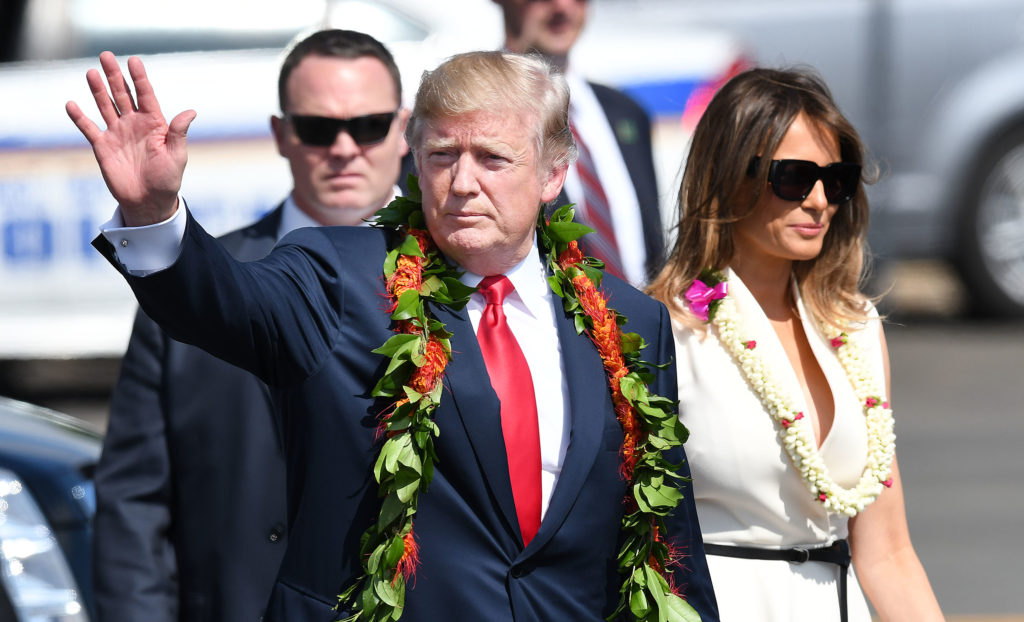
Data from FEMA shows that Trump has denied a larger percentage of requests for disaster aid than his predecessors, including himself during his first term, and that most of those denials have been in blue states. Included among the denials was a request from Hawaiʻi in which the state claimed nearly $3 million in damages from a storm on Maui in early 2025. One reason for that denial was that the request was filed too late.
Trump also has taken longer than previous presidents to decide when to declare a disaster, which is the first step for unlocking federal funds. A recent investigation from E&E News found that he has taken 80 days on average to rule on a request from Democratic-led states while the wait in Republican-led states has been about half that.
Green declined an interview, but in a text message said that over the weekend he spoke with Markwayne Mullin, Trump’s brand new secretary of the Department of Homeland Security, which oversees FEMA. At a press briefing Monday, Green said Mullin told him he was familiar with the North Shore of Oʻahu, where much of the damage occurred, because he previously owned property there.
In his text to Civil Beat, Green said Mullin was “very gracious in offering support” and that he anticipates Hawaiʻi’s request for disaster aid to be approved.
When asked whether he was concerned about Trump’s history of denying requests from Democratic governors, Green said he was not interested in discussing “divisive narratives.”
“They don’t help me advance our recovery,” he said.
Denial Would Be ‘Highly Unusual’
While Trump’s decisions have largely fallen along party lines, U.S. Rep. Ed Case said it would be “shocking” for the president to deny Hawaiʻi’s request this time around.
Officials from FEMA have already been on the ground assessing the destruction from the back-to-back storm systems, Case said, and the estimated damages far outpace the agency’s own minimum thresholds for providing disaster aid. The threshold is currently set at $1.94 per capita, which equates to just under $3 million in cumulative financial impact. Since Hawaiʻi officials already have estimated the damages from the Kona low storms at above $1 billion, that would put the total impact per person at about $700.
That figure alone, Case said, makes it unlikely that Trump would reject Hawaiʻi’s request even if he does consider the current administration to be unpredictable.
“It would be highly unusual,” Case said. “There would have to be some reason other than the merits.”
The Trump administration also could decide to fund some projects, but not others. For example, the administration has stopped giving out hazard mitigation grants to help communities rebuild in ways that make them more resilient to future disasters. Green’s request did not seek this type of funding, but rather focused on money to help remove debris, rebuild infrastructure and provide direct assistance to residents.
The White House responded only with a statement, saying that the president is closely tracking the flood situation in Hawaiʻi but also noting that the administration’s philosophy is to focus on “working with State and local governments to invest in their own resilience before disaster strikes, ensuring American tax dollars are used appropriately to make response less urgent and recovery less prolonged.”
Support In Congress
Hawaiʻi’s entire congressional delegation, all of whom are Democrats, have backed Green’s request for federal aid. In a letter, they used the 2023 Maui fires as added justification.
“Prior to this disaster, our communities were still rebuilding from devastating wildfires in Maui and Hawai‘i Counties that claimed 102 lives and destroyed more than 2,000 structures,” they wrote “State and County officials now need federal support for the extensive repairs required for flood-damaged homes, small businesses, roads, and public facilities across the islands.”
Federal support came almost immediately after the wildfires while Joe Biden was president, and in the first year alone, FEMA and other agencies provided nearly $3 billion in aid.
Under Trump, federal disaster declarations have been sporadic, and a single day in October highlights some of the disparity experienced by other states.
On Oct. 22, Trump approved major disaster declarations for Alaska, Nebraska and North Dakota while denying requests from Vermont, Illinois and Maryland, which had appealed an earlier denial. Those decisions tracked along party lines with the states that voted for him getting access to federal dollars and those that didn’t losing out.
As Trump boasted of the approvals on social media he even cited his own election results. As one post declared, “It is my Honor to deliver for the Great State of Alaska, which I won BIG in 2016, 2020, and 2024.”
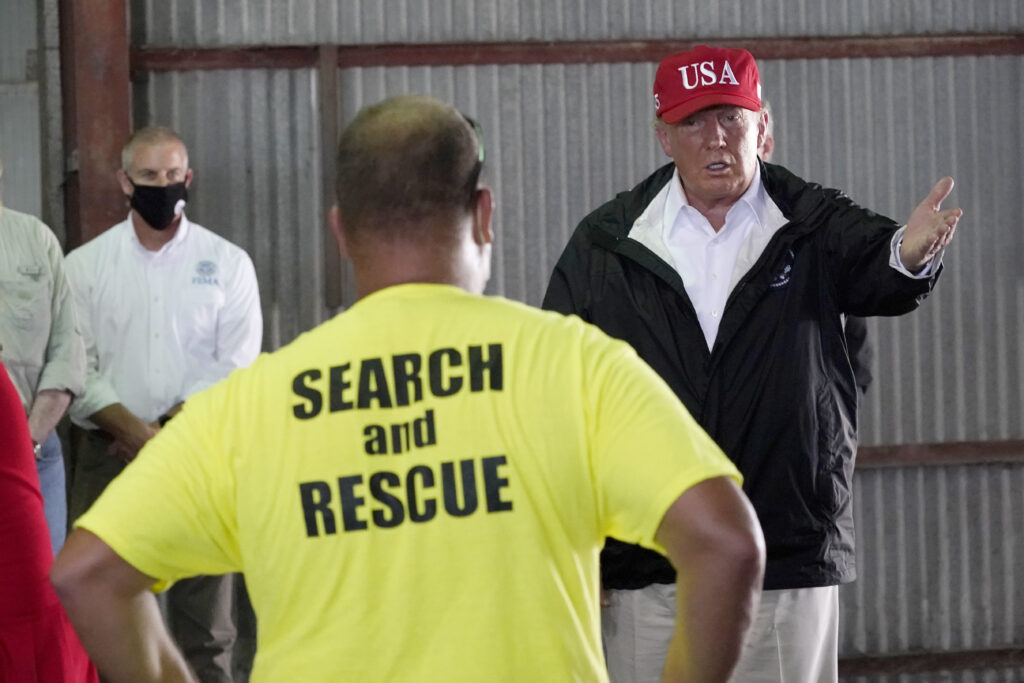
Hawaiʻi politicians, and Green in particular, have mostly avoided the type of open conflicts with Trump that might draw the president’s ire. Green has struck a more conciliatory tone with the president and his administration than other Democratic governors, for instance, such as Gavin Newsom of California and JB Pritzker of Illinois — both viewed as possible presidential contenders.
In general, Trump has inserted a lot of uncertainty into the process of requesting federal aid, said Mikaela Tajo, a climate policy analyst at the Center on Budget and Policy Priorities.
The denials and delays combined with the overall weakening of FEMA through staffing cuts and other changes, she said, “puts a bigger strain on people on the ground who are just trying to recover and rebuild their lives.” Climate change will only exacerbate the need, she said, as storms become more frequent and intense.
“That’s a bipartisan issue,” she said. “Disasters don’t care if you’re Republican or Democrat.”
Civil Beat’s coverage of climate change and the environment is supported by The Healy Foundation, the Marisla Fund of the Hawaiʻi Community Foundation and the Frost Family Foundation.