Can China build a financial powerhouse by 2030?

China’s 15th Five-Year Plan contains a formulation with no precedent for its explicit articulation in seven decades of national planning: build a financial powerhouse. Adopted by the National People’s Congress in March 2026, the plan does not treat finance as a supporting function for economic growth. It treats finance as a strategic instrument of technological capability.

The shift – from credit allocator to capital mobiliser – is the central financial commitment of the plan period. Whether China’s current system can become the system the plan demands is therefore the defining institutional question of the next five years.

Emphasis on modernised industrial system

The plan organises its financial architecture around a single concept: new quality productive forces – semiconductors, advanced manufacturing, artificial intelligence, biotechnology and clean energy. AI-related industries alone are projected to reach roughly Rmb10tn by 2030. That is the scale of capital the system is being asked to deploy.

The structural gap is stark. Direct financing accounts for roughly 31% of total social financing, while banks still represent around  0% of financial system assets. The plan’s response is architectural: increase the share of direct financing, develop five specialist finance categories – technology, green, inclusive, pension and digital finance – deepen the multi-tier capital market and actively expand equity, bond and derivative instruments. These are not adjustments to the existing system. They imply a fundamental rebalancing of it.

The 14th Plan led with technological innovation. The 15th places a modernised industrial system first – innovation follows. The sequencing is deliberate: translating breakthroughs into production capacity takes precedence over generating them. China is also stepping down its headline growth trajectory to  between 4.5% and 5%. The signal is clear: technological productivity must now deliver what volume growth can no longer guarantee.

The 14th Plan pursued both objectives largely through instrument-level measures – reserve requirement reductions, re-lending facilities and targeted credit guidance. These operated within a bank-dominated financial architecture and left that architecture intact. The 15th Plan does not adjust the system from within; it changes it. The Central Financial Work Conference has long insisted that finance must serve the real economy. The 15th Plan converts that instruction into a structural demand rather than a policy tool. The distinction is critical: instruments change outcomes at the margin; architecture determines what outcomes are possible.

Redesigning China’s financial system

Two enabling conditions signal the scope of change. The first is the creation of a secure and efficient financial infrastructure, the precondition for deeper capital markets. The second is the steady development of a digital renminbi. The two are sequentially linked: currency at scale requires the infrastructure layer first. Both are connected to the instruction to accelerate Shanghai’s development as an international financial centre. Taken together, they describe a financial system being redesigned from the settlement layer upward – infrastructure, instruments and institutional architecture evolving simultaneously (Figure 1).

Figure 1. Financial architecture for technological development

Financial system logic Institutional mechanism Role in innovation
Bank-led finance State banks and policy banks allocate credit Provides scale financing for industrial sectors
Market-led finance Equity markets, venture capital and private capital Prices technological risk and fund innovation
State-directed allocation Policy guidance towards strategic sectors Aligns capital with industrial strategy
Market allocation Competitive capital markets Supports entrepreneurial discovery

Sources: NPC 15th Five-Year Plan Outline, International Monetary Fund Financial Sector Stability  Assessment, Bank for International Settlements’ statistics, People’s Bank of China.

The tension is evident: the system must simultaneously preserve state-directed allocation while expanding market-based price discovery. These logics are not naturally complementary.

China’s institutional advantages are real. State ownership enables credit allocation at scale, and policy banks such as the China Development Bank have historically financed industrial expansion across entire sectors. That capacity is now being extended to technology-intensive industries. The STAR Market provides equity financing for technology firms whose risk profiles differ from traditional industrial borrowers. Yet the scale of these mechanisms relative to the financing demands embedded in the plan remains the critical constraint.

The challenge runs deeper than scale. Commercial banks are calibrated for predictable cash flows – collateral, covenant compliance and stable repayment cycles. They do not price technological experimentation; they finance proven returns. A financial system in which banks dominate the asset base faces a category problem rather than a capital shortage when asked to finance technological risk.

The regulatory dimension compounds the difficulty. Supervisory frameworks designed for collateralised lending do not extend naturally to technology investment, where collateral is limited and historical loss rates do not exist. This creates a regulatory gap. Recent IMF assessments, the International Monetary Fund’s 2025 Financial System Stability Assessment, and the 2026 Article IV consultation, all suggest that the regulatory framework must remain in step with the speed at which  China’s financial structure evolves. Expanding equity markets, venture capital and hybrid financing are therefore a structural requirement for financing the sectors the plan identifies as strategically essential.

Financial transition and systemic risk

China’s financial system must undertake this transformation while managing inherited vulnerabilities. The contraction of the property sector has weakened developer balance sheets and eroded the land revenues on which many local governments depended. Debt accumulated through local government financing vehicles remains significant across several provinces. International assessments consistently identify the interaction between public-sector balance sheets and banking exposures as the central systemic risk in China’s financial system.

The 15th Plan, therefore, assigns the financial system a dual task: stabilise an inherited vulnerability while financing sectors defined by technological uncertainty and long investment cycles. These objectives pull in different directions. Risk reduction encourages caution. Innovation financing requires tolerance for uncertainty.

The plan does not reduce the role of investment in China’s growth model. It redirects that investment – away from property and infrastructure and towards technology-intensive industries. The mechanism is a transfer of financial risk across sectors and instruments. . Capital previously secured against property collateral, supported by predictable cash flows and well-understood loss rates, is now expected to finance long-horizon technological investment with uncertain returns and no collateral base.

The balance sheet changes. The exposure does not disappear. It transforms – and,  and becomes harder to price, harder to provision for and harder to resolve if technological bets fail.

There is, therefore, a structural price embedded in the plan’s ambition. Other major economies built deep capital markets gradually over decades of expansion, crisis and institutional adaptation. China is attempting to compress that evolution into a single planning cycle while managing the legacy of a credit-intensive development model and navigating a more contested external environment.

Building financial capacity rather than inheriting it is the sovereignty premium the plan appears prepared to pay. In the plan’s own terms, a financial powerhouse is a system capable of pricing technological risk, sustaining long-horizon investment and directing capital towards strategic capability rather than immediate return. Whether China’s financial architecture can evolve quickly enough to perform that role is the central institutional question. The Fifteenth 15th Plan has placed for the decade. .

Udaibir Das is Vice Chair of OMFIF, Visiting Professor at the National Council of Applied Economic Research, Senior Adviser of the International Forum for Sovereign Wealth Funds, and Distinguished Fellow at the Observer Research Foundation America.

As part of our efforts to better understand how our renminbi capabilities can support our clients and partners, we are conducting a short survey to gather your insights and feedback. Please take a moment to fill out our quick survey:  China-UK investor forum survey.

Interested in this topic? Subscribe to OMFIF’s newsletter for more.


Source link

Visited 1 times, 1 visit(s) today

Related Article

Will this be the Chinese Century?

China is quietly looking weaker

In the 1980s, a lot of people wrote books and articles about how Japan was going to be the world’s leading country. The most famous of these was Ezra Vogel’s Japan As Number One: Lessons for America. At the same time, in 1989, Bill Emmott wrote a book called The Sun Also Sets: The Limits

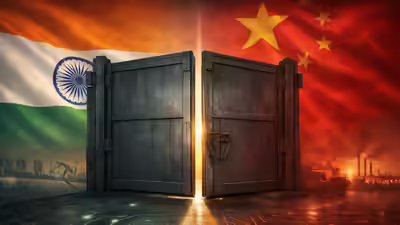
The door India left ajar:  Economic ties with China see a calibrated reset with easing of FDI rules - explained

The door India left ajar: Economic ties with China see a calibrated reset with easing of FDI rules – explained

NEW DELHI: Nearly six years after India tightened scrutiny of foreign direct investment from countries sharing land borders, the government has initiated a recalibration of the framework governing such investments, allowing minority ownership structures routed through overseas entities to access the automatic route while retaining approval requirements for direct investments from neighbouring jurisdictions.The Union Cabinet

Three Charged for Smuggling Billions in Sensitive AI Tech to China

Three Charged for Smuggling Billions in Sensitive AI Tech to China

Three men, including two Taiwanese nationals, were charged with allegedly smuggling $2.5 billion in sensitive AI-related computer technology to China, according to a federal indictment first unsealed on Thursday. [RELATED: Former Air Force F-35 Instructor Arrested After Defecting and Training Chinese Fighter Pilots…] “Controlling the export of sensitive U.S. artificial intelligence technology is essential to

Mainland china, macau

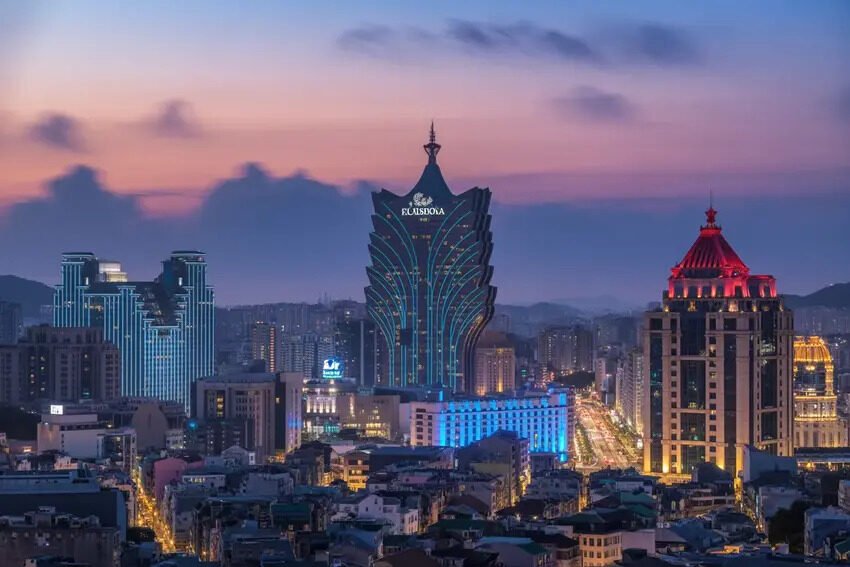
Mainland China Overtakes South Korea, Indonesia, Thailand, US, Taiwan, Philippines, and More as Macau Hits Record Four Million Tourists in February 2026, Boosted by Holiday Tourism Surge

Home » TOURISM NEWS » Mainland China Overtakes South Korea, Indonesia, Thailand, US, Taiwan, Philippines, and More as Macau Hits Record Four Million Tourists in February 2026, Boosted by Holiday Tourism Surge Published on March 21, 2026 Image generated with Ai Mainland China overtakes South Korea, Indonesia, Thailand, the US, Taiwan, Philippines, and more as

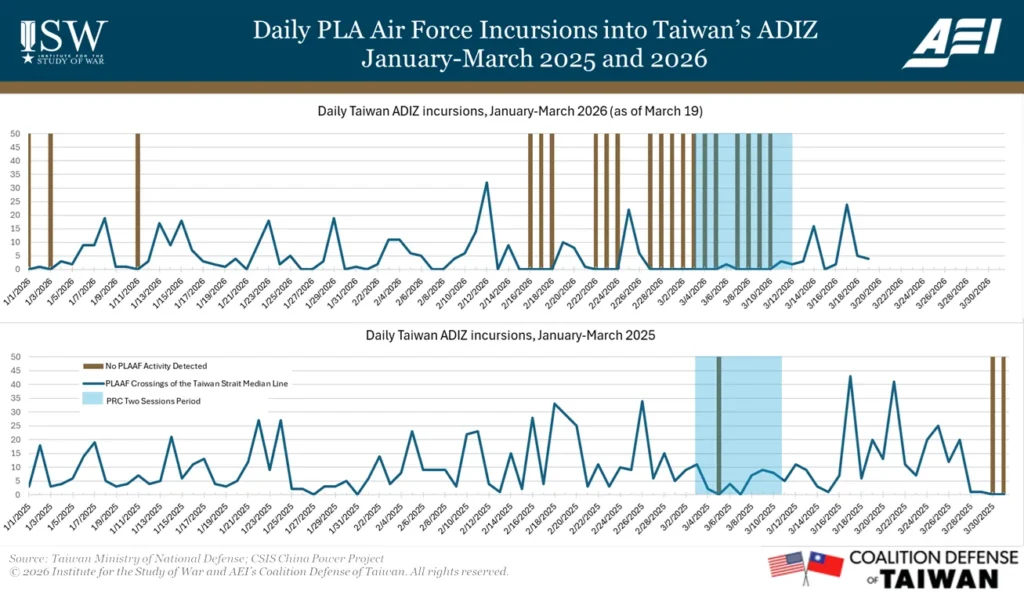
Daily PLA Air Force Incursions into Taiwan’s ADIZ January–March 2025 and 2026

China & Taiwan Update, March 20, 2026

Toplines US President Donald Trump announced on March 17 that he would delay his planned talks with CCP General Secretary Xi Jinping to prioritize the conflict in Iran. US Treasury Secretary Scott Bessent met with PRC Vice Premier He Lifeng on March 15 and 16 to discuss issues related to US-PRC trade, including the prospect

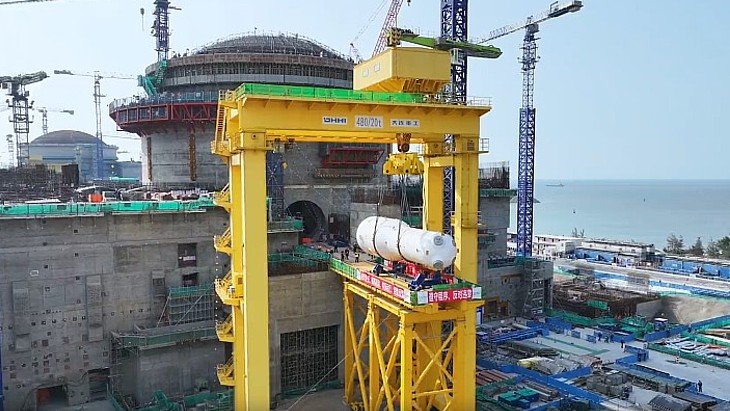
Early construction landmarks for Chinese units

Early construction landmarks for Chinese units

The giant CA20 structural module of Bailong nuclear power plant’s unit 1 has been lifted into place – and the first steam generator moved into position at Lufeng nuclear power plant’s unit 6. The construction of Phase I (units 1 and 2) of the Bailong plant in China’s Guangxi Zhuang Autonomous Region was among approvals for

Chinese President Xi Jinping, also general secretary of the Communist Party of China Central Committee and chairman of the Central Military Commission,

US intelligence assesses China has no fixed timeline to invade Taiwan

NEWYou can now listen to Fox News articles! Despite years of warnings that China could move on Taiwan within the decade, the U.S. intelligence community now assesses that Beijing is not planning an invasion of Taiwan by 2027 and has no fixed timeline for doing so.   “The IC assesses that Chinese leaders do not

Why Russia’s Shahed Drone Program Cannot Survive Without China

China Saves Billions as Russian Oil Discounts Surge Under Pressure — UNITED24 Media

Russian oil companies faced significant losses in potential revenue throughout 2025 due to steep discounts required by Chinese refineries. The total value of these discounts reached $2.2 billion over the past year, according to The Moscow Times on March 20. We bring you stories from the ground. Your support keeps our team in the field.

An Army carry team moves the flag-draped transfer case containing the remains of U.S. Army soldier Maj. Sorffly Davius, of Cambria Heights, N.Y., who died in Kuwait, during a casualty return, Monday, March 9, 2026, at Dover Air Force Base, Del. (AP Photo/Julia Demaree Nikhinson)

US House Panel Asks Pentagon to Review Safran Ventures in China

WASHINGTON, March 20 (Reuters) – ⁠A ⁠top lawmaker asked ⁠the Pentagon to review ​French aerospace company Safran’s joint ventures ‌in China, saying the ‌U.S. defense contractor’s ⁠commercial ⁠ties with Chinese companies raise concerns, according ​to a letter seen by Reuters. Representative John Moolenaar, chair of the ​House Select Committee on China, cited ⁠Safran’s work ⁠with

Pentagon finds another 'problem' with Anthropic and this one is linked to China

Pentagon finds another ‘problem’ with Anthropic and this one is linked to China

Representative Image. In pic: Anthropic CEO Dario Amodei The US Department of War has reportedly raised new national security concerns about Anthropic. In a recent court filing tied to an ongoing legal dispute with the AI company, the Pentagon has cited the Claude developer’s use of foreign workers, including those from China. The Department of

China's technology long game - by Kyle Chan

China’s technology long game – by Kyle Chan

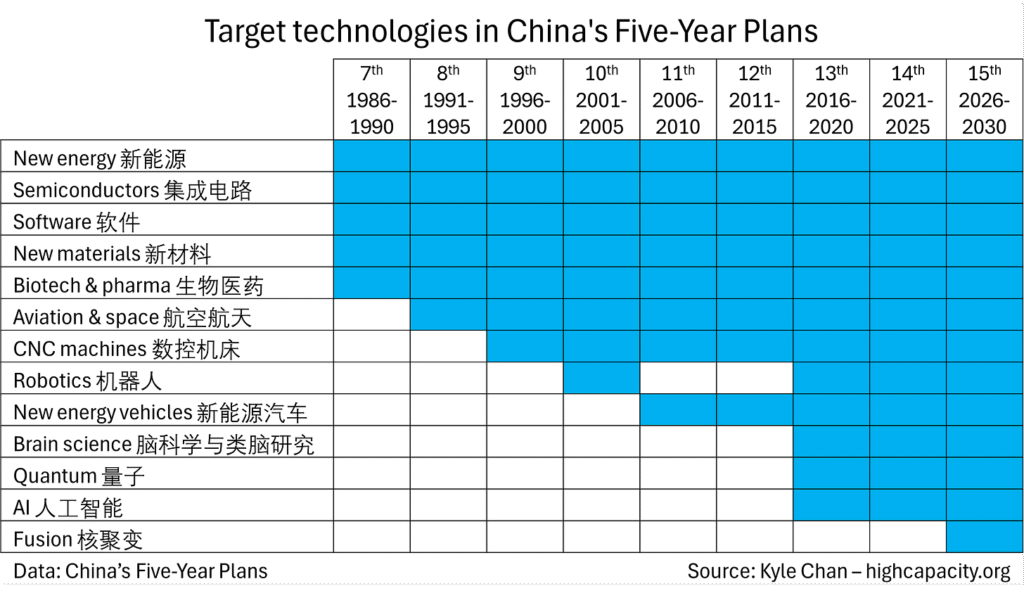
The following is a cross-post from Kyle Chan’s excellent High Capacity substack. Technology is a central focus of China’s new 15th Five-Year Plan. China is aiming to develop “strategic emerging industries” (战略性新兴产业) such as robotics and smart EVs as well as “future industries” (未来产业) such as quantum, fusion, brain-computer interfaces, 6G, and embodied AI. With

Amazon, Meta, Google and Microsoft's 'AI problem' reaches China as two biggest Chinese technology companies lose $66 billion in less than a day

Amazon, Meta, Google and Microsoft’s ‘AI problem’ reaches China as two biggest Chinese technology companies lose $66 billion in less than a day |

FILE (AP Photo/Mark Schiefelbein, File) It seems investors’ anxiety about the rise in capital expenditure of companies to fuel their artificial intelligence (AI) infrastructure and strategy has reached China as well. In the past few months, some of America’s biggest technology companies including Amazon, Meta, Google and Microsoft have seen billions wiped out from their

Taiwan’s Defence Minister Wellington Koo. File

China poses pressing threat, deterrence needed to avert invasion, Taiwan says

Taiwan’s Defence Minister Wellington Koo. File | Photo Credit: Reuters China poses a pressing threat given its military build-up ‌continues unabated, and effective deterrence is needed to make sure ​any attack would be very risky for Beijing, Taiwan ⁠Defence Minister Wellington Koo said on Friday (March 20, 2026). China does not currently plan to invade

Alibaba workforce shrinks 34% in 2025 as Chinese tech giant doubles down on AI

The Alibaba stand at the World Artificial Intelligence Conference at the Shanghai World Expo Exhibition Center in Shanghai, China, on July 5, 2024. Nurphoto | Nurphoto | Getty Images Alibaba‘s workforce shrank by roughly 34% over the course of 2025, as the company offloaded some of its offline retail businesses while doubling down on artificial

Chinese Founder of router-maker TP-Link to Federal agencies: Our CEO and his wife are becoming US citizens under Trump Gold Card program

Chinese Founder of router-maker TP-Link to Federal agencies: Our CEO and his wife are becoming US citizens under Trump Gold Card program

Amid rising scrutiny, TP-Link’s CEO Jeffrey Chao is applying for U.S. permanent residency via a $1 million visa program, a move that coincides with ongoing federal investigations into his firm. The investigations, conducted by the Commerce, Justice, and FTC departments, are fueled by worries that Chinese authorities might pressure TP-Link to support cyber threats. Jeffrey

supermicro headquarters

Supermicro executives charged in $2.5B AI smuggling scheme to China

NEWYou can now listen to Fox News articles! Federal prosecutors charged three men linked to Super Micro Computer Inc. in a sweeping scheme to smuggle billions of dollars in U.S. artificial intelligence technology to China using fake documents, shell companies and staged equipment, officials said. The defendants allegedly diverted $2.5 billion worth of AI servers

Donald Trump looking serious and sitting at a desk.

Trump has postponed his meeting with Xi, but China is not wasting any time on it

For months behind the scenes in Beijing, Chinese and American officials have been locked in negotiations over one of the most consequential political meetings of this year.  China’s President Xi Jinping was set to host United States President Donald Trump at a highly choreographed reception in Beijing at the end of March. Iran war live

0
Would love your thoughts, please comment.x
()
x