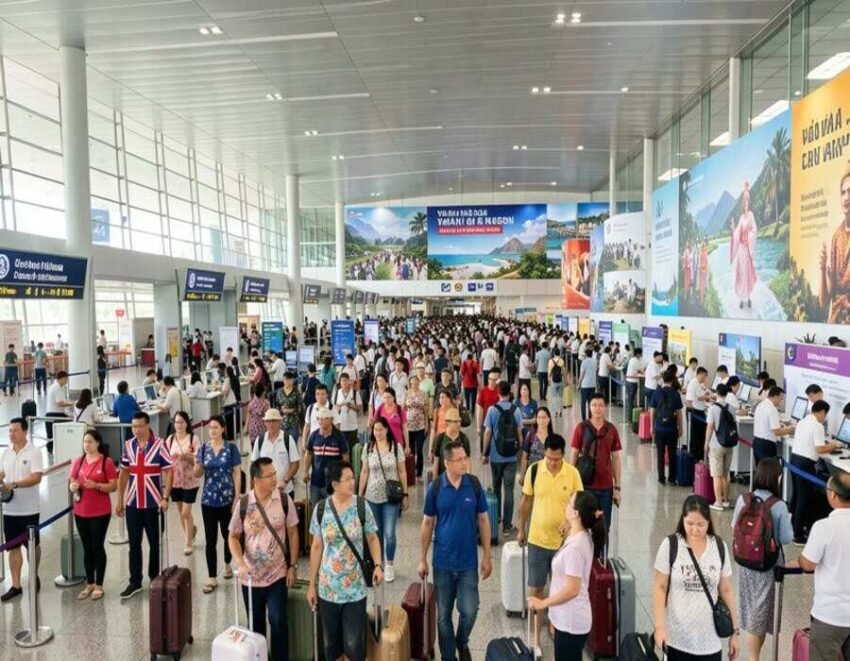
China’s post-holiday job market in early 2026 has delivered a brutal reality check to millions of migrant workers flooding back into Guangzhou, Shenzhen, and Dongguan. Factories that once hired by the thousands are either closed or offering poverty-level wages, while predatory labor agencies have filled the vacuum, and entire commercial districts stand empty. The collapse of employment in China’s southern manufacturing heartland signals a deepening economic crisis the CCP’s official statistics are designed to obscure.
“Post-90s only. Only post-90s. Anyone born before 1990 can go home. Under 33 only. Not a single person over 33.”
This is the reality confronting workers seeking factory jobs in China’s Pearl River Delta in early 2026. In an economy where decent employment is vanishing, young Chinese workers have abandoned any aspiration for career growth, stability, or upward mobility. Their only remaining standard for a “good job” is bare survival, and even that has become difficult to find.
After the Lunar New Year, millions of workers arrived in Shenzhen, Dongguan, and other coastal manufacturing cities carrying their belongings, only to discover that there were no jobs waiting for them. Some were cheated out of money by fraudulent recruiters before they even started.
Labor intermediaries confirmed that getting into a decent factory now requires personal connections. Direct hiring by factories has effectively ended; all recruitment flows through labor agencies, and an estimated 70 percent of those agencies are exploitative operations that either skim wages or charge hidden fees. High-paying positions simply do not exist.
Success
You are now signed up for our newsletter
Success
Check your email to complete sign up
“The going rate for permanent workers in Dongguan right now is three to four thousand yuan a month at smaller factories with little overtime. Bigger factories might pay four to five thousand. Very few exceed six thousand,” one worker reported.
For context, even four thousand yuan per month (roughly $550) is barely enough to cover rent, food, and basic expenses in a Chinese manufacturing city where the cost of living, while lower than first-tier cities, has not dropped in proportion to wages.

Dongguan and Shenzhen look like ghost towns
Workers describe the once-thriving manufacturing hub of Dongguan as an empty shell. One man recounted stepping out to buy cigarettes and finding every shop on his block shuttered: the corner store from the day before, closed; the next block, closed; an entire loop around his neighborhood, nothing open. “This is Dongguan,” he said.
Shenzhen, China’s technology and innovation showcase, presents a similar picture. One resident described a public park across from the Ping An Finance Center, one of the world’s tallest buildings, as completely deserted. “I had an entire park to myself,” he said. “Not a single person.”
The rental market in Shenzhen has quietly turned. Landlords report that even with rent reductions of 300 to 500 yuan, apartments sit vacant. Previously, units near subway stations or with fresh renovations would rent within days. Now, well-located, nicely renovated apartments sit on the market for weeks with minimal inquiries. Landlords have begun covering internet fees and management charges to attract tenants, with little success.
Tenants are abandoning their leases, leaving behind security deposits without bothering to collect them. One landlord described a tenant who ran a Japanese restaurant and simply walked away. The furniture, kitchen equipment, and tableware were all still there, but the business was dead.
One observer described the chain reaction: “You think it only affects small business owners when shops close? When the barber shop, the restaurant, the clothing store downstairs all shut down one by one, your own paycheck is quietly shrinking too. The collapse of brick-and-mortar businesses is dragging down the entire urban economy. This is a chain reaction with no winners.”

Guangzhou’s unemployment statistics hide the real crisis
Officially, Guangzhou’s unemployment rate appears low, GDP growth looks healthy, and per-capita savings continue to climb. The numbers are impressive on paper, but the reality for working people is something else entirely.
China’s official unemployment statistics only count urban residents. Anyone with a rural household registration, or hukou, is excluded from the count, no matter how long they have lived and worked in a city. A migrant worker who has spent a decade in Guangzhou, lost their job, and cannot afford their next meal does not register as unemployed under the CCP’s statistical methodology. The employment crisis among the country’s hundreds of millions of migrant workers is, by design, invisible in the official data.
Meanwhile, the social welfare gap is visible in public. A scenic area in Shantou, Guangdong province, has been overrun by beggars for years: elderly people, individuals with disabilities, and apparently sick people lying in carts, some with IV drips attached. Whether professional operators or genuinely destitute, their presence in growing numbers reflects a country where the CCP’s social safety net barely exists for the most vulnerable.
Job seekers face exploitation, fraud, and despair
Workers who do manage to find employment often discover that the advertised conditions bear no resemblance to reality. Job listings promising 8,000 yuan per month with room and board turn out to offer a base salary of 3,500 yuan, with the remainder tied to performance targets that are nearly impossible to meet. Factories advertising daily wages of 300 yuan cannot retain workers because the conditions are brutal: 12-hour shifts on assembly lines, overnight work that causes dizziness, and dormitories packed like shipping containers. Workers leave after two days, and the listings reappear.
One job seeker in Shenzhen described contacting more than 1,000 companies, submitting more than 200 resumes, and receiving roughly 10 interview invitations, many of which turned out to be companies padding their recruitment metrics rather than actually hiring. “Am I being punished for some crime?” the worker wrote online. “If I can’t find work soon, I’m going home.”

When ‘normal’ work becomes an impossible standard
When the basic conditions for safe, survivable employment cannot be met, quitting or opting out of the workforce entirely has become an increasingly common choice among Chinese young people. On Chinese social media, “work” has become synonymous with meaninglessness, and “lying flat” (tangping) represents the final aspiration for many in their professional lives.
What young Chinese workers now consider a “good job” amounts to what would be considered a normal, baseline position anywhere else: no mandatory consecutive overtime, wages paid on schedule, reasonable vacation and sick leave that is actually honored, healthy relationships among colleagues, and some opportunity for new employees to learn. Even this modest standard has become extremely scarce in an economy where employers hold all the leverage and workers have no protections.
“If you’re thinking about coming to Shenzhen to work in 2026, take my advice and hold off,” one worker warned. “Open any job app and you’ll see listings for 8,000 a month with room and board. But when you show up to interview, the base is 3,500 and the rest is performance pay you’ll never hit.” The gap between what is advertised and what is real has become the defining feature of China’s job market, and millions of workers are learning the hard way that the CCP’s economic miracle has nothing left to offer them.