As global conflicts intensify, particularly with the escalating war in the Middle East, attention has turned to how major powers such as China and Russia are responding — as fresh insight into China’s defence spending emerges.
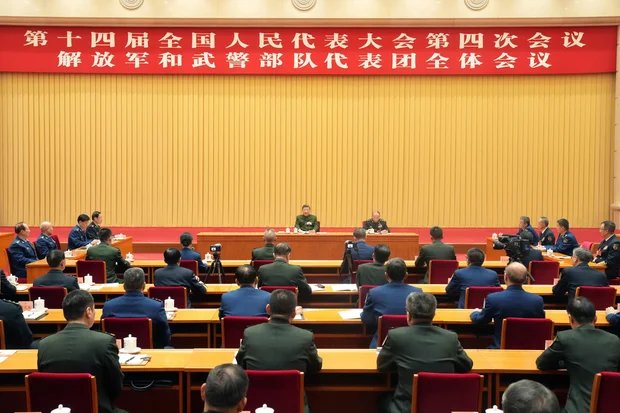
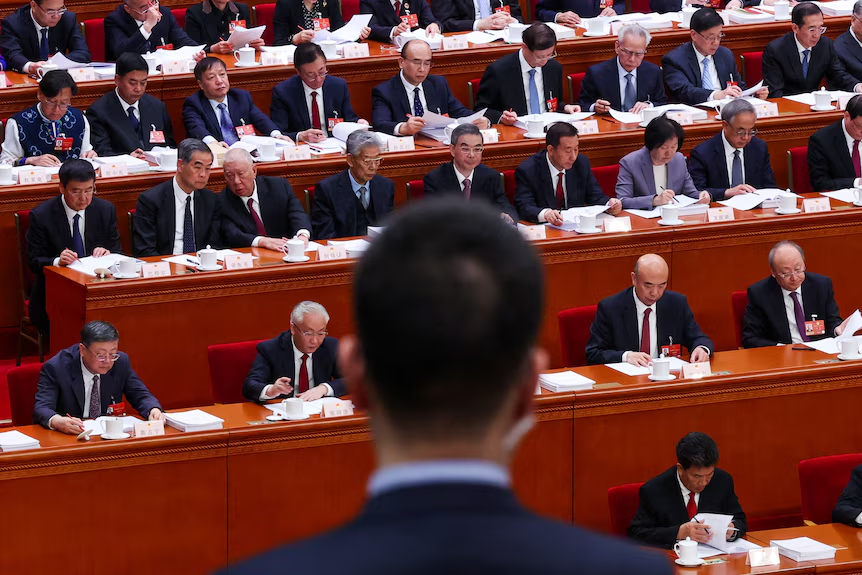
On Thursday, China convened its largest annual political gathering in Beijing, where Premier Li Qiang announced a 7 per cent increase in the country’s defence budget for this year. The figure is slightly lower than last year’s 7.2 per cent rise.
Even so, the increase is still higher than China’s economic growth target of about 5 per cent, highlighting the government’s continued focus on military development.
Experts say the boost is unlikely to be linked to potential involvement in the Middle East, with China more focused on strengthening its capabilities in the Indo-Pacific.
Chinese state media reported in 2025 that China’s defence budget has long remained at around 1.5 per cent of its GDP. By comparison, Australia’s defence spending in 2024 was close to 2 per cent of GDP, while the United States allocated about 3.4 per cent.
China’s adjusted defence spending comes as much of the world watches for responses from China and Russia following US and Israeli strikes on Iran on Saturday that killed Iran’s Supreme Leader Ali Khamenei.
China and Russia have issued strong statements condemning the attacks, with Chinese media reporting the country’s foreign minister told his Israeli counterpart that China calls for an immediate stop to military operations. Similarly Russia’s foreign minister spoke to his Iranian counterpart.
But so far, neither country has announced military or direct economic support for Iran. The Kremlin said on Thursday it had not received any request for assistance from Iran.
What China’s defence budget signals
Chinese state news agency Xinhua has said it’s China’s “sovereign right” to adjust defence budgets and it is “keeping steady and moderate growth in military expenditures to safeguard its sovereignty, security, and development interests in a fast-changing world”.
It stated NATO, the US and Japan had set their defence spending proportion higher than China in recent years, and that China’s defence spending remained “comparatively modest across key relative indicators”.
But Dr Richard McGregor, Senior Fellow for East Asia at Lowy Institute, told SBS News that the official drop of 0.2 per cent in China’s defence spending was “meaningless” as a metric to interpret China’s ambitions.
“The thing you need to remember with the Chinese military budget is there’s a lot of spending off the books,” he said.
McGregor noted that even though China’s military budget remains small compared to the US, China could “get a much bigger bang for their buck”.
“In other words, it’s much cheaper to build a ship or a tank or a gun in China than it is in America. So you also have to take into account [on] how far that money goes,” he said.
McGregor didn’t think that China’s increased budget would lead to direct military support for Iran. Instead, he said China is focused on the Indo-Pacific region.
“The most important of them is obviously Taiwan, but I think China also wants to project power throughout the South China Sea and beyond the First Island Chain,” he said.
The First Island Chain refers to a string of archipelagos in the Indo-Pacific region that could act as a border to shield the US from China.
Dr Malcolm Davis, Senior Analyst at the Australian Strategic Policy Institute, also agreed that China would avoid getting involved with the war in the Middle East directly.
“I think China’s main concern is the cutting off oil and energy supplies that sustains its economic growth,” he told SBS News.
The Economist reported in October 2025 that China has been stocking petrol barrels, predicting by 2026 China would have reached a petroleum reserve that could cover the nation for at least 120 days.
What will happen to the war in Ukraine?
Davis, who also agreed that China’s defence spending signalled their focus on the Indo-Pacific region, said China could benefit from the ongoing war in the Middle East, where the US might be dragged into “a forever war”.
He argued the conflict could divert the US attention away from the Indo-Pacific, creating space for China to make a move against Taiwan.
Similarly, Russia could also benefit from the diversion of the US from Ukraine as a result of the war in the Middle East, Davis said.
“It’s really about ensuring that America has the ability to deter Russia and China in their respective theatres at the same time as confronting Iran,” he said.
Associate Professor Matthew Sussex at Griffith University told SBS News that while Russia initially heavily relied on Iran-made Shahed drones used by Russia during its war against Ukraine — Moscow might have calculated the pros and cons for getting involved in the Middle East as the Ukraine conflict grinds on.
Ukrainian President Volodymyr Zelenskyy had warned that the US involvement in the war against Iran could make it challenging for Ukraine to source air defence missiles.
Sussex also agreed that Ukraine might face weapon shortages if the US was dragged into the war for a longer time.
“The United States has stopped giving any military aid to Ukraine under the second Trump administration, and the Europeans have just been buying American hardware and then giving it to the Ukrainians,” he said.
But Sussex also noted that the European countries have been offering locally-made weapons to Ukraine. “So I think it’s almost at the point now where the United States has less leverage over Ukraine, because it’s less reliant on it,” he said.
“And if it manages to keep going with mainly European military hardware, then that means that while it might put some cramp in the Ukrainian Armed Forces, it’s probably not going to be enough to swing the war in terms of Russia decisively.”
Friendship, or situationship?
While China, Russia and Iran have long-term engagements, with their leaders often holding in-person meetings over the past decade, the trio aren’t in an alliance like the Five Eyes or European Union where one country would expect support from others if they were attacked.
Instead, China and Russia have adopted a Comprehensive Strategic Partnership with Iran, which focuses on in-depth engagement and cooperation in multiple aspects such as trade, economy, culture and defence.
“What we often do in the West is we assume that Russia [and] China that they have sort of sets of alliances in the way that Western countries do, and that’s not really the case,” Sussex said.
McGregor also noted that when the US seized Venezuelan president Nicolás Maduro in January, there had been questions about China not showing support for its friends.
“But I think that’s because people confuse Chinese policy. China does not want to be the US. They do not want to get in a fight with the US or a fight overseas,” McGregor said.
“Their way of building their power is basically through geoeconomics, so they don’t like the economic disruption, but they’re not especially more exposed than anybody else.”
Davis, who called China, Russia, Iran and North Korea as “the axis of authoritarian states”, said the group might not be “as strong as we thought” milaritarily.
“I think that maybe [the group] is a wide axis, but maybe not a deep axis,” he said.
But he also called for caution toward the four countries. “I don’t think between China and Russia in particular, that there’s a great deal of military capability there, and we really haven’t seen North Korea come into play at this point.”
“So I think it’s an interesting indicator of just how strong the alliance that axis is, but we shouldn’t be too overconfident as a result.”
For the latest from SBS News, download our app and subscribe to our newsletter.