From the world’s first in-reactor thorium breeding confirmation to a dual PWR-HTGR plant and commercial supercritical CO₂ generation, China is assembling a vertically integrated advanced nuclear ecosystem. The breadth of activity signals a coordinated push toward fuel independence and industrial deployment.
While the bulk of focus on advanced nuclear technology has honed in tightly on the U.S., from enrichment and conversion to advanced fuels, reprocessing strategies, and fast-spectrum systems, several other countries are moving to secure sovereign capability over the materials and technologies that power their nuclear fleets. Perhaps most watched is China, which has firmly established itself as the world’s most aggressive builder of new capacity in recent years. As of early 2026, China operates 58 nuclear reactors (about 56.4 GW installed)—second only to the U.S. by number of operating reactors—and has 33 additional units (more than 35 GW) under construction. By comparison, only 10 years ago, China operated 34 reactors (about 27 GW)—less than half of today’s fleet—and relied on foreign reactor technology, and had no indigenous advanced fuel cycle capability.
The country’s aggressive transformation is backed by state policy. In April 2025, China’s State Council approved construction of 10 new reactors—eight Hualong One (HPR1000) units and two CAP1000 units—across five coastal sites, representing a ¥200 billion (about $27 billion) investment, but it marked the fourth consecutive year of 10 or more reactor approvals. Between mid-2025 and early 2026, meanwhile, China reported measurable progress across the nuclear fuel cycle.
While verifying specific details and obtaining independent insight has been a reporting hurdle, the scope of achievements put forth in official announcements is worth assessing.
Thorium Molten-Salt Reactor: First In-Reactor Breeding Confirmation. China achieved a significant fuel cycle milestone with its TMSR-LF1 thorium molten-salt reactor—a 2-MWth prototype built by the Shanghai Institute of Applied Physics (SINAP), which is part of the Chinese Academy of Sciences. The reactor reached first criticality on Oct. 11, 2023, and achieved full power by June 2024. In October 2024, SINAP scientists performed the world’s first addition of thorium fuel to a working molten-salt reactor (MSR), creating a platform for thorium-uranium fuel cycle research unavailable elsewhere. And one year later, in November 2025, SINAP announced that TMSR-LF1 had successfully bred uranium-233 from thorium, providing the first experimental data on thorium fuel conversion in an operating reactor.
TMSR-LF1’s liquid-fuel design allows continuous refueling without shutdown, offering improved fuel utilization and reduced waste generation compared to solid-fueled systems, Chinese researchers have said. Project planners are now moving to accelerate the program, and their reported next step is a 100-MWth thorium MSR demonstration reactor targeted for 2035. Commercial thorium MSRs are envisioned by approximately 2040 for applications in carbon-free heat and hydrogen production.
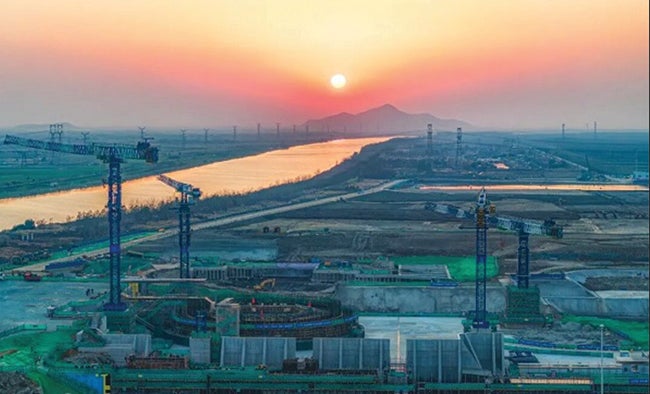 |
| 3. Construction is underway at the Xuwei Nuclear Heating and Power Plant in Lianyungang, Jiangsu Province. The project—which began concrete pouring for Unit 1’s nuclear island on Jan. 16, 2026—pairs two 1,208-MWe Hualong One pressurized water reactors with a 660-MW high-temperature gas-cooled reactor (HTGR) in the world’s first dual-coupling demonstration combining Generation III and Generation IV reactor technologies. Courtesy: China National Nuclear Corp. (CNNC) |
World’s First PWR–HTGR Dual-Coupling Plant. In January 2026, China broke ground on a first-of-a-kind hybrid nuclear energy project that pairs large third-generation pressurized water reactors (PWRs) with an advanced fourth-generation high-temperature gas-cooled reactor (HTGR). At the Xuwei Nuclear Heating and Power Plant (Phase I) in Lianyungang, Jiangsu Province, two 1,208‑MWe Hualong One PWRs will be integrated with a 660‑MWe HTGR in what China National Nuclear Corp. (CNNC) describes as the world’s first plant to combine a PWR and an HTGR in a single, large-scale industrial complex (Figure 3). Designed primarily for high-quality industrial steam supply (power generation is a supplement), the project will represent the first commercial deployment of China’s fourth-generation HTGR technology alongside its indigenous Hualong One reactors at one site.
The HTGR unit will use TRi-structural ISOtropic (TRISO) pebble fuel and high-temperature helium coolant. It envisions that steam from the PWRs will be further heated by the HTGR to deliver superheated steam for petrochemical and other industrial processes. Once completed, Xuwei Phase I is expected to supply about 32.5 million tonnes of industrial process steam per year and generate more than 11.5 TWh of electricity.
CNNC has said that the project, which was approved in August 2024 and launched with first concrete for Unit 1’s nuclear island in January 2026, represents a scalable “China Solution” for low‑carbon transformation in energy‑intensive industrial hubs. The PWR-HTGR hybrid concept, notably, builds on China’s operating experience with the Shidao Bay HTR‑PM prototype—a twin‑module pebble‑bed reactor complex delivering about 210 MWe from two 200‑MWth reactor modules that entered commercial operation on Dec. 6, 2023—as well as on follow‑up safety and performance testing conducted in 2024. HTR‑PM is a Generation IV HTGR that uses spherical “pebble” fuel and helium coolant to supply both electricity and high‑temperature steam for industrial processes. In 2023–2024, Chinese researchers from Tsinghua’s Institute of Nuclear and New Energy Technology and project partners reported full‑scale loss‑of‑cooling tests and initial district heating and industrial steam supply projects at Shidao Bay, demonstrating the reactor’s inherent safety and multipurpose cogeneration capabilities.
Fast Reactors and Closed Fuel Cycle Infrastructure. On the fast reactor front, China’s CFR-600 project is advancing the country toward a plutonium-based closed fuel cycle. The first CFR-600—a 600-MWe sodium-cooled fast neutron reactor at Xiapu, Fujian Province—began low-power test operation in 2023, fueled with high-enriched uranium (HEU) supplied by Russia’s TVEL. A second CFR-600 unit at Xiapu is reportedly under construction and expected to start up as early as this year, potentially fueled with mixed-oxide (MOX) fuel using recycled plutonium from spent fuel.
To support its fast reactors, China is building back-end fuel-cycle infrastructure. At CNNC’s Gansu Nuclear Technology Industrial Park, a pilot reprocessing plant rated at 200 tonnes per year is reportedly nearing completion, along with a 20-tonne-per-year (t/yr) MOX fuel fabrication facility targeted for commissioning very soon. When operating at design capacity, the reprocessing plant could extract approximately 15 tonnes of plutonium annually from used fuel—sufficient to fabricate MOX for a fleet of fast reactors.
China is also in long-running negotiations with France’s Orano to build a larger commercial reprocessing facility (approximately 800 t/year) and a MOX plant. The domestic pilot facilities in Gansu constitute a crucial first step toward fuel self-sufficiency.
Hualong One Fleet Expansion. China’s fleet of indigenous Hualong One (HPR1000) reactors continues to grow. Zhangzhou Unit 2 (1,126 MWe net) in Fujian Province achieved first criticality on Nov. 3, 2025, and grid connection on Nov. 22, 2025. After successful trial operation, CNNC declared Zhangzhou-2 in full commercial service on Jan. 1, 2026. This follows Zhangzhou-1, which began commercial operation exactly one year earlier. The two units comprise Phase I of the Zhangzhou nuclear power base, a planned six-unit site that will become the world’s largest Hualong One installation.
Construction started in 2019, and both first-phase reactors were completed in approximately five years, meeting planned timelines. Each unit generates roughly 10 TWh per year. All of China’s new reactor projects now reportedly rely on 100% domestically manufactured components, reflecting a high degree of supply chain localization.
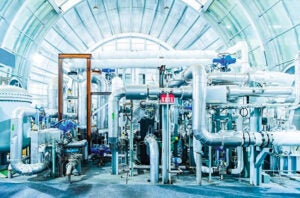
Supercritical CO2 Power Cycle: World’s First Commercial Operation. In December 2025, meanwhile, CNNC inaugurated what it called the world’s first commercial supercritical carbon dioxide (sCO2) power generation unit, “Chaotan One” (Super Carbon One), at Shougang Shuicheng Iron & Steel in Liupanshui, Guizhou Province. The demonstration system (Figure 4) consists of two 15-MWe sCO2 turbine-generator sets that use high-pressure CO 2 instead of steam in a closed Brayton cycle to convert waste heat from the steel plant’s sintering process into electricity.
While details are scarce, Chaotan One likely marks the first time sCO2 power technology has moved from laboratory research and development (R&D) to full commercial operation. Compared to conventional steam-based waste heat recovery systems, sCO 2 cycles boost generation efficiency by more than 85% and net power output by more than 50%, while halving the physical footprint of equipment.
The pilot plant was developed by CNNC’s Nuclear Power Institute (NPIC) in collaboration with Jinan Iron & Steel Group and Shougang Group. NPIC has been researching sCO2 cycles since 2009. After grid connection on Dec. 20, 2025, an independent expert panel—led by academicians from the Chinese Academy of Engineering and Chinese Academy of Sciences—declared the technology “internationally leading” overall.
CNNC now reportedly plans to scale up applications through a molten-salt energy storage plus sCO2 generation pilot—as a selected Chinese national “first-of-a-kind” demonstration project—envisioning completion in 2028.
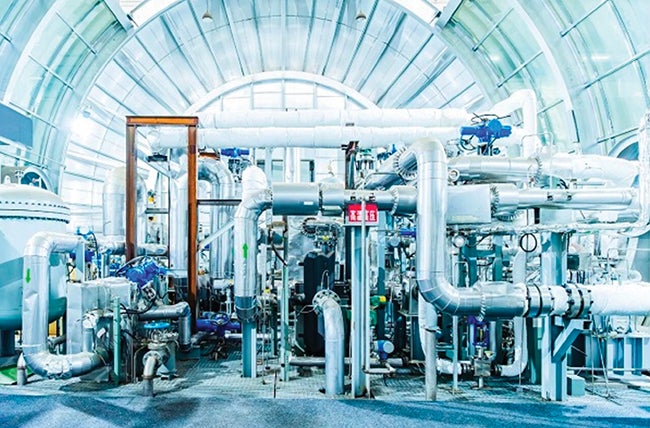 |
| 4. The “Chaotan One” (Super Carbon One) supercritical carbon dioxide (CO2) power generation system at Shougang Shuicheng Iron & Steel in Liupanshui, Guizhou Province. The 2 x 15-MW demonstration plant uses high-pressure CO2 in a closed Brayton cycle to recover waste heat from steel sintering, achieving more than 85% higher efficiency than conventional steam systems while occupying half the footprint. Grid connection occurred Dec. 20, 2025, marking the world’s first commercial deployment of sCO2 power technology. Courtesy: CNNC |
SMRs, Hydrogen, and Multipurpose Applications. China’s ACP100 small modular reactor (SMR)—branded “Linglong One”—is under construction at the Changjiang site in Hainan Province and is expected to reach first criticality in 2026. The 125‑MWe integrated PWR uses a compact design in which the reactor core, steam generators, and pressurizer are all contained within a single pressure vessel. First concrete was poured in July 2021, and by late 2025, major civil works and cold testing were complete, and the project was reported to be nearing completion. Linglong One is widely described as the world’s first land‑based commercial SMR to begin construction following an International Atomic Energy Agency (IAEA) safety review of its design, and CNNC notes it has signed cooperation intentions on SMR projects with multiple countries.
China’s nuclear hydrogen production is meanwhile advancing via two pathways. At CNNC’s Tianwan Nuclear Power Station, a proton exchange membrane (PEM) electrolyzer system has been demonstrated using reactor electricity and steam to produce high‑purity hydrogen at a rate of a few kilograms per hour, equivalent to roughly 100 tonnes per year at continuous operation. Public hydrogen and nuclear roadmaps indicate that Tsinghua University’s Institute of Nuclear Energy Technology is targeting a commercial‑scale nuclear hydrogen demonstration in the latter 2020s.
At the same time, the country’s nuclear district heating has also expanded rapidly. CNNC’s Haiyang Nuclear Power Plant in Shandong has become a flagship project, using waste heat from two AP1000 reactors to provide large‑scale urban district heating now covering hundreds of thousands of residents across tens of millions of square meters. A water-heat cogeneration pilot at Haiyang integrates desalination with district heating, supplying on the order of 100 tonnes per day of potable water. At Qinshan Nuclear Power Plant in Zhejiang, a nuclear heating demonstration launched in December 2021 now provides central heating to nearly 4,000 residents in Haiyan County, with a goal of expanding service to several million square meters in the near future.
Progress for Fusion. China’s Experimental Advanced Superconducting Tokamak (EAST) in Hefei set a new world record announced on Jan. 20, 2025, which involved sustaining a high‑temperature plasma at more than 100 million degrees Celsius for 1,066 seconds—nearly 18 minutes. Chinese researchers report that this long‑duration, steady‑state, high‑confinement operation is an important step toward demonstrating the conditions required for continuous fusion burn. EAST is the world’s first fully superconducting tokamak, and since achieving first plasma in 2006, it has carried out well over 100,000 experimental shots, progressively extending pulse length from seconds to the current record.
China is also preparing for the China Fusion Engineering Test Reactor (CFETR), which is intended as a bridge between ITER‑class experiments and fusion demonstration plants. The comprehensive research platform supporting CFETR—the Comprehensive Research Facility for Fusion Technology (CRAFT) in Anhui—remains in the final stages of construction. Multiple key subsystems have been approved, and installation is underway. It is slated to reach full completion sometime this year as a dedicated platform to validate CFETR technologies and components. Public fusion roadmaps indicate that CFETR construction is foreseen to begin in the late 2020s, with the aim of progressing from a few hundred megawatts of fusion power toward demonstration‑relevant operation in the 2030s.
In parallel, China is advancing a fusion‑fission hybrid concept known as the “Xinghuo” (Spark) high‑temperature superconducting reactor. This project, planned for Yaohu Science Island in Nanchang, Jiangxi Province, would combine a high‑temperature superconducting tokamak with a surrounding subcritical fission blanket, targeting about 100 MW of net electric output and an ambitious energy‑gain factor (Q) above 30. Current plans envision construction toward the end of this decade, and Chinese media have suggested operation around 2030–2031 if development proceeds on schedule.
—Sonal Patel is a POWER senior editor (@sonalcpatel, @POWERmagazine).