The story of U.S.-China nuclear engagement illustrates how steady science and technology diplomacy benefit both countries as well as global security.
BY YANLIANG PAN
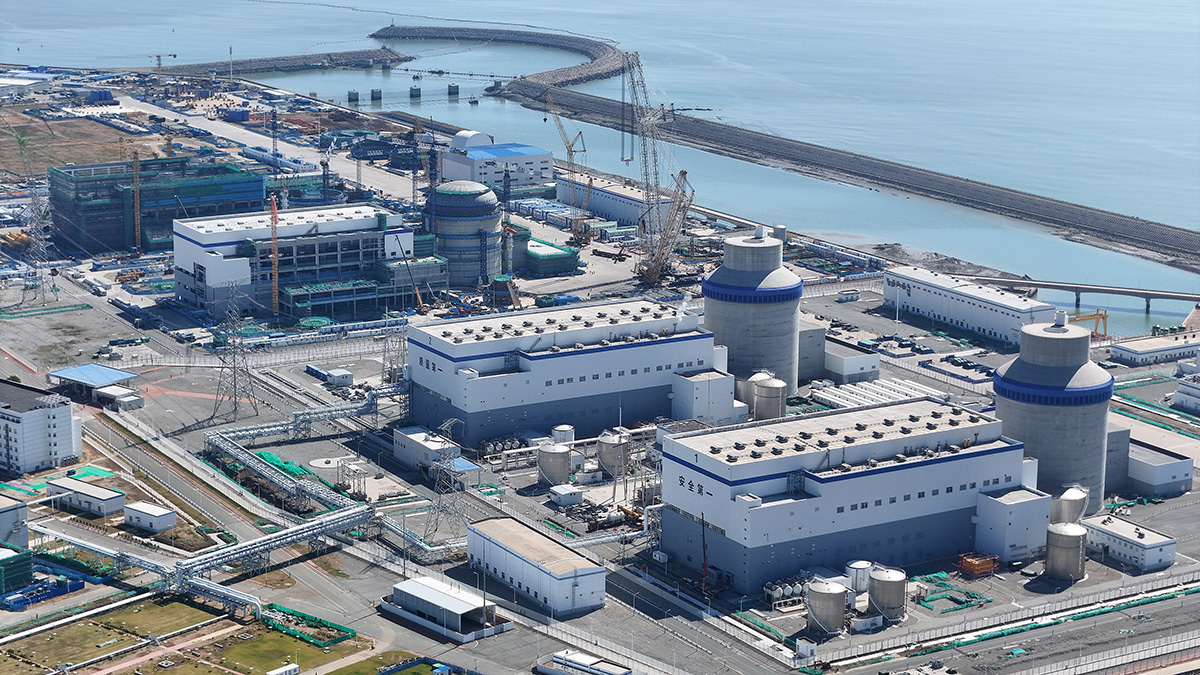
An aerial view of operating Westinghouse AP1000 units and CAP1000 units (the Chinese version of Westinghouse’s AP1000) under construction at the Haiyang Nuclear Power Plant in the Shandong province of China, 2024.
WPTO
The United States is locked in a nuclear energy race against Russia and China—a race to control advanced nuclear technologies, markets, and supply chains; assert energy dominance in the era of revolutionizing artificial intelligence; and maintain global nuclear safety, security, and nonproliferation norms. Or so goes the prevailing narrative.
It is true that the United States urgently needs to make its nuclear industry more competitive than it is today. Russia is dominating global civil nuclear exports. China is set to overtake the U.S. in nuclear energy capacity by 2030. For all the talk in America about advanced and small modular reactors, China is ahead in actually building them. In short, the competition is real. It is by no means, however, the whole story.
For nearly half a century following President Richard Nixon’s 1972 visit, the United States and China cooperated, rather than competed, in nuclear technology and science—from fundamental nuclear and high-energy physics to fission and fusion.
The United States helped lay the foundation of China’s nuclear safety, security, and nonproliferation governance. To this day, U.S. technology permeates China’s conventional and advanced reactors—technology China acquired not through theft but through formal collaboration with U.S. companies and national laboratories under the Department of Energy (DOE).
What’s more, there was a time when China’s nuclear weapon establishment welcomed U.S. access to its most sensitive facilities for security, nonproliferation, and arms control collaboration.
Barring short episodes of friction, the story of U.S.-China nuclear engagement is one that illustrates how steady science and technology diplomacy could benefit both countries as well as global security.
Early Cooperation
The story began in November 1972, when the director of the Stanford Linear Accelerator Center (SLAC), Wolfgang Panofsky, received a Chinese scientist by the name of Zhang Wenyu, the director of Beijing’s Institute of Atomic Energy. The institute had contributed critical research, components, and fissile material feedstock to China’s nuclear weapon program in the 1950s and 1960s. Zhang, however, was pursuing a different mission as he visited SLAC.
President Nixon’s February 1972 visit to China had opened the door to bilateral scientific exchanges. In September 1972, Zhang received a directive from Chinese Premier Zhou Enlai to set up China’s national scientific program in high-energy physics. His visit to the United States just two months later was aimed at establishing scientific exchanges critical to China’s nascent high-energy physics endeavor.
From 1973 onward, Chinese scientists regularly visited U.S. national laboratories and leveraged U.S. help in conducting basic scientific research while designing the large particle accelerator that would jump-start China’s experimental high-energy physics program. Panofsky provided critical input and was invited to join Chinese leader Deng Xiaoping at the accelerator’s groundbreaking ceremony in Beijing. He would later become an important U.S. participant in Track 1.5 and Track 2 nuclear diplomacy with China.
U.S.-China Exchanges
In 1979 informal U.S.-China scientific exchanges culminated in the Agreement on Cooperation in Science and Technology—the first major agreement between the two governments following the establishment of formal diplomatic relations. Through successive implementing accords, cooperation under the agreement expanded from high-energy physics to magnetic fusion, and from nuclear physics to safety, security, nonproliferation, and energy sciences.
Exchanges, while civilian-focused, spawned relationships between the two countries’ senior nuclear weapon scientists. Los Alamos National Laboratory Director Harold Agnew recalls meeting the deputy head of China’s nuclear weapon program in 1979, when the latter visited the United States with a Chinese Nuclear Society delegation.
A separate delegation that visited Los Alamos the previous year included a Chinese nuclear physicist by the name of Yang Fujia, who later arranged for scientists and intelligence staff from the U.S. weapons lab and DOE to visit nearly all of China’s nuclear weapon facilities, from research reactors deep in the mountains of Sichuan to the northwestern Lop Nur test site. The information they gathered about the geology and depth of the Chinese testing tunnels would later allow the United States to more precisely estimate the yields of China’s nuclear weapons.
For all the talk in America about advanced and small modular reactors, China is ahead in actually building them.
In return, the Americans offered their knowledge in fissile material accounting and control, as well as arms control monitoring and verification. The 1990s lab-to-lab exchange program spearheaded by then–Los Alamos director Siegfried Hecker aimed to help keep Chinese weapons secure while reinforcing the country’s integration into the international nonproliferation and disarmament system.
China had been intensely skeptical of this system prior to U.S. engagement. Celebrating its first atomic bomb test in 1964, Beijing dismissed the Partial Nuclear Test Ban Treaty ratified by the United States, United Kingdom, and USSR the previous year as “a big fraud to fool the people of the world” and “consolidate [their] nuclear monopoly.” Defying nonproliferation restrictions, China made nuclear transfers to countries outside the International Atomic Energy Agency (IAEA) safeguards regime.
This continued until the United States convinced China, via diplomatic engagement, to embrace nonproliferation and export controls. In 1981 the United States began helping China build up its civilian nuclear safety regulatory capacity nearly from scratch. At the same time, diplomats began negotiating a bilateral agreement on the peaceful uses of nuclear energy.
Paving the Way for Business
To satisfy U.S. conditions on a peaceful use agreement and on civil nuclear commerce, senior Chinese leaders committed their country to nonproliferation in principle. In 1984 China became a member of the IAEA. That same year, the DOE, with State Department support, began extending assistance to China in nuclear security and nonproliferation safeguards.
By the late 1980s, Chinese safety and security specialists were spending months, if not years, on training and research assignments at the U.S. Nuclear Regulatory Commission (NRC) and national laboratories. When they returned and took up senior posts in China’s civil nuclear establishment, they brought back and implemented U.S. nuclear safety, security, and safeguards practices. It was with U.S. inducement and assistance that China implemented voluntary safeguards arrangements with the IAEA, acceded to the Treaty on the Non-Proliferation of Nuclear Weapons (NPT), ceased its unsafeguarded nuclear transfers, and became a member of multilateral export control regimes.
In 1996, when information surfaced about China National Nuclear Corporation’s unauthorized sale of ring magnets to Pakistan, Washington insisted that Beijing implement more robust export controls on nuclear and dual-use items as a precondition for allowing U.S. companies to engage in civil nuclear commerce with China. In the years that followed, U.S. experts advised China on its nuclear and dual-use export control regulations and offered enforcement training.
Nonproliferation diplomacy opened the door to civil nuclear commerce. In the decades following the 1979 Three Mile Island accident, U.S. civil nuclear construction all but ground to a halt amid market and regulatory challenges. As legal barriers to civil nuclear commerce with China were lifted, U.S.-based Westinghouse rushed to secure Chinese orders for its first-of-a-kind AP1000 reactor, which it had not had success marketing elsewhere.
In 2006 the U.S. government endorsed the reactor sale and technology transfer deal, thus making China the first country to construct the AP1000. Lessons learned from Chinese licensing and construction of the AP1000 informed the U.S. project at the Alvin W. Vogtle Electric Generating Plant in Burke County, Georgia. The two units that were completed there in 2024, 15 years after their construction was approved and with tens of billions of dollars in cost overruns, remain the only AP1000 units to operate outside China. Today, China operates more units of the U.S. AP1000 than any other country in the world—including the United States.
There has also been cooperation in advanced reactors. After the resolution of lingering export control issues in the early 2000s, the Massachusetts Institute of Technology became the first U.S. entity to receive DOE authorization to collaborate with China over nuclear technology—specifically, the technology of high-temperature gas-cooled reactors.
When the George W. Bush administration announced its Global Nuclear Energy Partnership in 2006, China became one of the most eager participants. Its Institute of Atomic Energy, which had been conducting civilian research since the 1970s, engaged national laboratories under the U.S. DOE within a bilateral action plan to advance fast reactor and fuel cycle technologies. Cooperation extended far beyond the Bush administration.
In 2014 the Chinese institute made its experimental fast reactor available to DOE for joint material testing. Meanwhile, the Chinese Academy of Sciences conducted joint research with Oak Ridge National Laboratory in molten-salt reactors and with Idaho National Laboratory in hybrid energy systems. In 2015 Bill Gates’ advanced reactor company, TerraPower, signed an agreement with China National Nuclear Corporation to construct its first traveling wave reactor in China. That, however, was not meant to be. In just three years, the U.S. government’s restrictions on civil nuclear cooperation with China terminated this partnership and others like it.
The Relationship Today
In 2018 the U.S. administration heavily restricted civil nuclear exports to China, citing technology theft and military diversion concerns and channeling a new strategic outlook of “great-power rivalry.” According to the U.S. Justice Department, Chinese hackers had gained illegal access to Westinghouse technology and inside information in parallel with the negotiation of legal technology transfer. In 2016 China General Nuclear, a Chinese state-owned nuclear company, was indicted for acquiring U.S. nuclear know-how outside U.S. law and the U.S.-China civil nuclear cooperation framework.
These charges were intertwined with concerns that China would benefit militarily from U.S. civil nuclear technologies, whether legally or illegally obtained. At the time of the indictment, China General Nuclear was developing floating nuclear power plants that Washington believed might give the Chinese military an advantage in the East and South China Seas. There were also long-standing concerns that China could divert U.S. power reactor technologies toward naval propulsion or use civil nuclear infrastructure to produce fissile material for weapons. Amid China’s nuclear and conventional military buildup as well as broader U.S.-China strategic rivalry, these concerns began to outweigh the perceived benefits of continued nuclear cooperation. Washington’s 2018 policy shift was in part a reflection of this new reality.
Nonproliferation diplomacy opened the door to civil nuclear commerce.
Since then, rivalry has overshadowed the two countries’ long history of partnership in nuclear energy and nonproliferation. Export controls—an area in which the two countries used to cooperate in order to mitigate regional proliferation threats—have become an avenue of geopolitical and technological competition. The United States has added an increasing number of Chinese entities to its export control lists. In response, China is leveraging its dual-use export control system to threaten rare earth restrictions on the United States. Few remember that China set up the system in the 1990s under U.S. diplomatic pressure and with U.S. technical help.
In November 2025, the Chinese Academy of Sciences announced that its prototype molten-salt reactor successfully demonstrated the conversion of thorium to uranium—a step that could extend available uranium resources. Commentaries regarding China’s thorium accomplishment trace the molten-salt concept to Oak Ridge National Laboratory’s pioneering work more than 50 years ago yet rarely highlight the much more recent U.S.-China collaboration.
The long history of U.S.-China civil nuclear cooperation should not be forgotten. Nor should it be reduced, as in some simplistic narratives, to a story of China stealing U.S. IP to race ahead in civil nuclear technologies. The real story is much more complex: The United States and China have engaged in legitimate and mutually beneficial civil nuclear cooperation while navigating real IP protection challenges and military diversion risks.
If China ends up winning the nuclear energy race, the United States should claim no small credit. China has benefited immensely from cooperation with the United States across nuclear energy technologies, safety, security, nonproliferation, export controls, and diplomacy—many diplomats in the Chinese Foreign Ministry’s Department of Arms Control were trained in the United States. But the benefit was not unilateral.
U.S. nuclear engagement with China over the decades has benefited American public interests—by bringing China into the global nonproliferation regime, giving the U.S. nuclear industry access to the Chinese market, enabling China’s transition to clean energy technologies, and improving the safety of Chinese nuclear power plants in the belief that a nuclear accident anywhere is a nuclear accident everywhere.
The United States is more secure when Beijing maintains full control of its nuclear arsenal and fissile material and is not inadvertently aiding weapons proliferation due to lax dual-use export controls. Equally significantly, science and technology diplomacy has built political bridges since the normalization of diplomatic relations in 1979 and has since given the United States transparency and access to China’s civil and defense nuclear complex.
Ultimately, the United States never lost sight of its interests. Cooperation has never simply been for cooperation’s sake. The United States could benefit further from a revived, yet cautious, civil nuclear partnership with China that takes IP and dual-use concerns seriously. The partnership could focus, for instance, on precommercial technologies where IP sensitivities are mitigated and potential military utility is limited. If U.S. policymakers decide to suspend the frame of competition, at least in the civil nuclear domain, there is yet the opportunity to restore and reap the residual goodwill from a half century of cooperation.

Yanliang Pan is a research associate at the James Martin Center for Nonproliferation Studies, where his work focuses on nuclear energy, nuclear supply, international nuclear cooperation, and emerging technology issues.
When sharing or linking to FSJ articles online, which we welcome and encourage, please be sure to cite the magazine (The Foreign Service Journal) and the month and year of publication. Please check the permissions page for further details.
Read More…
- “Congressional Pressures and U.S.-China Policy” by Robert Sutter, The Foreign Service Journal, May 2005
- “The United States and China at a Crossroads” by Henry M. Paulson Jr., The Foreign Service Journal, July-August 2019
- “OP64: Nuclear Verification’s Holy Grail: Verifying Nuclear Warheads—A New Approach” by Miles Pomper, William Moon, Marshall Brown, Ferenc Dalnoki-Veress, Dan Zhukov, Dick Gullickson, and Yanliang Pan, CNS Occasional Paper, December 2024