Steven Hatzakis, widely known in the retail trading industry as the Global Director of Online Broker Research at ForexBrokers.com, has formally launched ForexGPT, an AI-native trading platform designed to unify market analysis, trade execution and automation under a structured tool architecture. Rather than positioning itself as a chatbot bolted onto a broker dashboard, ForexGPT is built around the Model Context Protocol (MCP), an open standard that enables AI models to call external tools in a controlled, schema-validated way.
The architectural premise is straightforward but ambitious: every analytical function, every trade action and every account query is exposed as a defined tool endpoint. Instead of asking an AI model to “figure out” how to trade, the system routes requests through clearly defined operations such as scanning instruments, retrieving chart data, calculating position size or placing an order. Each of these passes through validation before touching broker infrastructure. The result is an interface layer where natural language becomes the trigger for structured actions.
At launch, ForexGPT exposes more than 60 callable tools. These span system health checks, market discovery, watchlist management, deep multi-timeframe analysis, trade execution, account history review, autonomous agent configuration and prop trading challenge simulation. All trading currently runs on demo accounts through broker API integration, with live activation positioned as a near-term milestone.
From Market Scanner to Execution: Compressing the Trading Workflow
 The platform’s analytical core is its proprietary sentiment engine. Each of the 127 supported instruments is scored on a -100 to +100 scale, aggregating signals from multiple technical indicators across configurable timeframes. Scores near the extremes are positioned as higher-conviction environments, while values near zero indicate mixed conditions. Crucially, the score is not a black box. Traders can review the breakdown of contributing indicators to understand how the composite number was derived.
ForexGPT’s market scanner applies this scoring process simultaneously across all supported instruments. Within seconds, users can rank markets by signal strength, filtering for bullish or bearish conditions and then drilling into individual assets for deeper analysis. Multi-timeframe checks across H1, H4 and daily charts are integrated into the workflow, reducing the need to toggle between separate chart layouts. In practical terms, the scanner functions as a triage engine, narrowing attention to the markets most aligned with predefined technical criteria.
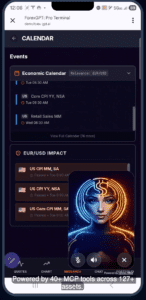
Beyond scanning, the platform provides direct access to chart data, interactive candlestick visualization and AI-powered chart interpretation. A user can request raw OHLCV data, analyze a single timeframe in depth or run simultaneous multi-timeframe analysis for confluence. Economic calendar tools add event awareness, while live spread checks and instrument specification queries give traders operational context such as margin requirements and minimum trade sizes. This creates a pipeline that moves from discovery to validation to risk framing without leaving the same conversational session.
Execution tools are similarly granular. Traders can place market, limit and stop orders with configurable stop-loss and take-profit parameters. Open trades can be modified, partially closed or fully closed. Pending orders can be replaced or cancelled. Account history and order logs can be retrieved for audit purposes. Rather than navigating multiple platform tabs, a trader can execute each step as a discrete command that triggers a validated tool call.
Takeaway: The system aims to collapse the traditional multi-screen trading workflow into a single conversational thread that still retains structured controls.
Autonomous Agents With Graduated Control Levels
 A central feature of the launch is the ATLAS autonomous agent framework. ForexGPT includes nine pre-built strategies covering styles such as swing trading, scalping, high-frequency approaches, breakout strategies, trend following, mean reversion and news-aware trading. Each strategy operates as an independent scanning and execution engine capable of monitoring markets on its own schedule.
However, the system introduces four control levels to mitigate the leap from manual to automated trading. In manual mode, the agent functions purely as an analytical engine, surfacing setups without placing orders. In supervised mode, trade signals are sent to the user for approval via Telegram before execution. Semi-automatic and full-automatic modes increase autonomy, allowing trades to be placed under predefined risk parameters without manual confirmation.
This tiered control structure is designed to address a common psychological barrier in retail automation: the fear of surrendering total control to an algorithm. By allowing users to start in supervised mode and gradually increase automation, ForexGPT attempts to make the transition to agent-driven trading more incremental.
Each agent supports configurable risk rules, including stop-loss distances, take-profit multipliers, minimum sentiment thresholds and maximum concurrent positions. Full performance logs and trade histories are accessible through dedicated tools, providing transparency into how each strategy is behaving over time.
Takeaway: Automation is not presented as an all-or-nothing switch. The platform’s value proposition rests partly on how it stages the progression from discretionary oversight to algorithmic autonomy.
Prop Firm Challenge Simulation and Risk Discipline
Recognizing the popularity of proprietary trading firm evaluations, ForexGPT includes a dedicated prop challenge toolset. Users can select from predefined challenge profiles, compare account formats side-by-side and calculate position size within daily loss and overall drawdown constraints. A tracker monitors ongoing performance and flags potential pass or fail conditions based on rule compliance.
This feature reflects how retail trading has evolved. Many traders now train within structured rule environments before funding live accounts. By embedding these constraints directly into the execution layer, ForexGPT attempts to hardwire risk discipline into the decision-making process rather than relying solely on user discretion.
Voice Interface and Multi-Surface Distribution
ForexGPT extends beyond text chat into real-time voice interaction. Users can issue spoken commands to scan markets, retrieve sentiment data or initiate trades. The system processes speech-to-tool-to-speech interactions with low latency, rendering interactive charts and widgets while delivering spoken summaries. Voice access is available through the web terminal, embeddable widgets and even telephone-based authentication via SIP gateways.
Importantly, voice is not a simplified companion app. It calls the same MCP tool server as the text interface, ensuring feature parity across surfaces. This design choice reinforces the platform’s “one server, many clients” architecture. Whether accessed via ChatGPT, Claude, a standalone Pro Terminal or an embedded widget, the same tool layer powers the interaction.
The embeddable Super-Widget introduces a B2B dimension. Partner websites can deploy ForexGPT functionality with a single script integration. Anonymous visitors gain access to core analytical tools, while authenticated users unlock deeper capabilities including trade execution and autonomous agents. Partners receive API keys, configuration dashboards and usage metrics that track sessions, tool calls and engagement patterns.
Takeaway: Distribution strategy is as central as product design. ForexGPT is engineered to operate as a backend AI infrastructure layer that can power multiple front-end environments.
Protocol-Constrained Execution and the “Hallucination Firewall”
One of the more technically significant elements of the launch is its emphasis on schema validation before broker execution. Every tool call is checked against defined parameters before it is transmitted to the broker API. This approach aims to prevent malformed requests or unintended trades resulting from ambiguous natural language prompts.
In practical terms, the AI may interpret user intent, but it cannot bypass the constraints defined in the tool schema. If a trade request falls outside permitted parameters, it is rejected or flagged before execution. This structure is presented as a safeguard against AI hallucinations in financial contexts, reinforcing the idea that safety should be enforced at the protocol layer rather than relying solely on prompt engineering.
The broader thesis behind ForexGPT is that conversational AI can serve as an interface to capital markets infrastructure if it is bounded by strict validation rules. By combining sentiment scoring, scanning engines, agent frameworks and execution tools under MCP governance, the platform attempts to reconcile flexibility with control.
With more than 3,100 registered users and over 820 paid transactions reported since late 2023, growth has been described as largely organic. While live trading activation remains pending, the current release signals a shift in how AI may integrate with trading environments — not as a peripheral assistant, but as a structured execution gateway constrained by rules, schemas and risk checks.
For Hatzakis, whose background spans broker research, fintech evaluation and regulatory licensing, ForexGPT represents an attempt to formalize how AI can participate in financial workflows. Whether it becomes a mainstream trading interface will depend on adoption, broker partnerships and regulatory clarity. But as a design statement, it advances a clear proposition: conversational AI in trading should not be free-form. It should be protocol-bound, tool-validated and risk-aware from the ground up.