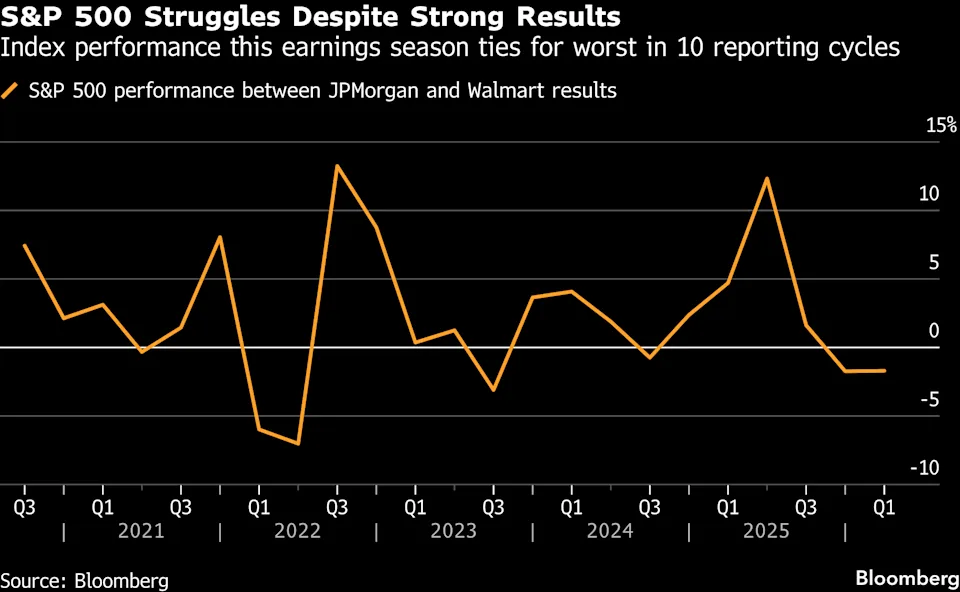
(Bloomberg) — The S&P 500 has been stuck in a range for the better part of four months, and investors are paying up to protect against the possibility that the next big move is down. To a growing number of strategists, that pessimism is cause to expect the opposite.
The change in mood among investors, particularly the retail crowd, arrives as the S&P 500 has churned below 7,000 for most of the year, defying predictions that a breakout is imminent. There are, of course, reasons for the stagnation. Artificial intelligence tools have led to big selloffs in a variety of sectors, trade policies remain opaque and geopolitical tensions are high.
Most Read from Bloomberg
The swirl of negative inputs prompted investors to pile into derivatives that pay out if the S&P 500 suffers a steep loss. Put-call skew, which measures the cost of buying downside protection compared to placing upside bets, jumped to a two-year high last week. Normalized two-month skew on the S&P 500 is now near the upper end of its five-year range.
Generally, when sentiment moves so far in one direction, strategists start to sense a contrarian signal.
“We’ve seen tremendous amount of flow into very short term tactical hedges,” said Stuart Kaiser, head of US equity trading strategy at Citigroup Inc. “Over the last six to 12 months equity markets haven’t significantly responded to most geopolitical events. If the Iran risk settles, a lot of risk premium would get compressed out of the market and the investors that have been corralled on the sidelines would start to engage to the upside.”
The data back up that view. An indicator of investor leverage by BNP Paribas SA that tracks metrics including ETF flows and futures-focused hedge fund strategies has ticked to lows last seen in November. But counterintuitively, such pessimistic positioning can be a buy signal.
“You could get mega tech-led rally over the next coming couple of weeks,” said Greg Boutle, head of US equity and derivatives strategy at BNP Paribas. “That could easily drag the S&P through 7,000, which has been a psychological level that it has not wanted to break through and that could force people to put a little bit of money to work.”
Boutle entitled his latest market missive, “Be greedy when others are fearful,” pointing out that a rally following Nvidia Corp.’s earnings last night could open the path for the S&P 500 to hit 7,000. A simple way to trade technology upside are call spreads on the Invesco QQQ ETF Trust, Bank of America analysts argued this week.
Nvidia’s results late Wednesday provided a potential spark for the bulls. The chipmaker issued better than expected revenue forecast and posted earnings that topped estimates, allaying at least for the time being some fears that AI spending was becoming a burden.
Regardless of Nvidia’s move, it likely will take more to signal the all-clear in equities. Retail investors who have reliably bought every dip in the past few years, are showing signs of fatigue. The non-professional crowd was responsible for 8.3% of total equity trading volume last week, compared with last year’s average of 11.7%, data compiled by Citi show. Earlier this year, their participation dropped to the lowest level since 2024.
“Retail trading volumes collapsed,” Kaiser said. “Those folks have really pulled back.”
Geopolitical risk remains as the US amasses a war force near Iran. Any hostilities there could upend global energy markets, making investors more concerned about geopolitical risk now than they have been in the recent past.
For bulls, that pessimism has created a buying opportunity.
Most Read from Bloomberg Businessweek
©2026 Bloomberg L.P.