Samsung has announced the Galaxy S26 phones and by far the biggest upgrade is the Privacy Display on the Ultra model. I was sceptical at first, but now I’ve seen it with my own eyes, I can tell you it’s the most innovative piece of phone tech in years.
Sure, none of the S26 phones come with magnetic Qi2 charging to rival the Pixel 10 and the generations of iPhone that have it, but this world-first might be a worthy trade-off. Privacy screen solutions have been around in various forms for a long time, but this is something truly unique.
Typically, privacy screens are a basic polarising filter, either inbuilt or that the user adds in the form of a stick-on layer. However, Samsung’s new tech combines a clever hardware layer along with software, giving you far more control over how it works.
Chris Martin / Foundry
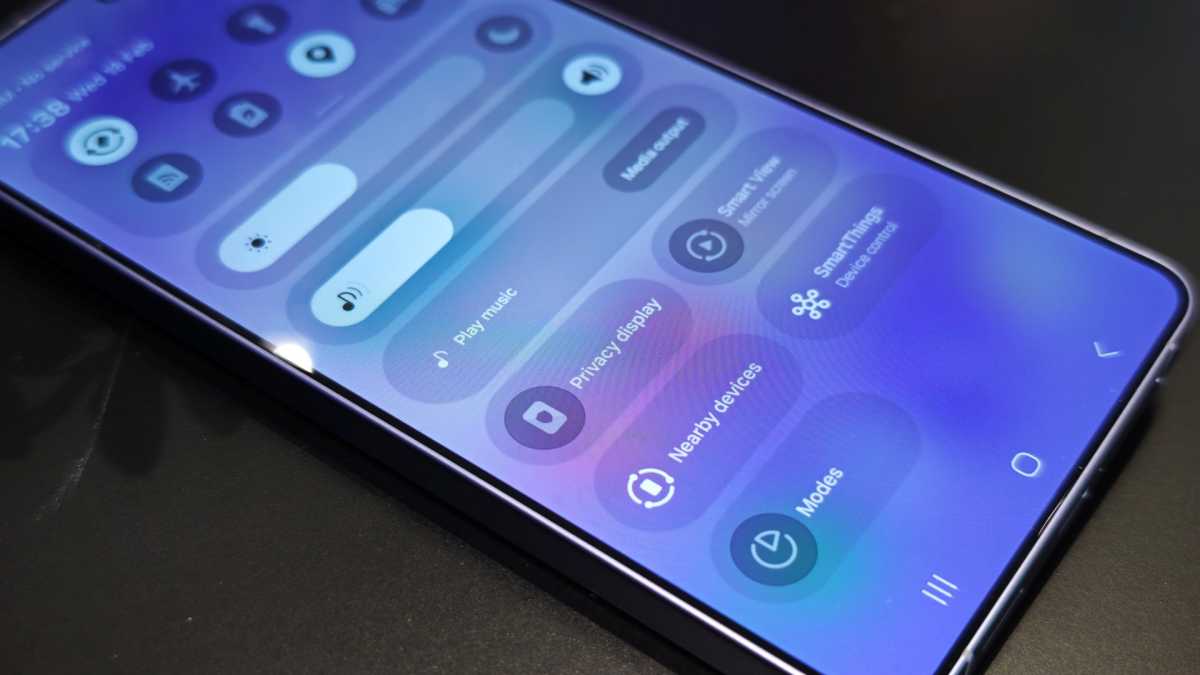
On the S26 Ultra, you’ll see a new Privacy Display option in the quick settings bar. When you switch this mode on, the phone essentially appears to be no different at all, but that’s because you are the phone’s primary user, so it’s still doing its job.
But as soon as you angle the phone to one side in imitation of someone next to you peeking at it, whatever is on the screen begins to disappear and eventually the screen is as black as if it’s simply switched off. Below is a gallery of photos showing how it changes as the angle gets more acute.
It works! And this technological leap feels as game-changing as when the Nokia Lumia 920 made wireless charging mainstream in 2012 (although it wasn’t the first) or when the Vivo X20 Plus UD introduced a fingerprint sensor built into the screen in 2018.
It’s somewhat ironic that phones have often been marketed with amazing viewing angles, while the opposite is true for the Galaxy S26 Ultra – the difference is that you get to decide when it’s on and off.
How the Privacy Display works and what it can do
As mentioned, the S26 Ultra’s Privacy Display works with a combination of software and hardware, so it can’t be retrospectively added to the S25 Ultra with firmware.
In simple terms, as described to me by Samsung, when you switch the feature on, the LEDs in the screen which are facing you stay on while “the pixels on the side will actually dim down.”
It means that when switched on, only the straight-on viewing angle can see the screen properly. You can also switch into ‘Maximum privacy protection’ mode to exacerbate the effect.
Also note that it works when viewing from the top and bottom, not just from the sides.
Chris Martin / Foundry
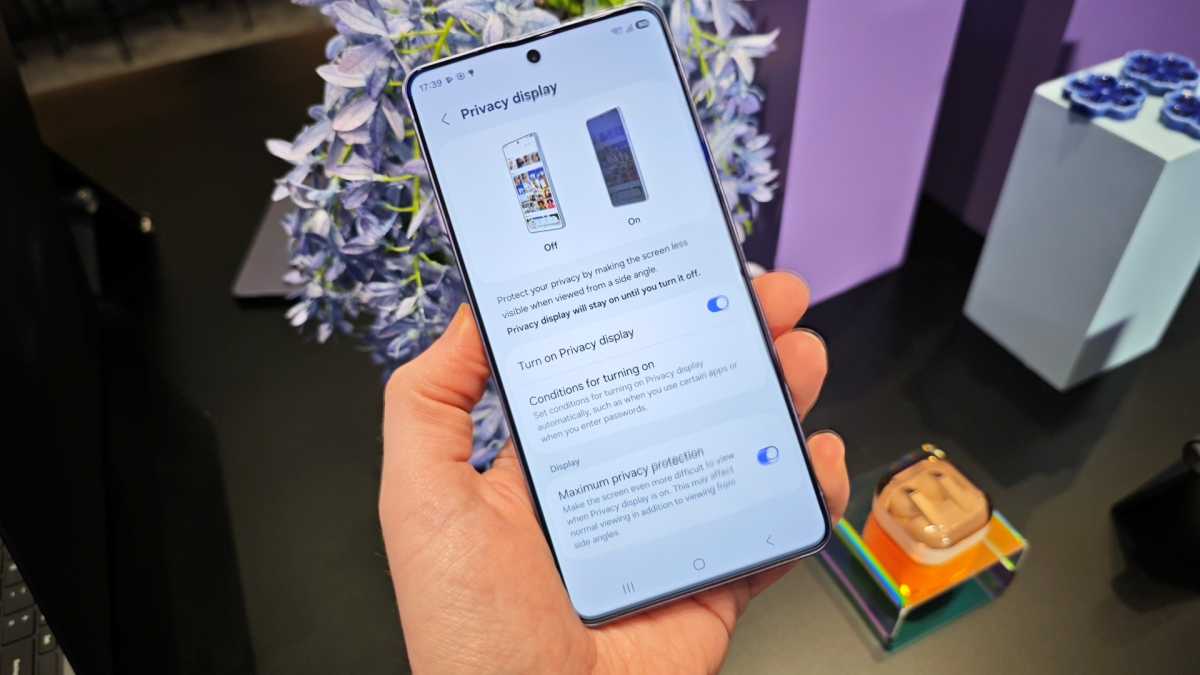
Because LEDs, or pixels, can be manipulated individually, this gives you the control to only block certain parts of the screen while the rest operates as normal. This includes entering your PIN as well as pop-up notifications (as seen at the top).
You can also select individual apps which trigger the privacy display, meaning that when you load up things like your banking app, or simply anything you don’t want other people seeing, you won’t have to remember to activate it.
Having seen it in the flesh, I can confirm that it’s seriously impressive. One of those pieces of tech that feels like magic.
Luke Baker
Sure, it’s not perfect, because when switched on, even viewing the screen directly results in a slightly worse experience – mainly a drop in brightness – but that’s understandable and also a reasonable trade-off.
It also won’t keep your screen blocked in all situations. For example, someone can be sitting behind you on a bus and still look over your shoulder and see the screen.
However, for many scenarios, like people sitting next to you in a crowded coffee shop or on the underground.
Still, downsides are minimal and not only did Samsung essentially confirm to me that it will be a staple of the Ultra model going forward, it could also appear in other devices as well – though not just Samsung’s own.
We think the S26 Ultra is the only sensible choice this year, but our hands-on review will help you decide. And if you’re deciding between the S26 Ultra and the Pixel 10 Pro XL, we have a comparison review of the two models that might help you to decide.
We also spoke to Samsung about the lack of Qi2 magnets and whether there will be a Galaxy S26 Edge later this year.