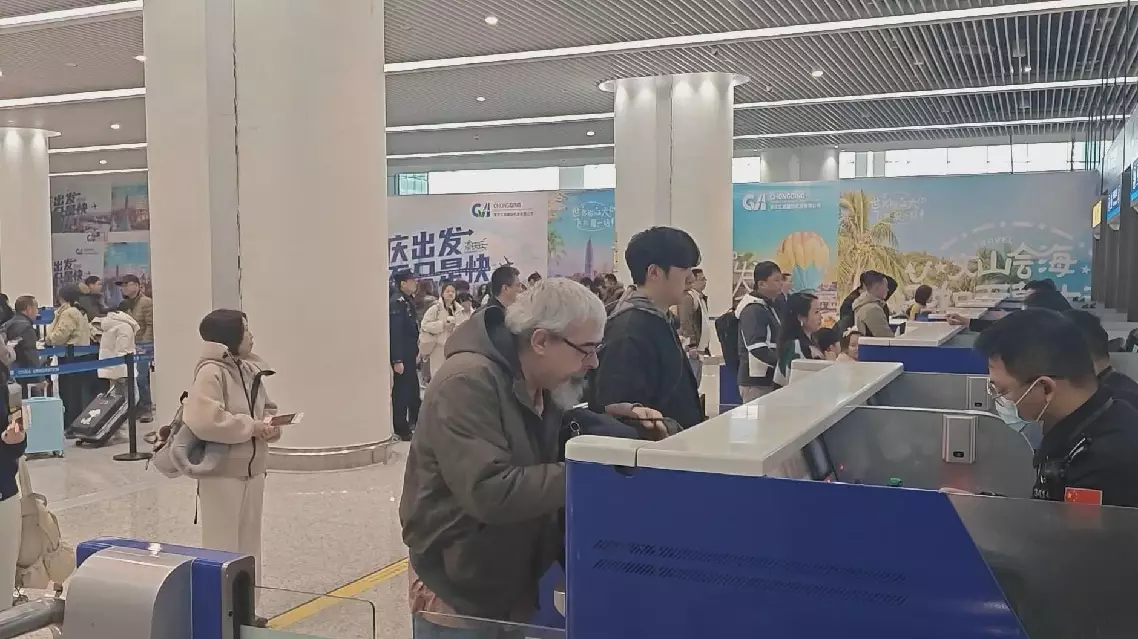
Chongqing Jiangbei International Airport has seen a surge in international passenger traffic as the Spring Festival holiday approaches, with foreign arrivals more than doubling year on year, according to local immigration authorities.
The Spring Festival, or Chinese New Year, falls on Feb. 17 this year. The official holiday runs for nine days from Feb. 15 to 23, while the broader Spring Festival travel rush lasts from Feb. 2 to March 13.
During the ongoing travel rush, the Chongqing port has processed over 112,000 inbound and outbound passengers and more than 800 flights, marking a nearly 50 percent increase compared with the same period last year.
Foreign nationals accounted for more than 20,000 entries and exits, more than doubled.
Projections indicate that during the peak holiday period from Feb. 15 to 23, the airport is expected to handle approximately 80,000 inbound and outbound passengers, averaging over 8,500 daily, with a single-day peak forecast to exceed 10,000 movements.
International travelers drawn to Chongqing cited the city’s vibrant atmosphere and festive charm as key attractions.
“I came to China to celebrate the New Year’s holiday and then I will stay here to study. I hope I will have a good time here,” said Linda Cirri, an international student from Italy.
“What we love about Chongqing is the vibrant vibe of the city, the lights everywhere, and it’s called the Cyber Punk City. And there are huge buildings everywhere. So we love it. And it’s really beautiful,” said Irem Bayer, a visitor form France.
“I celebrated Chinese New Year in China two years ago and found the experience to be very positive. The streets were abundant with goods, and the atmosphere was notably more vibrant, lively, and joyful,” said Andrea Colosio, a visitor from Italy.
The surge reflects growing international interest in experiencing China’s most important traditional festival firsthand, as well as Chongqing’s rising appeal as a global tourist destination.
China’s Chongqing embraces surge in int’l arrivals for Spring Festival holiday
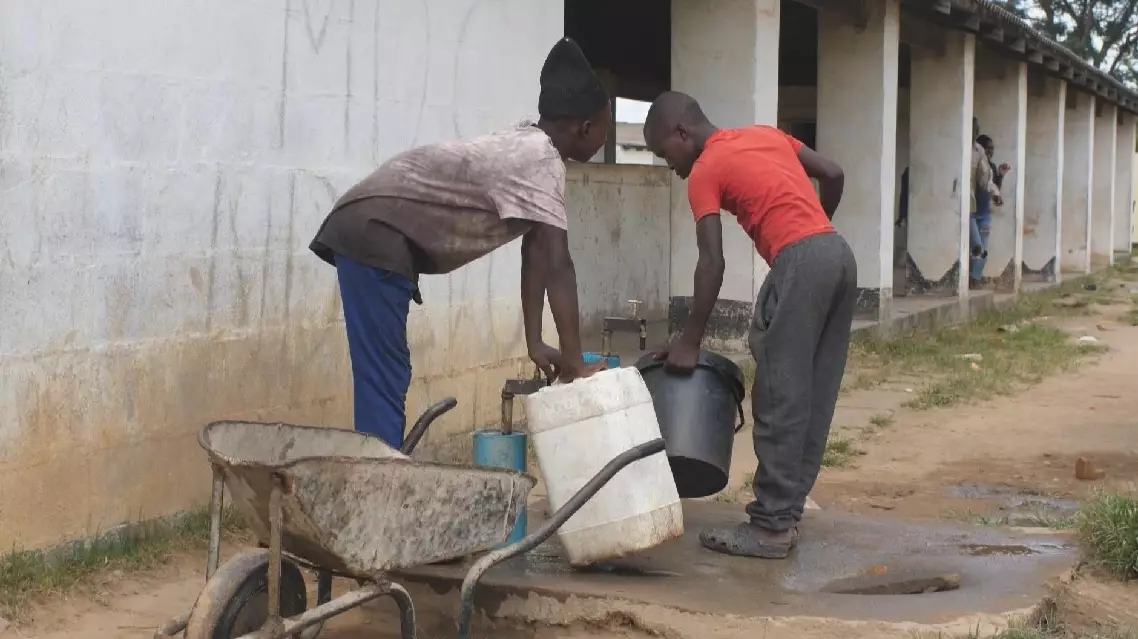
A solar-powered borehole drilling program supported by China has expanded water access across Zimbabwe’s rural and peri-urban communities, strengthening disaster recovery and sustaining livelihoods since Cyclone Idai struck in 2019.
Tropical Cyclone Idai entered Zimbabwe from neighboring Mozambique, triggering floods and causing tragic losses of life and property.
Launched under a Chinese government initiative to restore water and sanitation services after cyclones and drought, the program has delivered lasting benefits.
At Mahusekwa Growth Point, where boreholes were drilled last year, reliable water now sustains dozens of small businesses and households, underscoring how the intervention continues to shape community resilience seven years on.
“We now have clean water to wash our products and for customers to wash their hands before they eat. We also fetch water to use at our homes because there is an intermittent supply,” said Cynthia Garan’nga, a market vendor.
Reliable water access has also created employment opportunities, especially for young entrepreneurs such as car wash owner Loveness Marabwanya.
“Maybe I was going to get people to fetch water for me from the river, but it’s very far and I was going to pay more for that. To imagine that the water is just like a few meters away, it’s very easy and convenient for me,” she said.
The borehole is solar powered, which means the community can access water at any hour of the day, and that refers to greater reliability and sustainability. There are no longer any limitations of fuel costs or power cuts.
Mahusekwa is one of more than 300 communities nationwide benefiting from boreholes drilled under Chinese disaster assistance. Around 60 of them are in Mashonaland East, where water shortages had long slowed development and undermined food security.
“These boreholes came at the right time. Remember the last two or three years we have been having droughts,” said Jeremiah Gwanzura, chairperson of Marondera Rural District Council.
Gwanzura says the availability of water is sustaining livelihoods and boosting production, even during prolonged dry spells.
“We have livelihoods in terms of livestock cattle, people are doing boilers behind the scenes, road runners, goats, piggery projects within the rural set-up, and if there is the missing link of water, it means we are going nowhere. Some of the areas in the rural areas are using it for nutritional gardens, going to the market, so they will be watering their vegetables, they will be watering their plants,” he said.
At a national level, authorities say the boreholes reflect a shift from emergency response to long-term resilience.
“In any disaster recovery programme, what we always talk about is building-back better. And I’m sure this principle of building-back better, you can actually see it in the way that we are establishing these boreholes in Chimanimani, Masvingo, Midlands and Mashonaland East,” said Nathan Nkomo, chief director of the Civil Protection Department.
Beyond water access, China has also supported food security through agricultural training, helping communities rebuild stronger and more sustainably in the years since Cyclone Idai.
China-supported borehole program expands water access, strengthens Zimbabwe’s disaster recovery