EV Solar Modules Market Summary
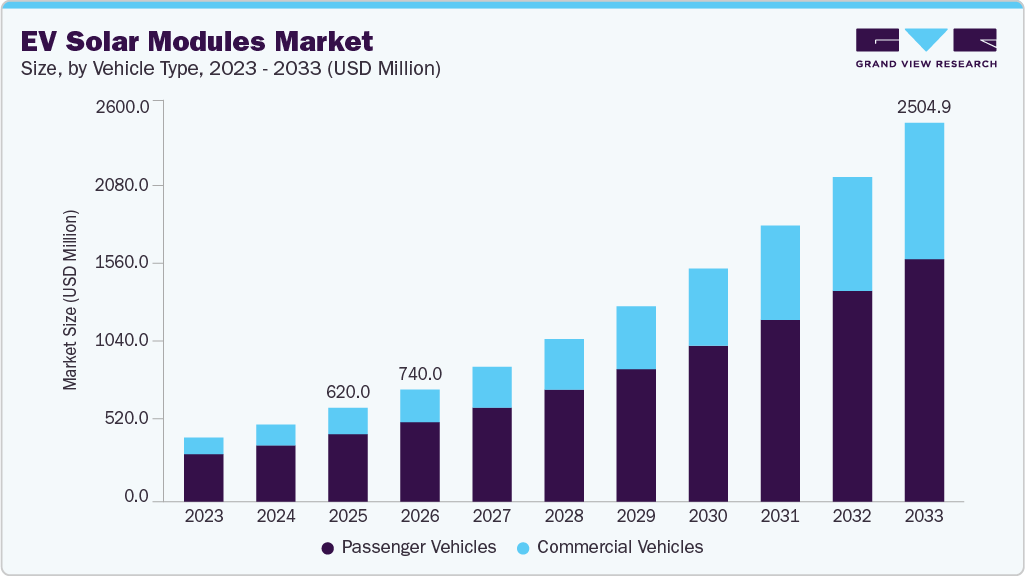
The global EV solar modules market size was estimated at USD 620.0 million in 2025 and is projected to reach USD 2,504.9 million by 2033, growing at a robust CAGR of 19% over the forecast period from 2026 to 2033. Market growth is primarily driven by the accelerating transition toward sustainable mobility, rising adoption of electric vehicles, and increasing emphasis on integrating renewable energy solutions within transportation ecosystems.
Key Market Trends & Insights
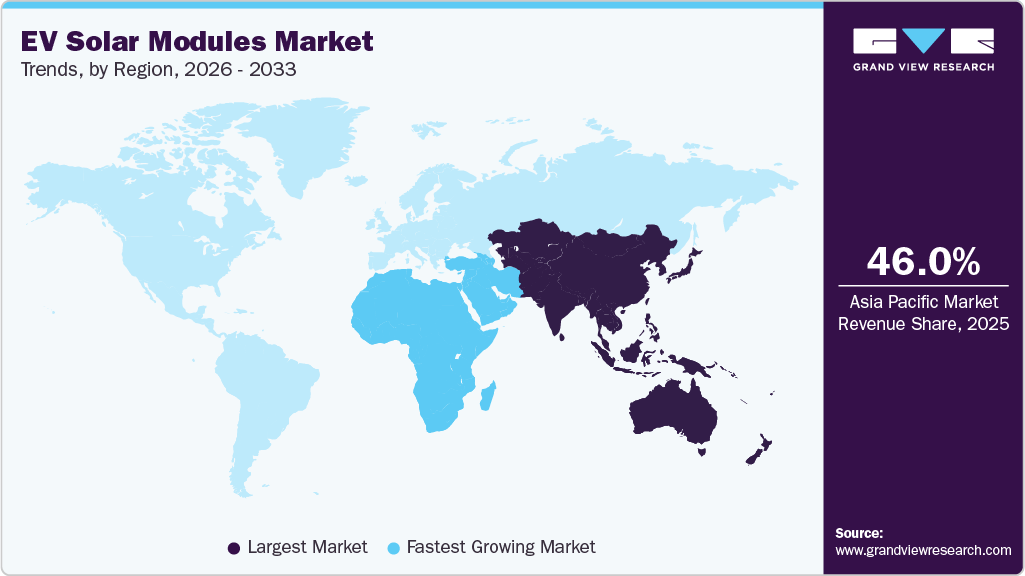
- Asia Pacific EV solar modules market held the largest share of 46.0% of the global market in 2025.
- The EV solar modules market in the China is expected to grow significantly over the forecast period.
- By vehicle type, the Passenger Vehicles segment held the highest market share of 72% in 2025.
- Based on the application, the Vehicle-Integrated Photovoltaic (VIPV) Modules segment held the highest market share in 2025.
Market Size & Forecast
- 2025 Market Size: USD 620.0 Million
- 2033 Projected Market Size: USD 2,504.9 Million
- CAGR (2026-2033): 19%
- Asia Pacific: Largest market in 2025
- Middle East and Africa: Fastest growing market
Automakers and technology providers are actively exploring solar-integrated vehicle technologies to extend driving range, improve energy efficiency, and reduce dependence on grid-based charging infrastructure. In addition, growing concerns related to carbon emissions, fuel dependency, and urban air quality are encouraging governments to promote clean transportation through incentives, subsidies, and supportive regulatory frameworks. Solar modules integrated into passenger and commercial vehicles help power auxiliary systems such as ventilation, infotainment, and battery trickle charging, thereby enhancing vehicle performance while lowering overall energy consumption. The expansion of EV charging infrastructure powered by solar energy is further supporting market growth by enabling decentralized and low-emission charging solutions.
Technological advancements in lightweight photovoltaic materials, flexible solar panels, higher conversion efficiencies, and improved durability are making vehicle-integrated photovoltaic (VIPV) modules increasingly viable for mass-market adoption. Automakers are also investing in design innovations to seamlessly incorporate solar panels into vehicle roofs, hoods, and body surfaces without compromising aerodynamics or aesthetics.
The market is also benefiting from rising investments in smart mobility, increasing consumer awareness of energy-efficient vehicles, and the growing alignment between the automotive and renewable energy sectors. Strategic collaborations between automotive manufacturers, solar technology companies, and energy providers are accelerating product development and commercialization. As battery technologies evolve and the cost of photovoltaic components continues to decline, EV solar modules are expected to play a progressively important role in enhancing vehicle sustainability and supporting the broader electrification of transport.
Drivers, Opportunities & Restraints
The global EV solar modules market is primarily driven by the rapid adoption of electric vehicles and the growing need to enhance vehicle energy efficiency through renewable integration. Automakers are increasingly incorporating solar modules into vehicle designs to extend battery range, support auxiliary functions, and reduce reliance on conventional charging infrastructure. Rising environmental concerns, stricter emission regulations, and government incentives promoting zero-emission mobility are further accelerating the adoption of vehicle-integrated photovoltaic (VIPV) technologies. In addition, the expansion of solar-powered EV charging stations is strengthening the business case for combining clean energy generation with electric transportation.
Opportunities are expanding with continuous advancements in photovoltaic technology, including lightweight materials, flexible panels, higher conversion efficiencies, and improved durability suitable for automotive applications. The emergence of smart mobility ecosystems and energy-autonomous vehicles is creating new avenues for innovation, particularly as automakers collaborate with solar technology providers to commercialize integrated solutions. Growing investments in commercial EV fleets, delivery vehicles, and buses also present strong potential, as operators seek to lower operating costs and enhance sustainability credentials. Furthermore, declining solar component costs, supportive policy frameworks, and increasing consumer preference for energy-efficient vehicles are expected to unlock additional growth across both developed and emerging markets.
However, the market faces restraints such as the relatively high upfront cost of integrating solar modules into vehicles and the limited surface area available for solar energy generation, which can restrict overall power output. Efficiency challenges under varying weather conditions, including reduced performance in low sunlight regions, may also impact adoption rates. In addition, design complexities, durability requirements, and the need to balance vehicle weight and aerodynamics can increase manufacturing challenges. Uncertainty regarding return on investment for end users, along with slower standardization of VIPV technologies, may further moderate the pace of widespread commercialization over the forecast period.
Vehicle Type Insights
The Passenger Vehicles segment held the largest revenue share of approximately 72.0% in 2025 in the global EV solar modules market. This dominance is primarily attributed to the rapidly increasing adoption of electric passenger cars worldwide, supported by favorable government incentives, rising environmental awareness, and strong consumer demand for sustainable mobility solutions. Automakers are progressively integrating solar modules into vehicle roofs and body panels to enhance driving range, support auxiliary functions such as ventilation and battery maintenance, and improve overall energy efficiency. In addition, growing innovation in vehicle-integrated photovoltaic (VIPV) technologies, combined with advancements in lightweight and high-efficiency solar cells, is making solar-enabled passenger vehicles more commercially viable. The expansion of smart mobility ecosystems and increasing consumer preference for technologically advanced, energy-efficient vehicles further reinforce the segment’s leadership in the global market.
The Commercial Vehicles segment is expected to register the fastest CAGR of approximately 22.7% over the forecast period, driven by the rising electrification of logistics fleets, public transportation, and last-mile delivery vehicles. Fleet operators are increasingly adopting solar modules to reduce operating costs, extend battery life, and support onboard systems such as refrigeration, telematics, and climate control without placing additional load on the main battery. Moreover, companies are prioritizing sustainability targets and carbon reduction strategies, encouraging the deployment of solar-assisted commercial EVs to enhance energy autonomy and minimize charging frequency. Technological improvements in durable solar panels designed for larger vehicle surfaces, along with growing investments in green logistics and government initiatives promoting zero-emission commercial transport, are expected to accelerate adoption and position this segment as the fastest-growing vehicle type in the EV solar modules market.
Application Insights
The Vehicle-Integrated Photovoltaic (VIPV) Modules segment held the largest revenue share of approximately 68.0% in 2025 in the global EV solar modules market. This leadership is primarily driven by the growing integration of solar technology directly into vehicle structures, including roofs, hoods, and body panels, to enhance energy efficiency and extend driving range. Automakers are increasingly leveraging VIPV systems to power auxiliary functions such as ventilation, lighting, and battery trickle charging, thereby reducing dependency on grid-based charging and improving overall vehicle sustainability. Continuous advancements in flexible solar panels, lightweight materials, and higher conversion efficiencies are further supporting large-scale adoption. At the same time, rising consumer preference for energy-optimized vehicles strengthens demand across both premium and mid-range EV categories.

The Solar Modules for EV Charging Infrastructure segment is expected to register the fastest CAGR of approximately 24.0% over the forecast period, fueled by the rapid expansion of EV charging networks and the global push toward renewable-powered transportation ecosystems. Solar-powered charging stations enable decentralized energy generation, reduce operational electricity costs, and help mitigate grid pressure during peak demand periods. Governments, utilities, and private operators are increasingly investing in solar-assisted charging hubs to align with decarbonization goals and strengthen clean energy integration within mobility infrastructure. Furthermore, advancements in energy storage systems, smart charging technologies, and microgrid solutions are expected to accelerate deployment, positioning this segment as the fastest-growing application in the EV solar modules market.
Regional Insights
Asia Pacific accounted for approximately 46.0% of the global EV solar modules market revenue in 2025, making it the largest regional market. This dominance is primarily driven by the rapid expansion of electric vehicle adoption, strong solar manufacturing capabilities, and supportive government policies promoting clean mobility across major economies such as China, India, Japan, and South Korea. The region benefits from a well-established EV supply chain, declining photovoltaic component costs, and large-scale investments in renewable energy infrastructure, all of which are accelerating the integration of solar technologies into vehicles and charging ecosystems.
Asia Pacific is also positioned for sustained growth due to rising urbanization, increasing fuel costs, and ambitious carbon neutrality targets set by regional governments. Automakers are actively investing in vehicle-integrated photovoltaic (VIPV) technologies, while public and private sectors continue expanding solar-powered charging infrastructure. The presence of leading battery manufacturers and solar panel producers further strengthens the regional ecosystem, ensuring long-term market expansion.
China EV Solar Modules Market Trends
China remains a major contributor to the Asia Pacific EV solar modules market, supported by its leadership in both electric vehicle production and solar panel manufacturing. Strong government incentives, aggressive EV adoption targets, and large-scale renewable energy deployment are encouraging automakers to integrate solar solutions into next-generation vehicles. In addition, the country’s focus on technological innovation, domestic manufacturing, and cost optimization is accelerating the commercialization of VIPV systems.
Growing investments in smart transportation networks and solar-powered charging stations are further reinforcing market growth. As China continues to prioritize energy security and emission reduction, the integration of solar modules within mobility infrastructure is expected to gain significant momentum, positioning the country as a key growth engine for the global market.
North America EV Solar Modules Market Trends
North America represents a technologically advanced market for EV solar modules, supported by rising consumer awareness, strong adoption of electric vehicles, and increasing investments in renewable-powered transportation infrastructure. Automakers and energy companies across the region are exploring solar integration to enhance vehicle efficiency and reduce lifecycle emissions. Favorable regulatory frameworks, tax incentives, and sustainability commitments from corporations are further contributing to market development.
The region is also witnessing growth in solar-assisted EV charging networks, particularly in urban and commercial fleet applications. Continuous innovation in photovoltaic efficiency and energy storage technologies is expected to support steady adoption, making North America a strategically important market over the forecast periods.
Europe EV Solar Modules Market Trends
Europe represents a steadily expanding market, driven by stringent emission regulations, ambitious climate goals, and strong government support for zero-emission mobility. Countries across the region are prioritizing renewable energy integration within transportation, encouraging automakers to adopt solar-enabled vehicle technologies. Increasing consumer preference for sustainable vehicles and the rapid electrification of public transport fleets are further boosting demand.
In addition, investments in smart cities, green infrastructure, and solar-powered charging corridors are strengthening the regional ecosystem. Collaboration between automotive manufacturers and clean energy providers is expected to accelerate innovation, positioning Europe as a key contributor to global EV solar module adoption.
Latin America EV Solar Modules Market Trends
The Latin American EV solar modules market is witnessing gradual growth, supported by improving renewable energy deployment and rising interest in electric mobility. Countries such as Brazil, Mexico, and Chile are investing in solar infrastructure while exploring pathways to reduce transportation emissions. Falling solar technology costs and increasing awareness of long-term fuel savings are encouraging adoption across both passenger and commercial vehicle segments.
Although the market is still in an emerging phase, expanding charging infrastructure and supportive policy developments are expected to create new opportunities. Partnerships between governments and private stakeholders to promote sustainable transportation are likely to support consistent regional growth.
Middle East & Africa EV Solar Modules Market Trends
The Middle East & Africa region is expected to register the fastest CAGR of approximately 21.6% over the forecast period, driven by abundant solar resources, growing investments in renewable energy, and increasing efforts to diversify economies away from fossil fuels. Governments across the region are actively promoting electric mobility and solar deployment through national sustainability strategies, creating a favorable environment for EV solar module adoption.
The rising development of smart cities, large-scale solar projects, and clean transportation initiatives is accelerating the establishment of solar-powered charging infrastructure. In addition, improving regulatory support, foreign investments, and technological partnerships are expected to enhance market penetration, positioning the Middle East & Africa as the fastest-growing regional market in the coming years.
Key EV Solar Modules Company Insights
Some of the key players operating in the global EV solar modules market include JinkoSolar, Trina Solar, LONGi Green Energy Technology, JA Solar Technology, Canadian Solar, First Solar, Hanwha Qcells, Waaree Energies, Adani Solar, and Vikram Solar, among others. These companies are actively involved in the research, development, and manufacturing of advanced photovoltaic modules that support electric vehicle integration and renewable-powered charging infrastructure. Their product portfolios increasingly focus on high-efficiency solar cells, lightweight modules, and durable panel designs suitable for vehicle-integrated photovoltaic (VIPV) applications.
Their strategic priorities include improving module efficiency, reducing production costs, and advancing flexible and lightweight solar technologies to enable seamless integration into passenger and commercial electric vehicles. Companies are also investing in next-generation cell architecture such as TOPCon and heterojunction (HJT), automation in manufacturing, and scalable production capabilities to meet rising global demand. In addition, partnerships between solar manufacturers, automotive OEMs, and energy providers are accelerating innovation in solar-assisted mobility solutions, enhancing vehicle energy autonomy, supporting decarbonization goals, and strengthening the long-term growth trajectory of the EV solar modules market.
Key EV Solar Modules Companies:
The following key companies have been profiled for this study on the EV solar modules market.
- Adani Solar
- Canadian Solar
- First Solar
- Hanwha Qcells
- JA Solar Technology
- JinkoSolar
- LONGi Green Energy Technology
- Trina Solar
- Vikram Solar
- Waaree Energies
Recent Developments
-
In November 2025, JinkoSolar achieved a world-record efficiency of 27.79% for its n-type TOPCon solar cell, as verified by Germany’s Institute for Solar Energy Research Hamelin (ISFH). This advancement underscores JinkoSolar’s commitment to enhancing solar cell performance, which is pivotal for applications such as vehicle-integrated photovoltaics (VIPV).
-
In August 2025, Trina Solar unveiled its Vertex N 2000V and Vertex N Shield modules at the RE+ (Renewable Energy Conference and Expo) 2025 event in Las Vegas. These high-efficiency modules are designed to meet the rigorous demands of modern energy applications, including EV solar charging infrastructure.
EV Solar Modules Market Report Scope
|
Report Attribute
|
Details
|
|
Market Definition
|
The EV solar modules market refers to the global revenue generated from the manufacturing, supply, and integration of photovoltaic modules for electric vehicles and solar-powered EV charging infrastructure.
|
|
Market size value in 2026
|
USD 740.3 million
|
|
Revenue forecast in 2033
|
USD 2,504.9 million
|
|
Growth rate
|
CAGR of 19% from 2026 to 2033
|
|
Base year for estimation
|
2025
|
|
Historical data
|
2021 – 2024
|
|
Forecast period
|
2026 – 2033
|
|
Quantitative units
|
Revenue in USD million/billion, and CAGR from 2026 to 2033
|
|
Report coverage
|
Revenue forecast, competitive landscape, growth factors, and trends
|
|
Segments covered
|
Vehicle type, application, and region
|
|
Regional scope
|
North America; Europe; Asia Pacific; Latin America; Middle East & Africa
|
|
Country scope
|
U.S.; Canada; Mexico; Germany; UK; France; China; India; Japan; South Korea; Brazil; Saudi Arabia; UAE
|
|
Key companies profiled
|
JinkoSolar; Trina Solar; LONGi Green Energy Technology; JA Solar Technology; Canadian Solar; First Solar; Hanwha Qcells; Waaree Energies; Adani Solar; Vikram Solar
|
|
Customization scope
|
Free report customization (equivalent up to 8 analysts working days) with purchase. Addition or alteration to country, regional & segment scope.
|
|
Pricing and purchase options
|
Avail customized purchase options to meet your exact research needs. Explore purchase options
|
Global EV Solar Modules Market Report Segmentation
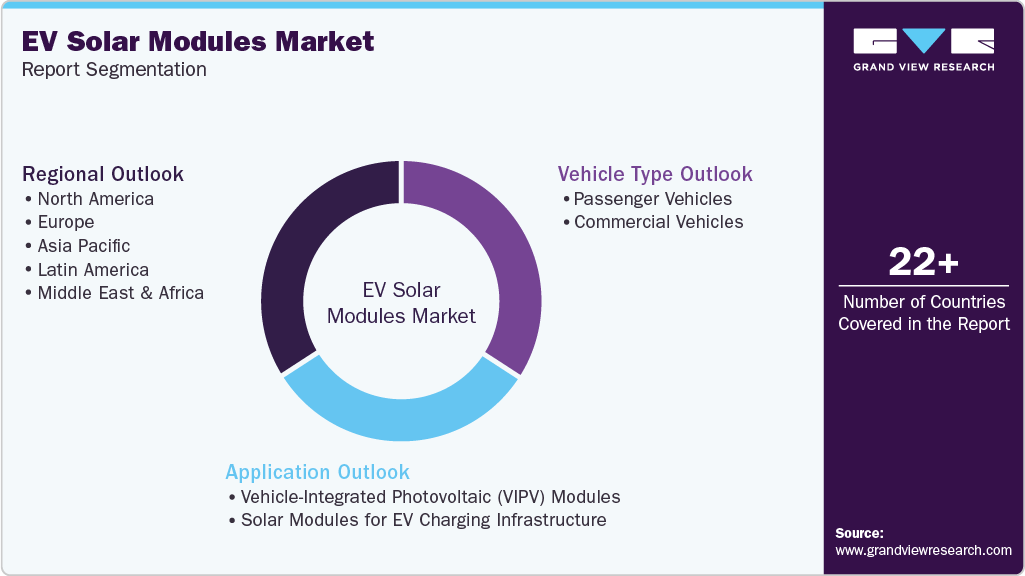
This report forecasts revenue growth at global, regional, and country levels and provides an analysis of the latest industry trends in each of the sub-segments from 2021 to 2033. For the purpose of this study, Grand View Research has segmented the global EV solar modules market report on the basis of vehicle type, application and region:
-
Vehicle Type Outlook (Revenue, USD Million, 2021 – 2033)
-
Passenger Vehicles
-
Commercial Vehicles
-
-
Application Outlook (Revenue, USD Million, 2021 – 2033)
-
Regional Outlook (Revenue, USD Million, 2021 – 2033)
-
North America
-
Europe
-
Asia Pacific
-
China
-
India
-
Japan
-
South Korea
-
-
Latin America
-
Middle East & Africa
-
Frequently Asked Questions About This Report
b. The global EV solar modules market size was estimated at USD 620 million in 2025 and is expected to reach USD 740.3 million in 2026.
b. The global EV solar modules market is expected to grow at a compound annual growth rate of 19% from 2026 to 2033 to reach USD 2504.9 million by 2033.
b. Based on the vehicle type segment, passenger vehicles held the largest revenue share of 72% in 2025.
b. Some of the key players operating in the global EV solar modules market include JinkoSolar, Trina Solar, LONGi Green Energy Technology, JA Solar Technology, Canadian Solar, First Solar, Hanwha Qcells, Waaree Energies, Adani Solar, and Vikram Solar, among others.
b. The key factors driving the EV solar modules market include the rising adoption of electric vehicles, growing emphasis on renewable-powered transportation, supportive government incentives for clean mobility, advancements in photovoltaic efficiency, and increasing investments in solar-powered EV charging infrastructure to reduce carbon emissions and enhance energy independence.