Wall Street’s foremost financial institutional has transformed from Wall Street’s bedrock to a stock market liability.
From a purely statistical standpoint, Wall Street loves President Donald Trump. While getting from Point A to B was a roller-coaster ride, the widely followed Dow Jones Industrial Average (^DJI +2.47%), broad-based S&P 500 (^GSPC +1.97%), and growth stock-dependent Nasdaq Composite (^IXIC +2.18%) soared 57%, 70%, and 142%, respectively, during Trump’s first, non-consecutive term in the Oval Office.
Since his inauguration on Jan. 20, 2025, the Trump bull market has taken shape, yet again. The Dow, S&P 500, and Nasdaq Composite have climbed by 13%, 15%, and 18%, respectively, through the close of trading on Feb. 3, 2026.
While several catalysts are fueling this bull market rally, some of which can be directly attributed to Donald Trump’s policies, there’s also an unlikely headwind that threatens to completely halt this seemingly unwavering optimism in its tracks: the Federal Reserve.
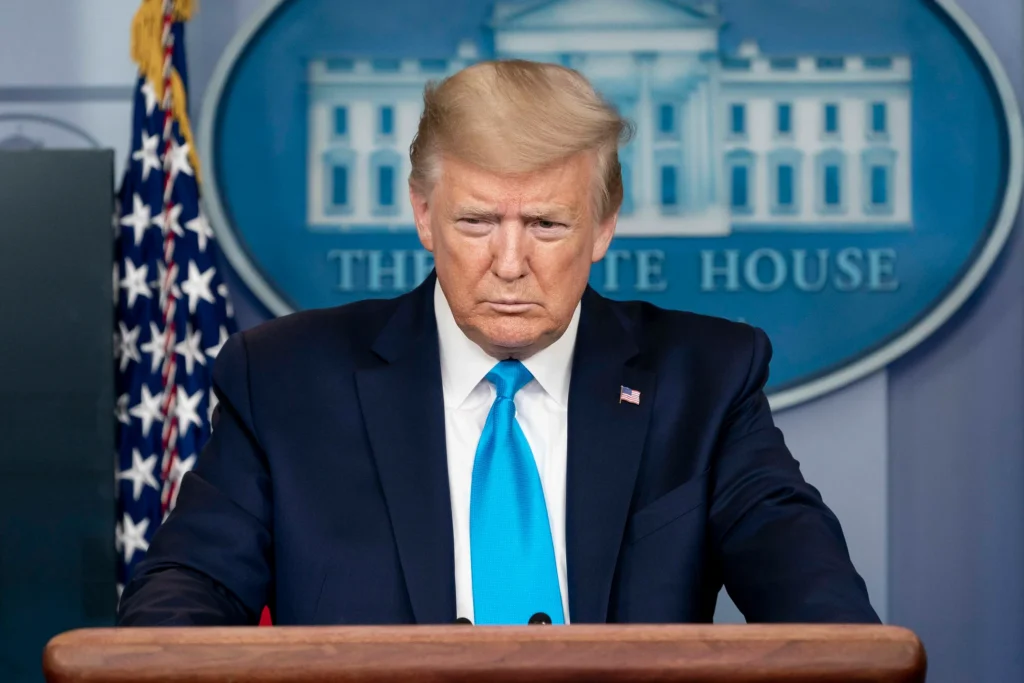
President Trump delivering remarks. Image source: Official White House Photo by Shealah Craighead, courtesy of the National Archives.
Stocks are flourishing with Donald Trump in the White House
Before diving into what’s been working, some objectivity is needed. Based on data compiled by Carson Investment Research, 26 of the last 33 presidential terms, including the present term for Trump, have yielded a positive aggregate return for the Dow Jones Industrial Average or S&P 500. A president overseeing gains in the stock market is perfectly normal.
Out of the 33 terms analyzed since March 1897, Carson Investment Group found Trump’s first term yielded the eighth-best cumulative return. Spanning 129 years, Trump’s initial foray in the Oval Office ranked in the top quartile among presidents.
One reason for this persistent optimism has been Trump’s flagship tax and spending laws. In particular, the Tax Cuts and Jobs Act (TCJA), signed into law in December 2017, permanently reduced the peak marginal corporate income tax rate from 35% to 21% (the lowest level since 1939).
Although the purpose of lowering taxes for businesses is to encourage hiring, acquisitions, and innovation, perhaps the most visible effect of the TCJA has been a significant increase in share buybacks. Share repurchases for S&P 500 companies are estimated to have topped $1 trillion in 2025, representing an all-time high. For time-tested companies with steady or growing net income, buybacks can help boost earnings per share, making their stock more fundamentally attractive.
Additionally, investors have been supportive of Donald Trump’s “America First” agenda. Despite the president’s tariff and trade policy being the source of stock market turbulence at times, his approach to trade has netted some domestic businesses significant investments.
Other bull market catalysts not directly attributable to President Trump include the hype surrounding next-big-thing trends, such as blockchain technology during his first term, as well as artificial intelligence and quantum computing during his current term, and better-than-expected corporate earnings.
Collectively, these catalysts have lifted the Dow, S&P 500, and Nasdaq Composite to record-closing highs. However, the Trump bull market may be on shakier ground than investors realize.

Jerome Powell’s term as Fed chair ends on May 15, 2026. Image source: Official Federal Reserve Photo.
Historic division at America’s foremost financial institution can upend the Trump bull market
Typically, the Federal Reserve is the bedrock of Wall Street. It’s the financial institution responsible for overseeing the nation’s monetary policy, with the goals of maximizing employment and stabilizing prices. The Fed chair and the Board of Governors of the Federal Reserve are knowledgeable people who aim to calm, not stir, the U.S. economy and equity markets.
Unfortunately, the current dynamic of the central bank is anything but calming.
The Federal Open Market Committee (FOMC) is a 12-member body, including current Fed Chair Jerome Powell, responsible for setting monetary policy. It does this by adjusting the federal funds target rate (the overnight lending rate between financial institutions) and through open market operations, such as overseeing the sale or purchase of U.S. Treasury bonds.
Although the FOMC sometimes lags in implementing monetary policy changes, investors often take solace in the fact that its members share a common goal and a unified vision of how to get there. This isn’t the case at the moment.
In each of the last five FOMC meetings, there have been dissenting opinions by at least one member. What’s more, in the October and December meetings, there were dissents in opposite directions. While a 25-basis-point reduction in the federal funds rate was the FOMC’s consensus in both meetings, at least one member favored no rate reduction, while another pushed for a more aggressive 50-basis-point cut.
Anna is correct below when she says:
“I have not seen a meeting with so much contradictions.”
—
This meeting was a mess.See the labels in the dot plot below.
One member of the FOMC thinks the Fed is going to HIKE rates this year. One (Stephen Miran) thinks it is going to cut… https://t.co/TRUQmD5I2E pic.twitter.com/qPlJGL57ln
— Jim Bianco (@biancoresearch) September 17, 2025
Since the beginning of 1990, there have only been three FOMC meetings with dissents in opposite directions. Two of these three meetings have occurred since late October. These dissents threaten to undermine the trust that investors almost implicitly place in the nation’s central bank.
To add fuel to the fire, Jerome Powell’s term as Fed chair comes to an end on May 15, 2026. On Jan. 30, President Trump nominated former Fed Governor Kevin Warsh to take Powell’s place.
Putting aside the uncertainties of whether Warsh has the votes in the Senate Banking Committee and/or U.S. Senate to be confirmed, there are questions about Warsh’s previously stated desire to deleverage the Fed’s $6.6 trillion balance sheet. If the Fed were to sell Treasury bonds and become a more passive market participant, the sale of these bonds could drive up long-term yields and make mortgages costlier.
The icing on the cake is that these unlikely headwinds from America’s foremost financial institution come at a time when the stock market is historically pricey. According to the S&P 500’s Shiller Price-to-Earnings Ratio, this is the second-priciest market in history, when back-tested to January 1871. In other words, there was little margin for error before the Federal Reserve transformed into a stock market liability.
Historic division at the FOMC could very easily upend the Trump bull market.