
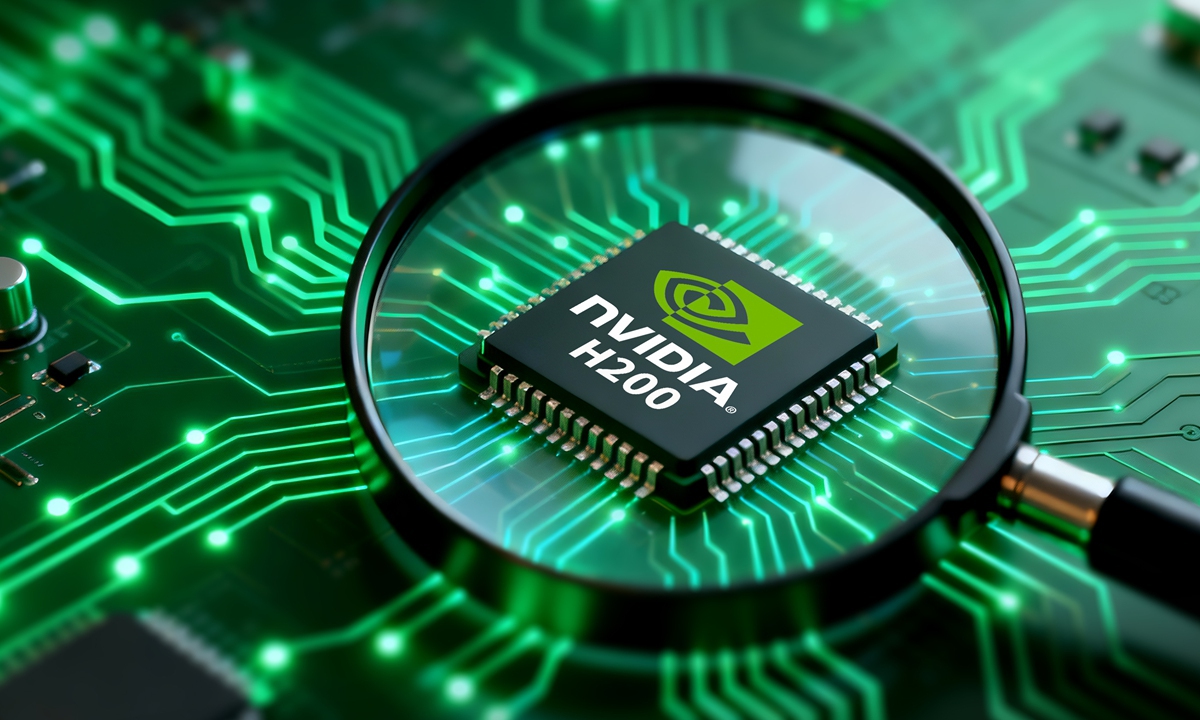
Nvidia H200 chip Photo: VCG
Against the backdrop of a complex global landscape intertwined with technological competition and cooperation, news from across the Pacific carries significant weight. On Tuesday local time, the US government officially approved conditional sales of Nvidia’s H200 AI chips to China. While strict restrictions were imposed on security reviews and sales volume, this is still seen as a subtle signal of interaction between the US and China in the technology sector. Some analysts believe that Washington is seeking a strategic balance between “containing China’s AI capabilities” and “avoiding forcing China to make technological leaps.” This policy adjustment, after weighing the pros and cons, is a vivid reflection of the achievements of China’s technological self-reliance.
The conditional sales of Nvidia’s H200 chip are by no means a sudden act of “goodwill” from the US. This decision was the result of meticulous calculation: the H200 chips allowed for export to China lag behind its most advanced Blackwell architecture products in performance, aiming to maintain a technological gap of at least one generation. Simultaneously, the policy comes with complex third-party testing and end-use verification. Washington’s goal is clear: to generate commercial profits through sales to China, ensuring American companies maintain a sustained market share in China, while to slow down China’s progress in developing advanced chip manufacturing processes through the restricted supply of “suboptimal” technology, thus maintaining the US’ long-term dominant position in related industries.
As of press time, the Chinese side had not yet issued an official response to the US policy. It should be noted that the policy governing exports of Nvidia’s H200 chips to China remains discriminatory. Approval authority for H200 exports is entirely in US hands, with restrictions imposed on both the quantity exported to China and the supply chain. The US government is also reportedly preparing to skim 25 percent of sales revenue from the transaction. Most crucially, this stringent export regime is not applied to other US trading partners but is targeted specifically at China.
In other words, Washington’s practice of “weaponizing” and “politicizing” its technological advantages has not fundamentally changed.
At the same time, we also noted that the US had previously banned exports of even lower-computing-power chips to China. The US’ conditional easing this time is indeed a significant adjustment. It reflects both sides’ efforts to manage differences and maintain economic and trade ties amid intense competition. It also shows that even in areas Washington regards as “strategic high ground,” or even “must-win” domains such as computing power and AI, a complete decoupling that runs counter to economic laws is ultimately unworkable. The deep interweaving of industrial and supply chains vividly demonstrates that cooperation is the greatest form of security.
Facts have repeatedly proven that artificially setting up technological barriers ultimately backfires, undermining one’s own innovation ecosystem and sapping the vitality of domestic firms in a closed environment. Past US attempts to cut off chip supplies to China did not stifle China’s high-tech development; instead, they spurred intensive breakthroughs under a new nationwide system of innovation. From iterations of Huawei’s Ascend chips, to breakthroughs in domestic GPUs for specific applications, to efforts across the entire industrial chain to fill gaps and strengthen links, China has demonstrated strong R&D potential and clear pathways for technological iteration. The easing of H200 export restrictions amounts to an implicit acknowledgment by the US that “blocking” and “sealing off” are no longer sufficient to halt China’s technological rise.
This contest surrounding the H200 chips confirms that independent innovation is the only correct path to breaking blockades and securing strategic initiative. Recently, DeepSeek and Chinese university researchers published new technical papers proposing a new AI model training technique to bypass GPU limits, potentially opening a more autonomous and sustainable new path for AI development.
Today, with the sustained technological progress coming to fruition, China is no longer content to trail behind on others’ tracks; it is committed to opening new technological routes and building new industrial ecosystems. The rise of Chinese technology is not solely about China’s own breakthroughs, but also about breaking monopolies, offering diversified development paths to the world, and helping more Global South countries bridge the digital divide and share in the fruits of scientific and technological advancement.
China’s technological development is moving toward independent innovation. As for the noise and speculation from Washington hawks seeking to block chip exports to China, there is little need to pay heed. In the dialectic between “cooperation” and “self-reliance,” China has already found a clear path to the future. Whether the outside world chooses to “restrict” or “allow,” it cannot alter the historical course of China’s technological self-reliance and contribution to the world. This is the confidence and vision befitting a major power in science and technology.









![The US Commerce Department on Tuesday opened the door for Nvidia to sell advanced artificial intelligence chips in China with restrictions [File]](https://charm-retirement.com/wp-content/uploads/2026/01/1768363621_1x1_spacer.png)
