Lyse DoucetChief international correspondent

 Reuters
Iran’s rulers are confronting their most serious challenge since their own 1979 revolution.
They’re now countering on an unprecedented scale – a ferocious security crackdown and near total internet shutdown has been unleashed on a scale unseen in previous crises.
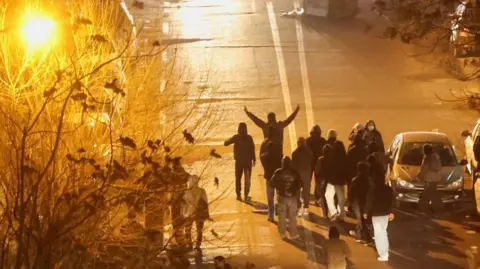
Some of the streets once engulfed by a roar of anger against the regime are now starting to go silent.
“On Friday it was extremely crowded – the crowd was unbelievable – and there was a lot of shooting. Then Saturday night it became much, much quieter,” a resident of Tehran told BBC Persian.
“You would have to have a death wish to go out now,” one Iranian journalist reflected.
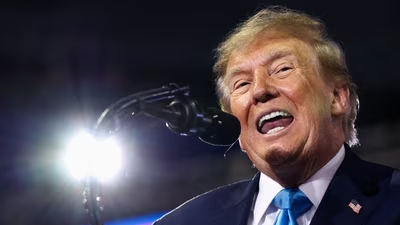
This time, an internal upheaval is also compounded by an external threat, with President Trump’s repeated warnings of military action coming seven months after the US carried out strikes on key nuclear facilities during a 12-day war between Iran and Israel, which left the regime weakened.
But, to use an analogy often used by the American leader, that has also given Iran “another card” to play.
Trump now says Tehran has called to go back to the negotiating table.
But Iran doesn’t have a good hand: President Trump says he may still have to take some kind of action before any meeting; talks won’t take all the searing heat out of this unrest.
And Iran won’t capitulate to what have been the US’s maximalist demands, including zero nuclear enrichment, which would cross red lines which lie at the very heart of this theocracy’s strategic doctrine.
Whatever the pressure of this moment, there’s no sign Iran’s leaders are changing course.
“Their inclination is to clamp down, to try to survive this moment, and then to figure out where they go from here,” says Vali Nasr from the Johns Hopkins School of Advanced International Studies, author of the book Iran’s Grand Strategy.
“But given their straits with the US, with Israel, with sanctions, even if they quell these protests, they don’t have many options to improve the lives of Iranians.”
This week may decide the momentum in this moment – whether Iran, and the wider region, is plunged into another bout of military attacks; whether brute force has completely put down these protests – as it has in the past.
Iran’s Foreign Minister Abbas Araghchi told diplomats in Tehran today that “the situation is now under total control”.
Outside, in the bright light of day, the streets of Tehran were filled with the crowds the government called on to come out and reclaim the streets from protesters.
Five days into a comprehensive communications blackout, a more chilling picture still sneaks out into the world through Starlink satellite terminals, Iranian technical creativity, and courage.
Doctors’ accounts of hospitals overwhelmed by casualties, grim videos of open-air mortuaries dotted by long lines of black body bags, voice notes sent to journalists at the BBC Persian Service expressing shock and fear.
The numbers rise. In the last wave of unrest in 2022 and 2023, which lasted more than six months, around 500 deaths were recorded by human rights groups and more than 20,000 arrests. This time, within a few weeks, reports say the death toll already climbs far higher and more than 20,000 have been taken in so far.
The government doesn’t deny the bloodshed; state TV is also airing images of makeshift mortuaries, even admitting some protesters have been killed.

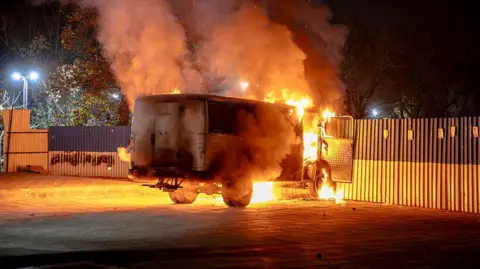
The streets of Iran have been on fire. Government buildings have been set alight as anger burned. They are symbols of the system, but attacks on public property are condemned by the government as the work of “terrorists and rioters. “
Legal language has also hardened in this time – “vandals ” will be charged with “waging war against God” and face the death penalty.
The government puts the main blame on foreign enemies – code name for Israel and the US – for an internal upsurge. This time, their accusation is also fuelled by the clear extent of infiltration by Israel’s Mossad security agency during their 12-day war last year.
With every new eruption of unrest in Iran, the same questions are asked: how far and wide do these protests reach; who’s taking to the streets and squares; how will the authorities respond?
 AFP via Getty Images
This latest wave has been unique in many ways.
It began in a most ordinary way. On 28 December, traders selling imported electronic goods in Tehran were jolted by the sudden currency collapse; they shuttered their shops, went on strike, and urged others in the bazaar to follow suit.
The government’s initial response was quick and conciliatory. President Masoud Pezeshkian promised dialogue and acknowledged “legitimate demands” in a country where inflation soars near 50%, and currency depreciations play havoc with people’s hardscrabble lives.
A new monthly allowance, amounting to about $7 (£5), was soon deposited in everyone’s bank account to help ease the pain.
But prices shot up further; the wave of unrest swelled.
Less than three weeks later, Iranians were marching everywhere – from small deprived provincial towns to major cities, chanting for economic and political change.
There are no quick and simple fixes now; it’s the system.
Iran is broken by years of crippling international sanctions, mismanagement and corruption, deep seated rage over restrictions on social freedoms, and agony over the cost of this prolonged standoff with the West.
But, so far, the centre appears to be holding.
“The most important element still missing from a full collapse is repressive forces deciding that they no longer benefit from, and are no longer willing to kill for, the regime,” explains Karim Sadjadpour, a senior fellow at the Carnegie Endowment in Washington.
Before this crisis erupted, the most powerful players in Iran’s ruling circles were known to be bitterly divided on key issues: if and how to resume the ill-fated negotiations with the US over a new nuclear deal, as well as how to restore strategic deterrence after the blows to its military proxies and political partners during the Gaza war.
But survival of the system, their system, matters above all else.
Ultimate authority still rests with the ailing 86-year-old Supreme Leader Ayatollah Khamenei, but he’s encircled by his most loyal defenders, among them the Islamic Revolutionary Guards Corps (IRGC), who now hold sway over the economy, politics and security of the Islamic Republic.
President Trump’s almost daily threats are known to have concentrated minds at the top. It has also provoked speculation far and wide over the impact of any outside intervention.
Military action could bolster the protesters; it could also backfire.
“The primary impact would be to shore up elite unity and suppress fractures within the regime at a moment of heightened vulnerability,” says Sanam Vakil, director of the Middle East and North Africa programme at the London-based think tank Chatham House.
 Reuters
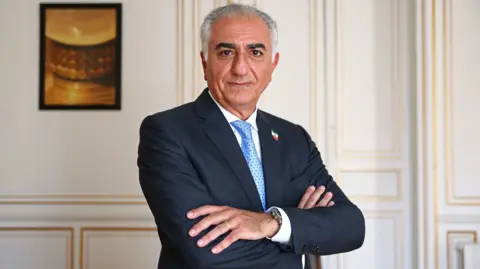
One of the loudest Iranian voices calling on President Trump to intervene has been the exiled former crown prince Reza Pahlavi, whose father was overthrown as Iran’s shah in the 1979 Islamic revolution. But his call, and his close ties to Israel, are controversial.
Other voices, from Nobel peace laureate Narges Mohammadi – still imprisoned in Iran, to award-winning filmmaker Jafar Panahi, insist that change must be peaceful, and must come from within.
In this current unrest, Pahlavi has shown his capacity to help galvanise and give shape to this uprising. His appeals at the start of last week for coordinated chanting appear to have drawn more people out into the bitter winter cold.
It’s impossible to know the depth of his support, and whether this profound yearning for change leads some to hold fast to a familiar symbol. Iran’s pre-revolutionary flag, with its lion and sun, has been unfurled again.
Pahlavi emphasises he’s not trying to bring back the monarchy but to lead a democratic transition; but in the past he has not been a unifying figure in the divided Iranian diaspora.
Fears of collapse and chaos, financial woes, and more, also weigh on the minds of Iranians including those who still back the ruling clerics. Reform not revolution is on some minds.
History tells us that when fervour and force meet on the streets, change can come from above, or below. It is always unpredictable – and often perilous.