‘National Total War’: America’s Growing Vulnerability Amid China’s Military Ascent | World News

'National total war': How China's military buildup up is making US more vulnerable
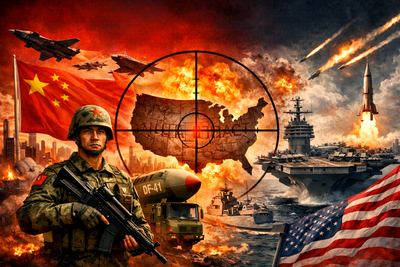
A new Pentagon report reveals China’s military buildup increasingly threatens the US homeland. Beijing is developing capabilities for direct attacks on critical infrastructure, cyber systems, and space assets, aiming to disrupt American decision-making during a Taiwan crisis. This signifies a shift from regional deterrence to direct homeland vulnerability, fundamentally altering US defense calculations.

For the first time, a Pentagon report says plainly what had long been implied. China’s “historic military buildup” has made the US homeland “increasingly vulnerable.” The phrase appears early in the Defense Department’s 2025 annual assessment of China’s military power, and it is not rhetorical flourish. It marks a shift in how the US government wants Americans to understand the problem Beijing poses. This is no longer only about aircraft carriers in the Pacific or missile ranges around Taiwan. It is about the United States itself as a target.The report, formally titled Military and Security Developments Involving the People’s Republic of China, describes a Chinese military that is no longer content with regional deterrence. The People’s Liberation Army is now measuring its capabilities against what it calls the “strong enemy,” an unmistakable reference to the United States. In doing so, it is building ways to pressure American decision-making directly, including through cyber access to critical infrastructure, long-range conventional and nuclear strikes, and attacks on the space systems that underpin US military power.

Calm With India, Weapons For Pakistan: Pentagon Report Warns Of China’s Strategic Balancing Act

The effect, the report argues, is a new vulnerability equation. Washington must now think not only about whether it can intervene in a conflict near Taiwan, but whether it can do so while absorbing disruption at home.Why it matters

  • The Pentagon’s core point isn’t just that China is getting stronger. It’s that Beijing is building multiple ways to shape US decision-making in a crisis-by threatening the homeland directly while also complicating US military intervention in the Indo-Pacific.
  • That shift widens the problem from “Can the US win near Taiwan?” to “Can the US sustain domestic stability, critical infrastructure, and space-enabled warfighting while intervening?” The report’s framing of vulnerability is deliberately multi-domain. The latest benchmark: 2027
  • The report says the PLA is making “steady progress” toward its 2027 goals, including achieving “strategic decisive victory” over Taiwan and building “strategic counterbalance” against the US in nuclear and other strategic domains. Then it translates the implication plainly: “China expects to be able to fight and win a war on Taiwan by the end of 2027.”
  • To get there, the report says the PLA is refining options to force unification, including “most dangerously” an amphibious invasion, “firepower strike,” and possibly a maritime blockade-testing “essential components” through 2024 exercises, including striking sea/land targets and striking US forces in the Pacific.

‘National total war’The most striking doctrinal shift described in the report is Beijing’s embrace of what Chinese military writings call “national total war.” The idea treats future conflict not as a discrete military contest but as a clash between entire national systems. Political authority, economic resilience, civilian infrastructure, information control, and military power are all part of the same battlefield.The Pentagon links this thinking directly to China’s long-term political goal of “national rejuvenation” by 2049 and to its nearer-term military benchmarks. Defense spending has nearly doubled since Xi Jinping took power. Civil-military integration reforms are designed to ensure that commercial sectors and local governments can be rapidly mobilized in wartime. Chinese planners, the report notes, have studied the war in Ukraine closely, drawing lessons about industrial capacity, sanctions resistance, and the risks of a prolonged fight.
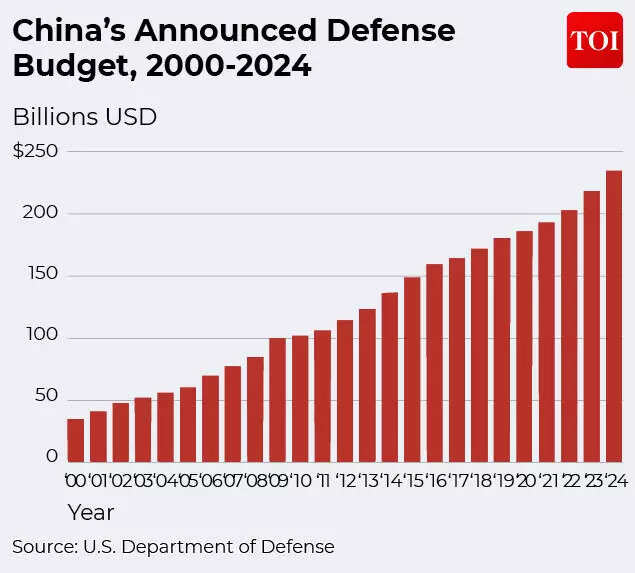
China defence budget over the years

This is not abstract theory. The report repeatedly emphasizes integration. China’s “core operational concept,” known as Multi-Domain Precision Warfare, is built around fusing data from space, cyber, air, sea, and land sensors into a single targeting system. The aim is to identify weak points in an adversary’s operational system and strike them quickly, at scale, and in coordination.
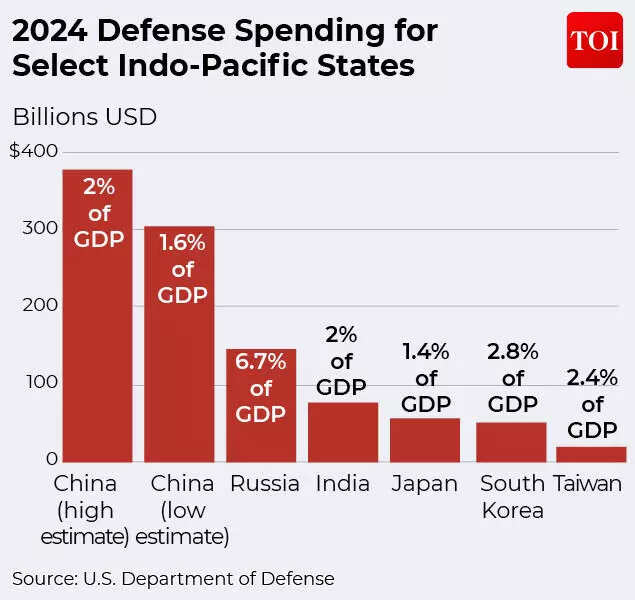
Defence budget: China and other Asian powers

Taiwan as the pacing scenarioEverything in the report ultimately bends back toward Taiwan. The Pentagon reiterates that the PLA is making “steady progress” toward its 2027 goals, which are explicitly tied to the ability to force unification with the island. The assessment translates the implication without hedging: China expects to be able to “fight and win” a war over Taiwan by the end of 2027.To get there, Beijing is refining multiple military options. A maritime blockade. A joint firepower strike campaign. A full-scale amphibious invasion. In 2024, the PLA’s “JOINT SWORD” exercises rehearsed the encirclement of the island, simulated strikes on sea and land targets, and practiced blocking key ports. These were not symbolic displays. They were stress tests of command-and-control, logistics, and coordination under realistic conditions.Crucially, Taiwan planning is inseparable from counter-intervention. The PLA’s growing missile forces can now range 1,500 to 2,000 nautical miles from China’s shores. In sufficient volume, the report warns, those strikes could seriously disrupt US operations across the western Pacific. Chinese units train against professional “blue forces” that replicate US equipment and tactics. The point is explicit preparation for a fight with American forces, not a generic regional contingency.Cyber as a homeland leverIf Taiwan is the likely trigger, cyber operations are the lever that reaches home. The report calls China the most persistent cyber threat to US government, military, and civilian networks in 2024. What distinguishes the current assessment is its emphasis on pre-positioning.Chinese cyber actors associated with campaigns such as “Volt Typhoon” have “burrowed into US critical infrastructure,” the report says. These intrusions go beyond espionage. They demonstrate the ability to disrupt systems during a crisis, including those needed to mobilize and deploy US forces. Likely targets include military command networks and civilian infrastructure with political or economic significance.The Pentagon’s language is careful but unsettling. Disruptions might be localized and temporary, lasting days or weeks. But the strategic effect could be outsized. Interruptions to pipelines, power, or telecommunications during a Taiwan crisis could slow military response and generate public pressure at home. Another campaign, known as “Salt Typhoon,” targeted US telecommunications providers in 2024, highlighting vulnerabilities in the backbone of American communications.Taken together, cyber operations are portrayed as a way to impose costs below the nuclear threshold while shaping the domestic environment in which US leaders make decisions.The ‘kill chain’The report is equally blunt about space. China sees space superiority as decisive. Its intelligence, surveillance, and reconnaissance satellite fleet has more than tripled since 2018, reaching over 359 systems by early 2024. That constellation dramatically improves China’s ability to track US aircraft carriers and expeditionary forces across the Pacific.These satellites are not passive observers. They are integral to closing what the military calls the kill chain: finding targets, tracking them, and delivering long-range precision strikes. Without space-based sensors and communications, that chain breaks.China is therefore building multiple ways to sever its adversary’s access to space. The report describes kinetic antisatellite missiles capable of destroying satellites in low Earth orbit, with ambitions to reach higher orbits. It highlights “dual-use” satellites equipped with robotic arms, such as Shijian-21, that can grapple and reposition other satellites. Ground-based lasers can disrupt or damage sensors. Jammers target military satellite communications across frequency bands.Cyber plays a role here too. Chinese actors have been implicated in attacks on foreign satellite networks, particularly those of the United States. The goal is not necessarily to destroy everything, but to degrade enough systems to slow decision-making and blunt operational advantage at the outset of a conflict.Nuclear growth and signalingOverlaying all of this is a rapidly expanding nuclear force. China’s warhead stockpile remained in the low 600s through 2024, the report says, but it is on track to exceed 1,000 by 2030. New silo fields in western China, a growing fleet of mobile intercontinental ballistic missiles, and advances in early warning systems point to a shift toward higher readiness.The report also notes Chinese interest in lower-yield nuclear weapons, suggesting a strategy that contemplates limited nuclear use rather than only massive retaliation.The effect is to thicken the strategic layer. Nuclear expansion does not replace cyber or conventional pressure. It sits alongside them, complicating escalation dynamics and shortening decision timelines.Ships, reach, and presenceNaval power provides the endurance behind this posture. China’s third aircraft carrier, Fujian, completed its first sea trials in 2024. The navy aims to field six carriers by 2035, for a total of nine. In October, China’s two operational carriers conducted their first dual-carrier operations, a milestone in integrated combat capability.The relevance to homeland vulnerability is indirect but real. Maritime power supports blockade options around Taiwan and sustained airpower projection. It also helps keep US forces at distance while other tools apply pressure elsewhere.China’s ambitions are not confined to the Indo-Pacific. The report details a growing global logistics network, from Djibouti to Cambodia’s Ream Naval Base, with potential future sites in Africa and the Pacific islands. Access to the Atlantic, the Pentagon warns, would pose new challenges for US planners.
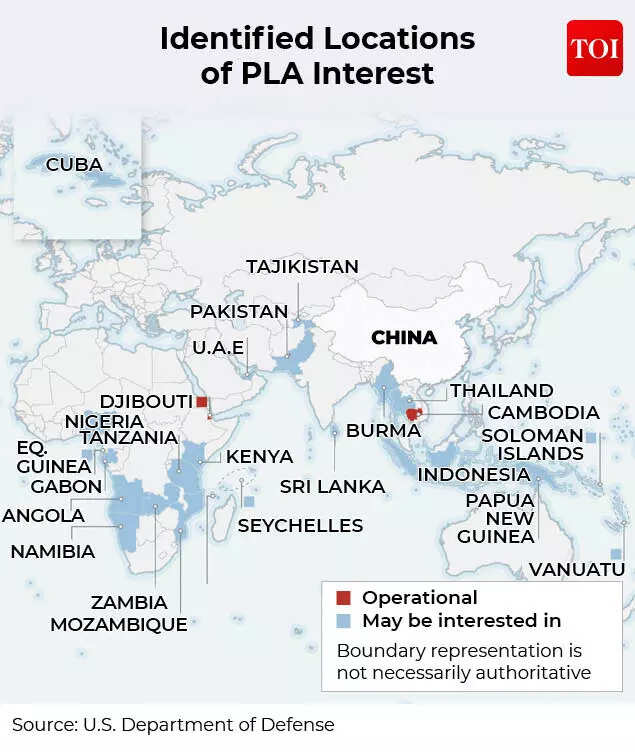
PLA is continuously expanding its interest areas

Russia and the outer perimeterChina’s partnership with Russia adds another layer. Combined bomber patrols near Alaska, joint coast guard operations in the Bering Sea, and expanded exercises signal a shared interest in countering the United States. These activities are not decisive on their own, but they stretch attention and resources, reinforcing the report’s central theme of multi-directional pressure.What the warning really meansThe Pentagon’s core message is not simply that China is stronger. It is that Beijing is building an integrated system designed to shape US choices in a crisis. The question is no longer only whether the United States can prevail militarily near Taiwan. It is whether it can do so while managing cyber disruption at home, threats to space systems, and a more complex nuclear backdrop.China is not betting on a single knockout blow. It is constructing multiple pressure points, many of them far from the Taiwan Strait, to raise the cost and uncertainty of American intervention.The report does not offer easy solutions. It does, however, make clear that the era in which the US homeland could be treated as a sanctuary in great-power conflict is ending. The competition, as Beijing’s own doctrine suggests, is becoming a contest between entire systems. And in that contest, distance alone is no longer protection.


Source link

Visited 1 times, 1 visit(s) today

Related Article

Many of the vessels found at the site contained residues that suggested they had been used to make alcohol. Photo: handout.

Bronze Age cemetery offers clues on how ancient Chinese brewed red rice wine

Traces of alcohol in pottery vessels discovered from a Bronze Age cemetery in northwestern China indicate that people at the time consumed beverages made using a fermentation starter of rice and a red mould. Archaeologists said the drink, similar to red rice wine, played a key role in mortuary rituals, and its presence at the

Thousands of Passengers Abandoned in Asia as Airports of China, Japan, Thailand and Malaysia Experience 55 Cancellations and 2,113 Delays by Air China, All Nippon, Malaysia Airlines, Jetstar and others, Affecting Beijing, Tokyo, Bangkok, Kuala Lumpur and more, New Update

Thousands of Passengers Abandoned in Asia as Airports of China, Japan, Thailand and Malaysia Experience 55 Cancellations and 2,113 Delays by Air China, All Nippon, Malaysia Airlines, Jetstar and others, Affecting Beijing, Tokyo, Bangkok, Kuala Lumpur and more, New Update

Home » Airline News In Asia » Thousands of Passengers Abandoned in Asia as Airports of China, Japan, Thailand and Malaysia Experience 55 Cancellations and 2,113 Delays by Air China, All Nippon, Malaysia Airlines, Jetstar and others, Affecting Beijing, Tokyo, Bangkok, Kuala Lumpur and more, New Update Published on December 25, 2025 Travelers across Asia

China military parade: Xi unveils new weapons as Putin, Kim Jong Un attend  'Victory Day' event

Jakub Korejba: China chooses strategy over war to lead the world – INTERVIEW

The world has long measured power by the roar of tanks and the flash of missiles. But what if real influence today takes a different form – a quietly signed contract, an overlooked port terminal, or a piece of technology without which the lights won’t turn on tomorrow? While some states debate morality, sanctions, and

Japan’s growing engagement with Taiwan angers China – DW – 12/24/2025

China has condemned a visit by a group of senior Japanese politicians to Taiwan as another example of Tokyo meddling in internal affairs. Beijing is ramping up accusations that Japan is swerving back to the militarism that led to catastrophic conflict across the Asia-Pacific region in the early decades of the last century. Tensions between

Donald Trump's trade restrictions on AI chips have given Chinese tech firms the environment they need to court global investors.

Trump’s Chip Embargo Against China Is Backfiring Spectacularly

Illustration by Tag Hartman-Simkins / Futurism. Source: Tasos Katopodis / Getty Images In a probably-predictable twist of geopolitical irony, America’s effort to block China’s access to cutting-edge AI chips hasn’t succeeded in stifling the People’s Republic — but instead forged a more self-reliant alternative to Silicon Valley that has investors jumping ship. As reported by

U.S. Rep. Gregory Meeks, D-N.Y., at a meeting for the House Foreign Affairs Committee in the Rayburn House Office Building on Feb. 12, 2025, in Washington, D.C.

Rep. Gregory Meeks, Sen. Elizabeth Warren challenge H200 chip exports

NEWYou can now listen to Fox News articles! Congressional Democrats are voicing alarm at the fact that the U.S. might soon begin selling cutting-edge chips to one of its greatest geopolitical adversaries. Rep. Gregory Meeks, D-N.Y., joined by Sen. Elizabeth Warren, D-Mass., wrote a letter to Under Secretary for Industry and Security Jeffrey Kessler on

Perception and Reality: What U.S.–China Relations Mean for Chinese Americans Today

Perception and Reality: What U.S.–China Relations Mean for Chinese Americans Today

Sheryl WuDunnExecutive, Lecturer, and Pulitzer Prize-Winning Journalist Sheryl WuDunn, the first Chinese-American reporter to win a Pulitzer Prize, has been a longtime banker, New York Times journalist, best-selling author, business consultant and wine-maker. She co-founded and is principal of FullSky Partners, advising for-profit ventures with a social mission in technology and healthcare, and helping drive

"made in china" tech gadgets

Why International Tourists Are Shopping for “Made in China” Tech Gadgets: The Role of Tax Refunds and Duty-Free Benefits

Home » CHINA TRAVEL NEWS » Why International Tourists Are Shopping for “Made in China” Tech Gadgets: The Role of Tax Refunds and Duty-Free Benefits Published on December 24, 2025 China is experiencing a surge in inbound tourism with international visitors increasingly planning travel around shopping for “Made in China” technology products. From drones and

Akash Sriram

US delays announcement of China chip tariffs until 2027

USTR says will impose new tariffs on Chinese chips in June 2027 Biden launched ‘Section 301’ probe into Chinese legacy chips a year ago Trump administration delay of chips tariffs aims to preserve China trade truce Dec 23 (Reuters) – President Donald Trump’s administration on Tuesday said it will slap tariffs on Chinese semiconductor imports

News about -  Why China is not rushing to become a global leader

Why China is not rushing to become a global leader

In global politics, where dominance is often measured by loud declarations and displays of power, China behaves like a master of the game of Go, carefully and silently placing its stones, favoring strategic depth over superficial spectacle. At first glance, all the prerequisites for hegemony seem to be in place: the world’s second largest economy,

Google Preferred Source

Ten former Samsung employees arrested for industrial espionage charges for giving China chipmaker 10nm tech — executives and researchers allegedly leaked DRAM technology to China-based CXMT, resulting in trillions of losses in Korean Won

South Korean prosecutors have arrested 10 former Samsung employees who have allegedly leaked 10-nm DRAM technology to ChangXin Memory Technologies (CXMT). The 10 individuals are accused of breaking the Act on Prevention of Divulgence and Protection of Industrial Technology, better known as the Industrial Technology Protection Act. Of the ten, five are key development personnel,

China, Russia clash with US at UN meeting over Venezuela oil seizures and naval pressure

China, Russia clash with US at UN meeting over Venezuela oil seizures and naval pressure

China accused the United States at the United Nations on Tuesday of violating international law and destabilising the Caribbean region, as Washington defended its seizure of Venezuelan oil tankers and vowed to intensify pressure on President Nicolas Maduro’s government. Speaking at an emergency meeting of the UN Security Council requested by Venezuela and backed by

Inside Ukraine’s Reinvented Wartime Diplomacy, Where ‘No’ Is Never the Final Answer

China Warns Ukraine Against Sanctioning Chinese Companies Over Alleged Support for Russia — UNITED24 Media

China has called on Ukraine to refrain from imposing sanctions on Chinese companies and citizens over their alleged involvement in supporting Russia’s war against Ukraine, warning it will take steps to protect its interests if such measures are introduced, Ukrinform reported on December 23. Speaking at a regular press briefing on December 23, Chinese Foreign Ministry spokesperson Lin Jian said Beijing firmly opposes unilateral sanctions that are

Kuaishou blames the cyberattack on “black and grey industries” – an underground ecosystem of illegal and legally ambiguous activities that range from cybercrime to bot-driven fraud. Photo: Getty Images

China’s Kuaishou hit by breach as explicit content floods live-streaming rooms

Short-video platform Kuaishou Technology reported a major cyberattack to the police after a breach on Monday evening allowed explicit content to flood high-traffic live rooms for more than an hour. Kuaishou’s live-streaming services were thrown into chaos at around 10pm when recommended feeds were inundated with explicit material, according to news website Sina. Viewership in

What interest do China and Russia have in Venezuela? – DW – 12/23/2025

The actions of the US fleet in the Caribbean are increasingly causing alarm. US warships not only have alleged drug boats in their sights; since early December, they have also been targeting oil tankers. Experts differ in their assessments of Venezuela‘s role in drug trafficking, but they all agree that oil exports are vitally important

Could Mexico make America great again? A China primer

Could Mexico make America great again? A China primer

Last week, I wrote about the ideological guardrails shaping U.S. trade and economic policy. To recap: the need to decouple from China, the re-industrialization of the U.S. economy, the shift from free trade to managed (or “fair”) trade, and the idea that economic policy isnational security policy. Now, I know you’re all eager to get

Trump Administration delays new China chip tariffs until June 2027

Trump Administration delays new China chip tariffs until June 2027

President Donald Trump’s administration announced on Tuesday (December 23) that it will impose new tariffs on Chinese semiconductor imports, however, the enforcement of these duties has been delayed until June 2027. This has essentially provided a significant window for ongoing trade negotiations. According to a report by news agency Reuters, the decision follows a year-long

Electricity Minister explores mining, technology cooperation with China’s NORINCO

Electricity Minister explores mining, technology cooperation with China’s NORINCO

Mahmoud Esmat, Minister of Electricity and Renewable Energy, met with Cheng Defang, Chairperson of China North Industries Group Corporation (NORINCO), at the outset of his visit to Beijing to discuss prospects for cooperation in exploration, mining and advanced manufacturing. NORINCO operates across several strategic sectors, including defence industries, oil and minerals, international engineering, specialised civil

China's commerce ministry to US on drone ban: Stop wrong practice or...

China’s commerce ministry to US on drone ban: Stop wrong practice or…

China’s commerce ministry has urged the US that Washington cease the “wrong practice” of blacklisting foreign-made drone systems after a sweeping move by US regulators blocked the import and sale of Chinese-made drones, citing national security concerns, a report has said. Several drone companies, including DJI, have been added to the “Covered List” that effectively

0
Would love your thoughts, please comment.x
()
x