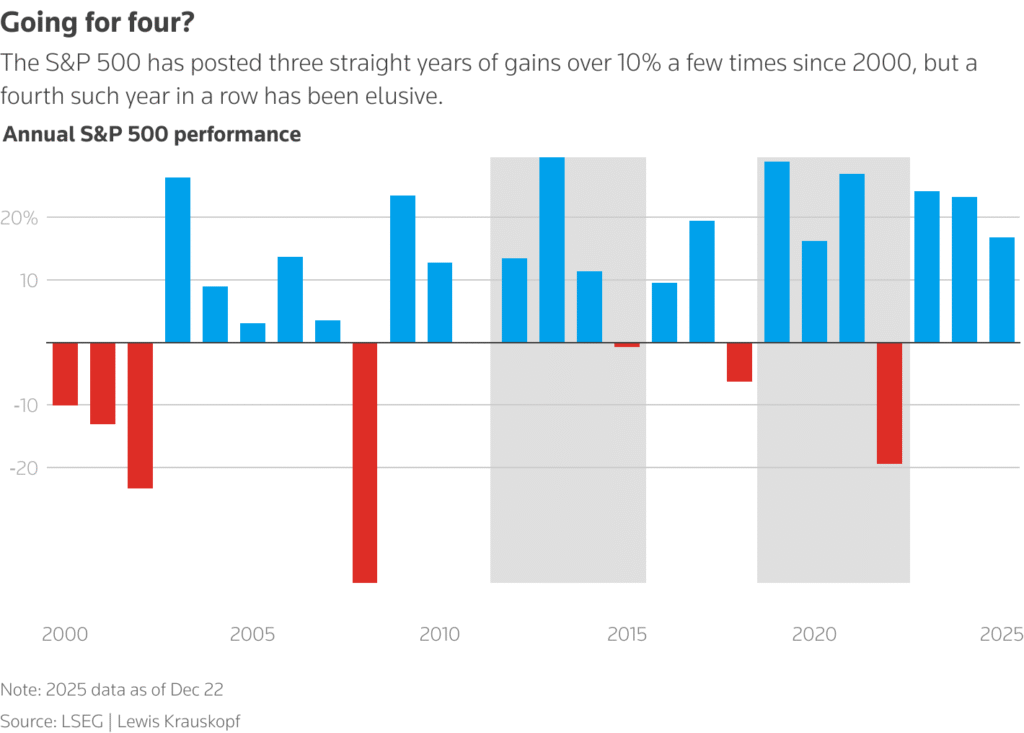
Forecasters largely expect more good times ahead for the stock market next year, but there are always surprises and risks that could upend the outlook.
Strategists at Morgan Stanley flagged three such curveballs that could ding markets next year, laying out what they believe could be the big surprises of 2026.
The bank is one of many on Wall Street that’s calling for another bright year for stocks. In its year-ahead outlook, it estimated the S&P 500 would climb another 13% in 2026, thanks to strong corporate earnings and a “rolling recovery” that will spread throughout the US economy.
“A year without surprises would be a surprise itself,” a team led by Matthew Hornbach wrote in a note to clients last week.
Here are the top three surprises the bank is eyeing in 2026.
1. A jobless productivity boom
LeoPatrizi/Getty Images
The US economy could see a “jobless productivity boost,” a turbocharged version of a “jobless recovery” that weighs on inflation and opens the door to more Fed rate cuts.
In this scenario, a weakening US job market would help keep a lid on wage growth and inflation, while accelerating productivity helps keep growth steady, Hornbach wrote. In such a scenario, core inflation could fall below 2%, he estimated.
“This supply-driven disinflation gives the Fed room to cut policy rates into accommodative territory without investors worrying about a policy-induced inflationary reacceleration,” he said, adding it could also quell investor anxiety about growing deficits in the US.
Labor productivity growth already looks to be on the rise. Output per hour among all nonfarm business workers rose to 3.3% year-over-year in the second quarter, up from the prior quarter’s 1.8% annual decrease, Labor Department data shows.
Investors are also pricing in a more ambitious pace for rate cuts next year than the central bank has officially projected. Fed officials have penciled in just one cut for 2026, though investors are pricing in a 72% chance that rates will end the year lower, according to the CME FedWatch tool.
2. Stock-bond paradigms shift again
Stock prices typically trade inversely to bond prices, as a decline in risk assets causes investors to seek safety in bonds.
That dynamic was turned on its head in 2025, with stock and bond prices both gaining steadily all year. That’s partly because stocks have been mired in a bad-news-is-good-news regime lately, Morgan Stanley said, referring to how weak economic data has been positive for stocks, as it’s elicited optimism from investors about Fed rate cuts.
But that dynamic could reverse once again if inflation falls back to the Fed’s target next year, they said. US Treasurys are seen both as a safe haven and a hedge against inflation.
“With inflation expectations at target — and at risk of falling below — a return of ‘bad-is-bad’ for risky assets brings back the hedging qualities of Treasuries that made them a ballast in investor portfolios throughout the low inflation experienced in the two-decade period prior to the pandemic,” Martin Tobias and Eli Carter, two strategists at the bank, wrote.
3. Commodity and energy prices soar
Jeri Clausing/AP
Commodities, including energy, enjoyed a big run in 2025 and could be headed for a repeat in 2026. That’s due to a series of events that could cause commodity prices to “erupt,” strategists speculated:
- The Fed continues to cut interest rates while other central banks raise rates. That makes the US dollar less attractive relative to other currencies around the world, reducing the greenback’s value.
- A cheaper dollar and stimulus help stoke an economic rebound in China, one of the world’s largest producers and consumers of rare earth and precious metals. The nation is also one of the world’s largest energy consumers.
“The weaker dollar and strong consumption story from China pushes energy prices — including gasoline which is currently below 5-year lows — to new highs,” the bank said.
Forecasters generally expect 2026 to be a positive year for energy prices and commodities as a whole, thanks to factors like tight supply, rising demand due to the AI trade, and increased appetite for safe-haven assets.
Gold, one such safe-haven, climbed past $4,400 for the first time on Monday, notching a new record. The metal is up almost 70% this year, set to close out its best annual performance since 1979.
Silver and coper, both metals at the center of the AI trade, also hit new all-time highs this week.