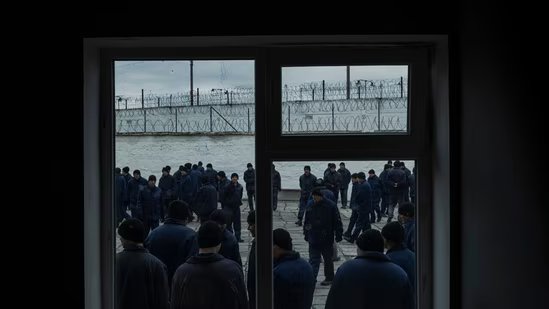
Prisons and lockups that jailed tens of thousands of people during Assad’s rule are now crowded with Syrians detained by President Ahmed al-Sharaa’s security forces and held without formal charges.
The first wave of detentions in the new Syria came almost immediately – just after victorious rebels flung open the doors of Bashar al-Assad’s notorious prisons.
As ordinary Syrians stormed detention complexes last December to search for loved ones who had vanished under Assad’s rule, thousands of the deposed dictator’s soldiers who had abandoned their posts – officers and conscripts alike – were taken prisoner by the rebels.
Then came the second wave in late winter: Hundreds of people from Assad’s Alawite sect, mostly men, were seized by the new authorities throughout Syria. Their detentions spiked after a brief uprising along the coast in March killed dozens of security forces, sparking reprisals that left nearly 1,500 Alawites dead. Those arrests continue to this day.
Beginning in the summer, there was another round of mass detentions, this time in the south among the minority Druze community. It came after hundreds died in an outbreak of sectarian violence, with government forces accused of summary executions and other abuses.
Throughout, there were other detentions from all denominations in the name of security: large numbers of people, many from Syria’s Sunni majority, accused of vague links to Assad; human-rights activists; Christians who say they have been shaken down for information or money; Shi’ites picked up at checkpoints and accused of ties with Iran or Hezbollah.

A member of the Syrian security forces walks near beds at one of the empty cells of Homs prison, following the fall of Syrian President Bashar al-Assad in Homs, Syria, December 21, 2024. (credit: Amr Alfiky/Reuters)
Prisons and lockups that jailed tens of thousands of people during Assad’s rule are now crowded with Syrians detained by President Ahmed al-Sharaa’s security forces and held without formal charges, a Reuters investigation has found.
Reuters compiled the names of at least 829 people who have been detained on security grounds since Assad’s demise a year ago, according to interviews with family members of the detainees and people who themselves were in detention. In reaching this number, Reuters also reviewed lists of detainees compiled by individuals who organized family visits to seven facilities.
Interviews, lists of detainees, and multiple accounts of overcrowding in the prisons and lockups suggest that the number of security detainees is considerably higher than the tally that Reuters was able to establish.
Some of the abuses that Syrians hoped would end with Assad have been revived by men working for the government that replaced him: detentions without charge or a paper trail, some of the same methods of abuse and torture, and deaths in custody that go unrecorded, according to dozens of interviews. Some detainees have fallen prey to extortion, according to interviews with 14 families. Five of the families reported receiving communications from alleged jailers or intermediaries demanding money in exchange for a relative’s release.
In December 2024, Sharaa pledged to “close the notorious prisons” of the fallen dictator. But Reuters found that at least 28 prisons and lockups from the Assad era have been operational again over the past year.
Asked for comment on the findings of this report, Syria’s Information Ministry said that the need to bring those involved in Assad’s abuses to justice explained many of the detentions and the reopening of some facilities.
“The number of people involved in crimes and violations in Syria under the former regime is very large, given the scale of the abuses committed,” the ministry said. “There are past crimes, involvement in new violations, and threats to security and stability by those associated with the regime, in addition to other crimes.”
The government said far more Syrians had been freed over the past year than are currently detained, but provided no numbers.
The detention facilities identified by Reuters include major prisons, large lockups located in vast complexes once run by Assad’s intelligence apparatus, and smaller lockups at checkpoints and police stations. Prisoners held at these facilities have little legal recourse, and at least 80 families said they lost track of their loved ones for months on end. Access to lawyers and family members varies across facilities, and public charges are rarely filed against security detainees, unlike those accused of common crimes.
Reuters also found that security detainees are sent to prisons previously run by rebel forces, including those forces once led by President Sharaa in his power base in the northern province of Idlib. The se detainees joined inmates already held there for years on security grounds during the civil war, according to a dozen former prisoners.
Across Syria, detainees and families described inhumane conditions they or their relatives endured when locked up – overcrowding, scarce food, outbreaks of skin disease from a lack of soap. Both security detainees and people accused of common crimes said abuse and neglect were rife in the detention facilities where they were held. Forty people who were either former detainees or family members of detainees also described abuse and sometimes torture, particularly in the lockups.
Reuters documented at least 11 deaths of people in custody, including three cases in which the families said they only learned their loved ones had died after their bodies were already buried.
In total, over 140 Syrians were interviewed for this report, including former detainees, relatives, lawyers, and human rights activists. Reuters also reviewed communications between jailers and detainees’ families, as well as photos of injuries from alleged torture.
Reuters was unable to independently verify certain details in the accounts of detainees and their families. But those interviewed were consistent in what they described, including the abuse in detention.
In its statement, the government said Syria’s legal, judicial, and security institutions needed to be rebuilt after Assad’s fall. Because of “this difficult reality, there are vacuums that lead to negative consequences that violate policies in some cases,” it said.
The government said 84 members of the security forces had been disciplined for incidents of extortion involving detainees and 75 for violence.
Since January, Syria’s Interior Ministry has announced more than 100 arrests for alleged abuses during the Assad era. The Reuters count doesn’t include these people, who are named and face specific accusations.
‘Distressing accounts’
The conditions described in the prisons and lockups do not approach the brutality of Assad’s rule. The fallen dictator presided over the disappearance of more than 100,000 Syrians during the civil war. Mass graves that his government created to hide the dead are still being discovered. All told, more than 300,000 Syrian civilians perished in the war, according to UN estimates from 2022. Assad’s father, Hafez, ruled with similar ruthlessness. Both oversaw a system marked by torture, extortion, and summary execution on an industrial scale.
But human rights advocates say the mass detentions and disappearances have cast a shadow over Sharaa’s government, which came to power on promises to take Syria out of more than five decades of single-family rule. The new leadership is struggling to fulfill those promises, as Reuters has documented in a series of articles this year.
The effort to rebuild the country has implications far beyond Syria. The Trump administration has embraced Sharaa as an ally in regional stability and the effort to hold Islamic State extremists in check. Asked to comment on the prison conditions described in this report, a senior US administration official said President Donald Trump “is committed to supporting a Syria that is stable, unified, and at peace with itself and its neighbors.”
The UN Office of the High Commissioner for Human Rights said in a statement on December 5 that it had documented “distressing accounts of summary executions, arbitrary killings and abductions” since Assad’s fall.
Thameen al-Kheetan, a spokesperson for the UN rights office, told Reuters the commission is unable to compile a registry of security detentions. “It remains challenging to determine with precision how many individuals are still detained, how many have been released, or which cases may amount to enforced disappearance,” he said. “In some instances, families may also hesitate to share information out of fear of repercussions.”
On November 25, thousands of Alawites in the Mediterranean coastal regions protested against sectarian attacks and for the release of community members who disappeared after being detained. The demonstrations were some of the largest since Assad’s fall.
Sednaya, the Damascus prison most notorious under Assad as a place of torture, disappearance, and death, was among the facilities shut down as soon as the dictator fell. It remains empty and is one of several detention facilities that the government said had been shut.
Still, Reuters found that two Damascus sites the government said were closed – Mezzeh airbase and the Khateeb detention center – have been operational during the past year.
Amer Matar, a journalist and filmmaker focused on human rights, said he was held for a total of four months in different detention facilities under Assad. When the dictatorship ended, he made a point of visiting multiple detention sites and photocopying documents. He aimed to help tens of thousands of families trace relatives and hold perpetrators accountable through an online portal, the Syria Prisons Museum, which provides open access to the files, photographs, and other evidence he collects.
When he visited Khateeb in February, he said he was initially blocked because he was told there were again prisoners inside. But Matar said he managed to enter and saw men crammed into a cell where he had been held for 16 days under Assad.
Matar also went to the Harasta detention center in Damascus, once run by Assad’s air intelligence unit and infamous for torture. Guards told him there were new prisoners, but all the guards nevertheless let him inside.
Matar was traveling to neighboring Lebanon in September, carrying recorded interviews with Syrian families stored on a hard drive, when he said he was stopped at passport control. At the border crossing terminal, he said he was stunned to be hauled into a cell and accused of smuggling confidential documents.
On the walls, he observed several hand-drawn calendars, all dated 2025. Matar knew from experience under Assad how to leave his own mark. He said he picked apart a pack of cigarettes, twisted the foil lining into a point, and scribbled: “Justice! Even if the world falls apart!”

A member of the Syrian security forces walks at the Kafr Sousa security complex after it was emptied following the fall of Syrian President Bashar al-Assad in Damascus, Syria December 15, 2024. (credit: Amr Alfiky/Reuters)
‘I’m in a bigger jail now’
Sharaa’s pledge to build a new Syria requires holding Assad’s enablers accountable for their crimes, while moving the country on from a devastating civil war that began in 2011 and ended with Assad’s exile in Moscow last December.
As Sharaa promised in mid-December last year to close prisons, his rebel forces were capturing soldiers from Assad’s army. Many were conscripts – men forced into the military with little choice in where or how they fought. Some were officers.
All have been detained in facilities where past abuses were prevalent. There are no publicly available lists of their names, and the government has not disclosed where they’re held.
The government also has not said how many soldiers have been detained or if they are considered prisoners of war, a status that would give them special legal protection.
Some have received amnesty through negotiations with the government, through informal mediation by community leaders, activists, and clerics, or directly with the government’s civil peace committee, formally known as the Supreme Committee for the Preservation of Civil Peace.
Among the soldiers freed through intervention by the government’s civil peace committee is a former conscript in his mid-20s. He fled to Iraq as the government collapsed, then returned after Syria’s new leadership pledged to question soldiers and release those not responsible for crimes. He asked that his identity be withheld.
He said he was among the first wave of arrests after Assad fell, spent half a year in Damascus’ Adra prison, and was released in May after his family made repeated calls to the civil peace committee.
Free now for eight months, he said he still lacks documentation confirming that he has been cleared. He fears he could be detained again at any moment. Syrian authorities have been issuing ID cards to some former soldiers, but he has not yet received one.
“I’m in a bigger jail now,” said the young soldier, who rarely ventures out of his home. He spoke to Reuters at a farmhouse near the Mediterranean Sea, where drought had cracked the earth under his family’s citrus trees.
The detainee lists contain names of soldiers held in prisons in Damascus, Homs, Hama, and Afrin. There, they are imprisoned with other Syrians detained on security grounds and people accused of common crimes. The organizers of the family visits showed the lists to Reuters.
Another former detainee at Adra, the Damascus prison that is among Syria’s largest, said inmates needed to sleep on their sides because the cells were so packed. The former detainee, who is Sunni, said there was no medicine or warm water for bathing. His daily diet consisted of a few olives and dates, and one piece of bread, he said. During his nearly two-month detention, he said he lost more than 20 kilograms.
The government reported that Adra currently has 3,599 inmates, slightly exceeding its capacity of 3,550, including 439 security detainees. For all the facilities, the government said, “the current reality is not the desired reality, but we are in the period of building institutions and rehabilitating prisons, and yet the humanitarian situation has improved significantly.”
Additionally, the government stated that some lockups are currently used to detain individuals during ongoing legal proceedings.
Detainees who were held in lockups in the Damascus neighborhoods of Kafr Sousa and Mezzeh describe some of the most harrowing conditions. Assad’s intelligence services ran both facilities during the civil war.
New prisoners began filling parts of the Kafr Sousa detention facility as early as February, said Matar, who visited then. It had emptied after Assad’s fall.
One detainee, an Alawite who was picked up with his brother in mid-May, said he was held in both Kafr Sousa and a facility in the Mezzeh neighborhood that was once used by Assad’s political-security branch. The man said that a neighbor’s complaint about noise on their street led to a raid on the family home in May by the Internal Security Forces, the national law enforcement agency still commonly referred to by its former name, General Security Services (GSS).
The officers took them into custody after checking their IDs, which identified their birthplace as Latakia, a region that is majority Alawite, an offshoot of Shi’ite Islam followed by the Assad family.
At the Mezzeh political-security lockup, he said 30 men shared a single cell. He saw his brother there once, when new inmates were having their heads forcibly shaved. Guards ordered the men to keep their eyes on the floor, a practice prevalent during Assad’s rule.
“It was my first time in detention, and it was very hard on me,” he said.
There, the man was interrogated for a week. His captors flogged him with cables and accused him of being an Assad sympathizer.
He stated that he was then transferred to the detention facility at Kafr Sousa, located elsewhere in Damascus. He caught sight of his brother there again, his face bruised. They said nothing, because prisoners weren’t allowed to speak to each other.
There, his new interrogators questioned him about his religion. “Do you pray?” Do you worship God?” But he said it was worse for former soldiers: “They came from interrogation with smashed bones, unable to walk.”
Two weeks after his arrest, an interrogator blindfolded him and forced him to sign a document with an inked finger, then loaded him into a car.
They dropped him on a Damascus street, he said, with one final order: “Don’t look back and don’t remove the blindfold until we are gone.” He never saw the document and has no idea what was written on it. He does not know what happened to his brother.

This cell was located in the basement of the Khateeb detention center, which was run by an intelligence branch under former Syrian President Bashar al-Assad, in Damascus, Syria December 17, 2024. (credit: John Davison/Reuters)
Jails for profit
Under Assad, the detention system became as much a generator of large-scale profit for people who worked there – jailkeepers, judges, and lawyers – as a tool for crushing dissent. According to a 2024 UN report, “massive bribes” were an essential part of securing the release of detainees or advancing their legal proceedings.
Despite the new government’s promises to combat corruption, 14 families and four lawyers recounted getting demands for money in exchange for freeing a detainee. Most reported being unsure who was contacting them or what the relationship between the jailer and the extortionist on the phone was.
The amounts demanded appear arbitrary. Families of ordinary detainees – conscripts, farmers, blue-collar workers – are asked to pay anywhere between $500 and $15,000.
Families of military officers, people who influenced Assad, or those believed to be well-off, said they receive far higher demands. Six families reported that the ransom demanded by the individuals who contacted them exceeded 1 billion Syrian lira, or $90,000.
Among the missing are several members of a single Alawite family who vanished during the March killings on the coast. A WhatsApp conversation between the sister of one of the men and someone who claimed to be his jailer began at the end of March.
One exchange, seen by Reuters, shows the jailer set a deadline and demanded $3,000 in cash for the release of all of the men except one, who he said had died.
The text exchanges continued until October without a resolution. At one point, the family asked about the conditions.
When the family asked how the men were doing, the jailer said, “ What do you think the conditions are for a prisoner? …There’s torture and being suspended by the wrists.”
The family didn’t have the money to pay, and the jailer refused to tell them which of the men had died or provide proof that the others were still alive.
“When the money is ready, come to Idlib to see them,” the jailer wrote.
Another family shared an audio recording of demands to pay 100 million Syrian lira – the equivalent of $9,000 – for an army officer who they say was seized on December 31, 2024, on his way to surrender to the new government.
This is the exchange between a desperate relative of the officer and his alleged captor, who called from the detained man’s mobile phone that day:
Jailer: “Bring 100 million and come.”
Relative: “What? 100 million. Where do I get this money? If I sell this house, it won’t get 100 million.”
Jailer: “Listen, listen, listen then, you’ll never see him alive again.”
The family stated that it did not have the funds to pay. They have heard nothing since.
Sometimes paying the captors does not guarantee safety.
A 50-year-old farmer from a village in the province of Homs said he was grabbed twice by Internal Security Forces officers.
The first time, in March, two pickups marked “Internal Security” pulled up loaded with armed and masked men in black uniforms, he said. They surrounded his house, blindfolded him and his teenage son, and took them to the local police lockup to interrogate them about who in town had weapons.
The farmer said they forced his head and limbs into a car tire to immobilize him – a practice called the “dolab,” Arabic for tire, that started under Assad. They then beat him and his son bloody.
Throughout the ordeal, he said, his captors insulted him: “You are infidels, you are pigs.” The farmer shared pictures of the bruised soles of his feet and stitches across his ankles. A religious leader who acts as a mediator with the security forces confirmed the account.
The farmer was told a payment of $4,000 would secure their release. The officers released them to raise the money. The vehicle that picked up the cash, he said, was also marked “Internal Security” – like the ones carrying the men who had detained them in the first place. But the next day, another marked car arrived to take him back to the police station, he said.
This time, he was beaten unconscious. It was a stroke of luck.
The men sent him back to his family in a blanket, thinking he was dead, the farmer said. Friends smuggled him and his son out of Syria, where they remain.
Syrians have their own vocabulary of torture, coined over five decades of dictatorship and expanded during 14 years of civil war. That vocabulary, according to detainees of the new government, has survived the fall of Assad.
There is the “dolab” or tire experienced by the farmer. “Shabeh” is the practice of suspending a victim from his wrists. The “welcome party” – or “haflat istaqbal” – happens on arrival, when jailers line the corridor, and rain blows upon new detainees.
One young Alawite man said he was detained on March 9 in Latakia after he ventured outside during a government crackdown in response to the pro-Assad uprising. Black-clad officers pulled his jacket over his head, yanked off his shoes, and bundled him into their car over suspicions he was filming the movements of security forces with his phone.
The young Alawite said his abuse started immediately with a “welcome party” at the military security branch in the coastal region.
“Everyone ordered me to bark like a dog. They beat me with the butts of their rifles, their fists, their boots,” he said. “I thought my life was coming to an end.”
From there, he said, he was taken to three other lockups in Latakia, all used during the Assad era, and each with its own welcome party. His ankles hung him, he said, with a pistol shoved in his mouth. He was put alone in a windowless room for 20 days.
Twice while being transferred, the young man said, his jailers mused about killing him and dropping his body into the sea because the lockups had become overcrowded.
Finally, after four months, he was freed, still barefoot. His captors had never replaced the shoes torn off when he was seized.
Reuters could not independently confirm the young man’s account. Still, it was consistent with the type of abuse described by at least eight other former detainees who either witnessed it or experienced it themselves. He was also among at least 53 detainees whose cases exceeded the legal limit of 60 days during which a person may be held without a judicial proceeding.
The government stated that the Interior Ministry’s policies complied with Syrian law, which it said guaranteed access to a lawyer. The government also said extrajudicial detention is permissible “to prevent an imminent threat or the outbreak of violence.”
In late November, the Interior Ministry published a new code of conduct for its officers that, among other things, instructs them to “preserve and reinforce human rights, treat everyone with dignity and in accordance with international laws.” It specifically prohibits torture, allowing use of force “within approved limits.”
Assad’s legacy
Reuters documented at least 11 people who died in detention by speaking to relatives, including three whose deaths the government has said are under investigation. The government did not provide a total number of deaths in custody or comment on the findings about them.
Among the dead was a detainee at Kafr Sousa, a 59-year-old Christian merchant named Milad al-Farkh. His family said he was arrested on August 24 on allegations of hiding weapons, working as an arms dealer, and selling expired meat at his butcher shop.
Farkh’s family described the arrest as an attempt to pressure them into paying $10,000 in protection money.
Two weeks later, an inmate at Kafr Sousa managed to get a call out to the family to tell them al-Farkh was near death from torture. The call from the hospital morgue came the next day, on September 9, the family said.
One relative was arrested for demanding an autopsy. Finally, after intervention by a senior Internal Security official and clerics, doctors concluded al-Farkh had died from hitting his head in a fall, and the body was released to the family. They have yet to see the autopsy report or any written record of his arrest or death.
Reuters reviewed photos of Farkh’s body taken at the morgue, which showed what appeared to be a bloody wound on the back of his head.
On September 25, after the family petitioned for an investigation into Farkh’s death, the Interior Ministry announced they had searched his house and found a bomb. The family denies there were any explosives at the house.
Reuters also documented deaths at a checkpoint in Tartous and the prison there, as well as at other lockups, including a police station in Damascus near the famous Umayyad Mosque.
Three families said they learned of the deaths of relatives only after their bodies were buried. Among these were three men detained in Homs in January – an army veteran and his two sons, who were also Assad-era soldiers. Their family said they last saw the three being led away by Internal Security officers.
The governor’s office told them the men were at the central prison in Homs. For five months, they said, they visited regularly to leave food, medicine, and fresh clothes, and retrieve dirty laundry that they were told belonged to the three. They reported that they paid thousands of dollars to unidentified intermediaries but were never permitted to see the men.
Finally, two relatives went to a morgue in desperation and persuaded an employee there to go through digital photos of unidentified bodies. That was when the family discovered the men had been dead since January.
Written autopsy comments beneath the photos said the 62-year-old father had his throat slit, two family members recalled. One son had his face disfigured and skin flayed from his body, and a bullet to the face killed the other, they said. They were not permitted to keep any documentation, including the autopsies, they said. Reuters was unable to obtain the photos or reports.
The offices of the governors of Homs, Tartous, and Latakia did not respond to requests for comment.
The Syrian Network for Human Rights started documenting abuses under Assad in 2011 and has continued to release monthly reports on arbitrary detentions. Over the course of 2025, the group documented 16 deaths in detention under the new government.
In its latest report, released in early December, SNHR called on Syria’s new leaders “to establish legal regulations that will put an end to the harrowing era of arbitrary arrests and enforced disappearances.”
Matar’s experience of imprisonment under the new government was brief, but mentally taxing. The journalist and filmmaker said he was released within 24 hours at the border checkpoint with Lebanon without being charged.
“Anyone suspected of tampering with documents and evidence is dealt with according to the laws and regulations, as was the case with Amer Matar,” the government said.
He has no papers to prove that he was ever held or freed.
“The regime fell, but those ruling today decided to turn the Assad prisons into new prisons,” Matar said. “I swear to God, it’s the most absurd thing I have ever seen.”
Matar said he never recovered his hard drive from the checkpoint officers. He arrived in Lebanon 10 days later. He hasn’t returned to Syria since.