4
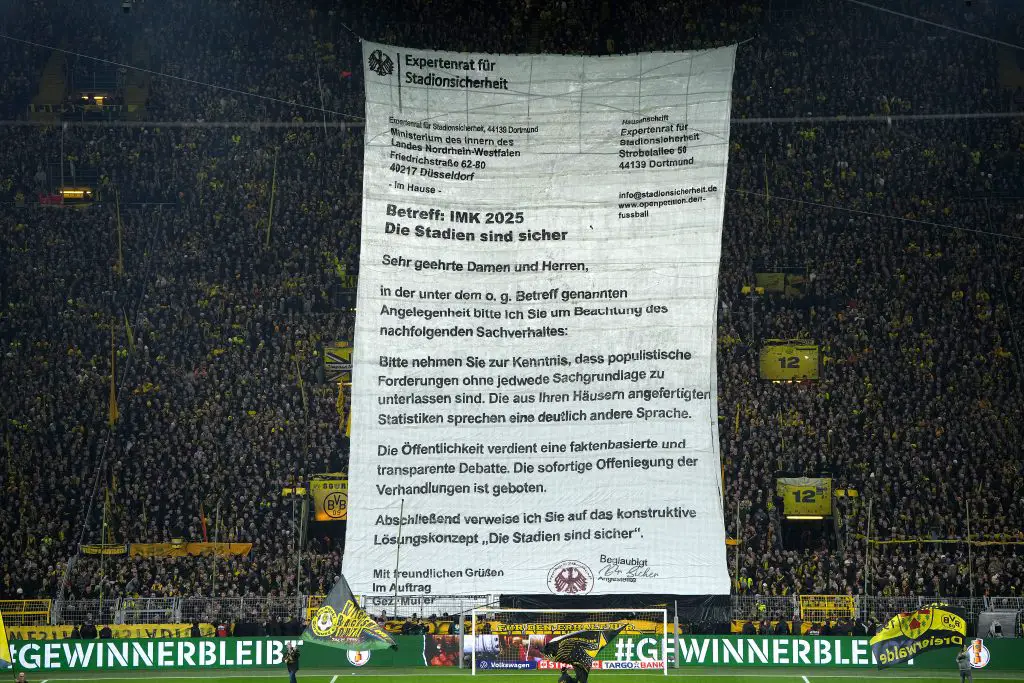
As Germany’s highly controversial Interior Ministry Conference in Bremen gets set to convene today, the DFB and DFL have written a letter to the IMK aligning themselves with Bundesliga fans. Borussia Dortmund supporters unveiled a banner depicting a letter from their own interior minister (also in support of their stance) ahead of last night’s DFB Pokal fixture against Bayer Leverkusen. Newly elected BVB President and DFL executive Hans-Joachim Watzke has also leant his support to the DFB/DFL letter.
In general, the anti IMK protests taking place in Germany over the last three weeks seek to voice opposition to draconian security measures being considered by the various Interior Ministers. A German federal inter-state working group (“Bund-Länder-offene-Arbeitsgruppe” or BLoAG) is convening a session aimed at discussing additional security protocols under the banner “Fußball onhe Gewalt” (“Football without violence). The group has already met several times before and concrete policy is expected to emerge from the IMK meeting.
There are hard-liners on both sides among the interior ministers of Germany’s 16 federal states. Over the weekend, Bavarian interior minister Joachim Herrmann (CSU) attempted to cool down some of the rhetoric on both ends of the debate by claiming that measures such as personalized ticketing and stadium bans using A.I. facial recognition software aren’t even on the agenda. Herrmann is nevertheless at best half correct in his claim, as some statements from IMK delegates have confirmed.
What is under discussion in Bremen?
That cannot be answered directly, but there is strong evidence in public newspapers and journals that confirm some ministers do want very harsh security measures put in place.Hard liners such as Saxony’s Armin Schuster (CDU) and Lower Saxony’s Daniela Behrens (SPD) are both on record as endorsing stadium bans and personalized tickets in higher-risk standing room ultra sections.
Behrens (speaking to the Hannoverschen Allgemeine Zeitung) and Schuster (in an interview with the Mitteldeutscher Rundfunk) endorsed closer coordination among so-called “Stadium Security Alliances” to enforce such harsh measures more uniformly and consistently. Additionally, online legal journal LTO has obtained a copy of a draft resolution penned by Behrens and political colleague Christian Pegel (SPD) from Mecklenburg-Vorpommerrn.
The resolution argues that violence inside football stadiums is increasing and that previously agreed upon measures (such as personalized ticketing) cannot go far enough. Some statistics are cited from a meeting in October 2024 which purportedly prove that violence inside German football stadiums is on the rise. A national stadium ban commission is advocated.
Can IMK rulings influence German football?
Potentially. The DFB and DFL are not legally bound to observe any additionally agreed upon statutes. It’s also traditionally the case that clubs can, for example, reject requests from local authorities to employ measures such as personalized ticketing and I.D. requirements from local and even state level law enforcements. A federal commission, on the other hand, could override the clubs in this case.
A national stadium ban commission is ostensibly something that will be debated at the conference, but one finds it difficult to envision something so all-encompassing meeting with enough approval from the conference delegates. Local “Stadium Security Alliances” (such as those presently operating in southern German states like Baden-Württemberg and Rheinland-Pfalz) are also proving effective.
Do the fans have a voice at this conference?
Not directly and this happens to be a huge point of contention. German football supporters still maintain the support of both of their FAs and many attendees prepared to argue on their behalf. The protest movement also has its own voice in the form of the public awareness about the issue that has been spread. The fact that the DFB and DFL are aligning themselves with the fans is enormous.
What does the DFL/DFB letter say?
It is quite potent. The two FAs argue that personalization of tickets is totally ineffective, runs contrary to German fan culture, and has considerable costs in terms of financial and organizational resources. Such a measure also causes delays in stadium entrance, which in turn creates its own security concerns. Whenever throngs of fans are caught at the gate, the risk of crushes and clashes.
Above all, the DFL and DFB make the reasonable request that there should be an open and transparent debate about the subject. A somewhat abridged translation of the letter offers significant evidence that – should the IMK opt to ignore the pleas of the FA – the conference will be perceived to be on the wrong side of German football, federal law, and public opinion.
“There are also controversial proposals, considerations, and planned measures that the DFL e.V. executive committee considers inappropriate and/or disproportionate and therefore rejects,” the letter reads. “A Federal Constitutional court ruling (2018) clearly states that a stadium ban as a preventive measure must be based on concrete and verifiable facts of sufficient weight
“The club imposing the ban must continue to take into account the specific circumstances of each individual case in order to justify the concern that a person poses a risk of future security-related disturbances,” the letter continues. “The specific circumstances are decisive. Ticket Identification does not lead to any demonstrable increase in security. This is disproportionate.“
Will German fan culture prevail?
In the opinion of this author, absolutely. Despite the fact that there are always risks to attending a football match, German football fans continue to attend matches in record numbers. The top three German professional football tiers have consistently led Europe in attendance figures for well over a decade. Germans do not fear the stadium experience for the very good reason that instances of violence are genuinely declining.
An annual report published at the end of October by the Zentralen Informationsstelle Sporteinsätze (“Central Information Office for Sports Operations -“ZIS”) showed a decline in the most important parameters: injured persons, criminal proceedings, and police working hours. This is despite rising attendance figures and smaller security contingents.
German fan societies are already pointing out that the statistics cited by hard-liners are inaccurate. In Schuster’s recent MDR interview, for example, the Saxon politician cites injury statistics associated with the use of pyrotechnics whilst completely ignoring the fact that most of these injuries occurred on New Year’s Eve and had nothing to do with football.
Chances that a national stadium ban commission will emerge from this meeting are virtually nil. In the unlikely event that something like this is endorsed, it will never be enforced. The German FAs and the clubs do not want it and will fight against it. One should never doubt the ability of the principled stance of German fans to prevent unlawful and immoral changes to the game.
Even before this conference starts, the fans have already won.