Provisional statistics of retail sales for October 2025
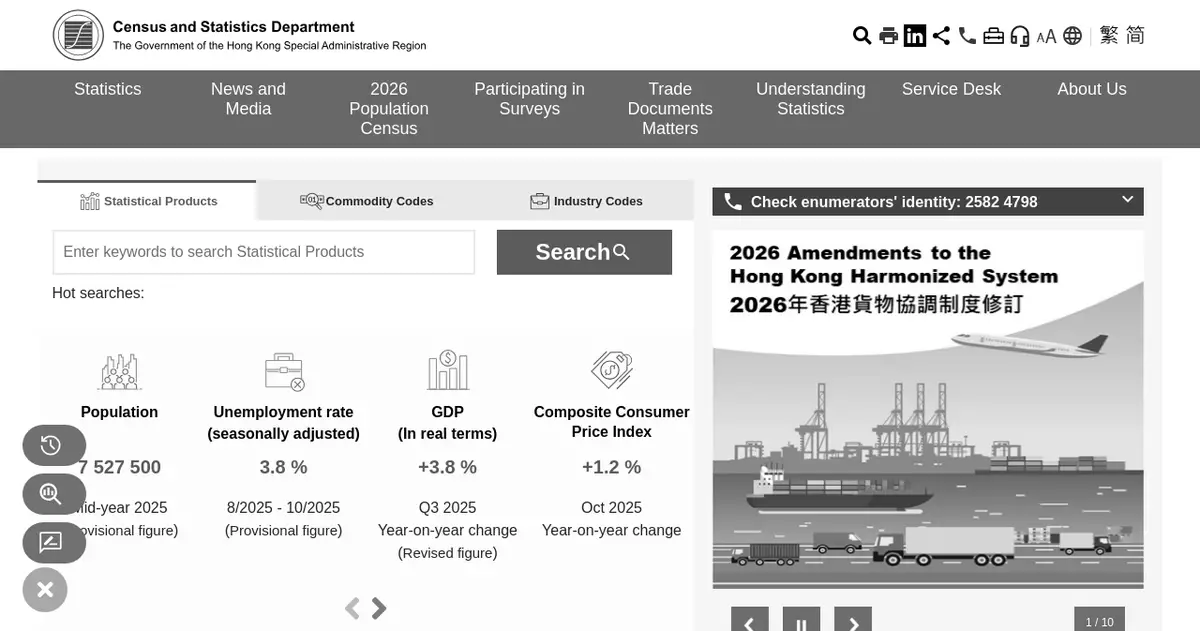
The Census and Statistics Department (C&SD) released the latest figures on retail sales today (December 1).
The value of total retail sales in October 2025, provisionally estimated at $35.2 billion, increased by 6.9% compared with the same month in 2024. The revised estimate of the value of total retail sales in September 2025 increased by 6.0% compared with a year earlier. For the first 10 months of 2025 taken together, it was provisionally estimated that the value of total retail sales remained at a similar level when compared with a year earlier.
Of the total retail sales value in October 2025, online sales accounted for 14.6%. The value of online retail sales in that month, provisionally estimated at $5.2 billion, increased by 27.2% compared with the same month in 2024. The revised estimate of online retail sales in September 2025 increased by 27.2% compared with a year earlier. For the first 10 months of 2025 taken together, it was provisionally estimated that the value of online retail sales increased by 9.5% compared with the same period in 2024.
After netting out the effect of price changes over the same period, the provisional estimate of the volume of total retail sales in October 2025 increased by 5.3% compared with a year earlier. The revised estimate of the volume of total retail sales in September 2025 increased by 4.8% compared with a year earlier. For the first 10 months of 2025 taken together, the provisional estimate of the total retail sales decreased by 1.5% in volume compared with the same period in 2024.
Analysed by broad type of retail outlet in descending order of the provisional estimate of the value of sales and comparing October 2025 with October 2024, the value of sales of electrical goods and other consumer durable goods not elsewhere classified increased by 24.6%. This was followed by sales of jewellery, watches and clocks, and valuable gifts (+9.5% in value); other consumer goods not elsewhere classified (+9.7%); food, alcoholic drinks and tobacco (+6.0%); commodities in department stores (+5.8%); wearing apparel (+0.9%); medicines and cosmetics (+3.8%); footwear, allied products and other clothing accessories (+1.1%); and optical shops (+4.4%).
On the other hand, the value of sales of commodities in supermarkets decreased by 1.8% in October 2025 over a year earlier. This was followed by sales of motor vehicles and parts (-20.1% in value); fuels (-8.7%); books, newspapers, stationery and gifts (-0.6%); furniture and fixtures (-2.3%); and Chinese drugs and herbs (-6.6%).
Based on the seasonally adjusted series, the provisional estimate of the value of total retail sales increased by 3.0% in the three months ending October 2025 compared with the preceding three-month period, while the provisional estimate of the volume of total retail sales increased by 1.4%.
Commentary
A government spokesman said that the recovery in retail sales gathered strength in October. The value of total retail sales rose by 6.9% over a year earlier, picking up further from the increase in the preceding month. Sales of most broad retail outlet types continued to grow.
Looking ahead, ongoing improvement in local consumer sentiment and sustained notable growth in visitor arrivals should continue to render support to retail businesses.
Further information
Table 1 presents the revised figures on value index and value of retail sales for all retail outlets and by broad type of retail outlet for September 2025 as well as the provisional figures for October 2025. The provisional figures on the value of retail sales for all retail outlets and by broad type of retail outlet as well as the corresponding year-on-year changes for the first 10 months of 2025 taken together are also shown.
Table 2 presents the revised figures on value of online retail sales for September 2025 as well as the provisional figures for October 2025. The provisional figures on year-on-year changes for the first 10 months of 2025 taken together are also shown.
Table 3 presents the revised figures on volume index of retail sales for all retail outlets and by broad type of retail outlet for September 2025 as well as the provisional figures for October 2025. The provisional figures on year-on-year changes for the first 10 months of 2025 taken together are also shown.
Table 4 shows the movements of the value and volume of total retail sales in terms of the year-on-year rate of change for a month compared with the same month in the preceding year based on the original series, and in terms of the rate of change for a three-month period compared with the preceding three-month period based on the seasonally adjusted series.
The classification of retail companies follows the Hong Kong Standard Industrial Classification (HSIC) Version 2.0, which is used in various economic surveys for classifying economic units into different industry classes.
These retail sales statistics measure the sales receipts in respect of goods sold by local retail companies and are primarily intended for gauging the short-term business performance of the local retail sector. Data on retail sales are collected from local retail companies through the Monthly Survey of Retail Sales (MRS). Local retail companies with and without physical shops are covered in MRS and their sales, both through conventional shops and online channels, are included in the retail sales statistics.
The retail sales statistics cover consumer spending on goods but not on services (such as those on housing, catering, medical care and health services, transport and communication, financial services, education and entertainment) which account for over 50% of the overall consumer spending. Moreover, they include spending on goods in Hong Kong by visitors but exclude spending outside Hong Kong by Hong Kong residents. Hence they should not be regarded as indicators for measuring overall consumer spending.
Users interested in the trend of overall consumer spending should refer to the data series of private consumption expenditure (PCE), which is a major component of the Gross Domestic Product published at quarterly intervals. Compiled from a wide range of data sources, PCE covers consumer spending on both goods (including goods purchased from all channels) and services by Hong Kong residents whether locally or abroad. Please refer to the C&SD publication “Gross Domestic Product by Expenditure Component” for more details.
More detailed statistics are given in the “Report on Monthly Survey of Retail Sales”. Users can browse and download this publication at the website of the C&SD (www.censtatd.gov.hk/en/EIndexbySubject.html?pcode=B1080003&scode=530).
Users who have enquiries about the survey results may contact the Distribution Services Statistics Section of the C&SD (Tel: 3903 7400; email: mrs@censtatd.gov.hk).
Source: AI-found images
DH announces latest situation of Legionnaires’ disease cases
The Centre for Health Protection (CHP) of the Department of Health today (December 1) reported the latest number of Legionnaires’ disease (LD) cases, and reminded the public of the importance of using and maintaining properly designed man-made water systems, adding that susceptible groups should strictly observe relevant precautions.
From November 23 to 29, the CHP recorded three community-acquired and one imported LD cases. All of the patients involved had underlying illnesses. The details of the cases are as follows:
The CHP is conducting epidemiological investigations to identify potential sources of infection and high-risk exposure. Initial investigations revealed that these are sporadic cases. No epidemiological linkages have been established between these four cases and other confirmed cases previously recorded in Hong Kong.
As of November 29, 151 LD cases had been recorded this year. In 2024 and 2023, there were 135 and 121 LD cases respectively.
Men, people aged over 50, smokers, alcoholics and persons with weakened immunity are more susceptible to LD. Some situations may also increase the risk of infection, including poor maintenance of water systems; living in areas with old water systems, cooling towers or fountains; using electric water heaters, whirlpools and spas or hot water spring spas; and recent stays in hotels or vessels.
Legionellae are found in various environmental settings and grow well in warm water (20 to 45 degrees Celsius). They can be found in aqueous environments such as water tanks, hot and cold water systems, cooling towers, whirlpools and spas, water fountains and home apparatus that support breathing. People may become infected when they breathe in contaminated droplets (aerosols) and mist generated by artificial water systems, or when handling garden soil, compost and potting mixes.
Immunocompromised persons should:
The public should observe the health advice below:
The public may visit the CHP’sLD page, theCode of Practice for Prevention of LDand theHousekeeping Guidelines for Cold and Hot Water Systems for Building Managementof the Prevention of LD Committee, and the CHP’srisk-based strategyfor prevention and control of LD.
Source: AI-found images