Polar bears face higher risk of disease in a warming Arctic

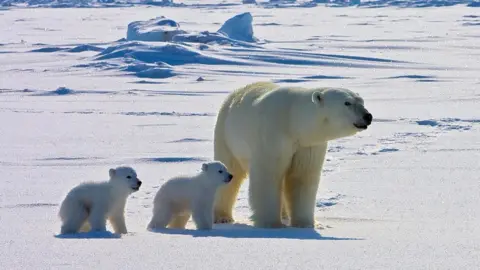
USGS A polar bear mother and cubs USGS

In a warming Arctic, polar bears are spending more of their time on land

As the Arctic warms, polar bears face a growing risk of contracting viruses, bacteria and parasites that they were less likely to encounter just 30 years ago, research has revealed.

In a study that has provided clues about how polar bear disease could be linked to ice loss, scientists examined blood samples from bears in the Chukchi Sea – between Alaska and Russia.

They analysed samples that had been gathered between 1987 and 1994, then collected and studied samples three decades later – between 2008 and 2017.

The researchers found that significantly more of the recent blood samples contained chemical signals that bears had been infected with one of five viruses, bacteria or parasites.
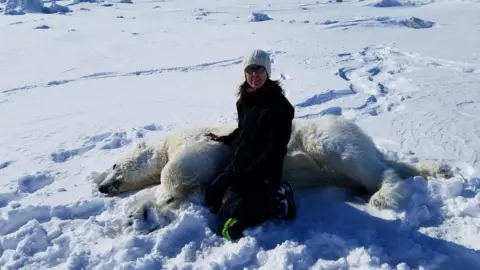
USGS Wildlife biologist Dr Karyn Rode from the US Geological Survey checks on a sedated wild polar bear in the Alaskan Arctic  USGS

Wildlife biologist Karyn Rode (here with a sedated wild polar bear) and her colleagues collected blood samples from wild bears to monitor the animals’ health

It is difficult to know, from blood samples, how the bears’ physical health was affected, but wildlife biologist Dr Karyn Rode from the US Geological Survey said it showed that something was changing throughout the whole Arctic ecosystem.

The researchers tested for six different pathogens in total – viruses, bacteria or parasites that are primarily associated with land-based animals but have been recorded before in marine animals, including species that polar bears hunt.

The study covered three decades, Dr Rode said, “when there had been a substantial loss of sea ice and there’s been increased land use in [this population of polar bears]”.

“So we wanted to know if exposure had changed – particularly for some of these pathogens that we think are primarily land-oriented.”

The five pathogens, as disease-causing agents are collectively called, that have become more common in polar bears, are two parasites that cause toxoplasmosis and neosporosis, two types of bacteria that cause rabbit fever and brucellosis, and the virus that causes canine distemper.

“Bears in general are pretty robust to disease,” explained Dr Rode. “It’s not typically been known to affect bear population, but I think what it just highlights is that things [in the Arctic] are changing.”

Key polar bear facts

  • There are about 26,000 polar bears left in the world, with the majority in Canada. Populations are also found in the US, Russia, Greenland and Norway
  • Polar bears are listed as vulnerable to extinction by the International Union for Conservation of Nature, with climate change a key factor in their decline
  • Adult males can grow to be around 3m long and can weigh close to 600kg
  • Polar bears can eat up to 45kg of blubber in one sitting
  • These bears have a powerful sense of smell and can sniff out prey from up to 16km away
  • They are strong swimmers and have been spotted up to 100km offshore. They can swim at speeds of around 10km per hour, due in part to their paws being slightly webbed
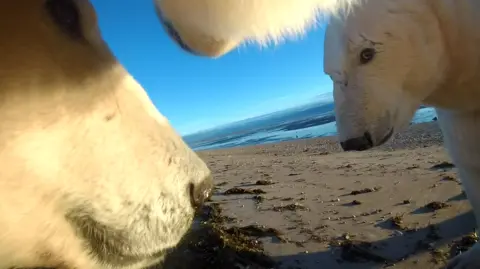
USGS A group of polar bears captured from a collar camera USGS

Studies with collar cameras have revealed what polar bears eat during the ice-free summer, as well as capturing surprising social interactions

In the US, polar bears are classified as a threatened species; scientists say the biggest threat to their future is the continuing loss of sea ice habitat, which they depend on as a platform from which to pounce on their marine prey.

Previous research using collar cameras on bears has shown that, as they spend more of the year on land – when there is no available sea ice to hunt from – the bears are unable to find enough calories.

Dr Rode explained that polar bears are top predators: “Our study suggested that they’re getting their exposure to some pathogens primarily through their prey species.

“So what we saw as changes in pathogen exposure for polar bears is indicative of changes that other species are also experiencing.”

The findings are published in the scientific journal PLOS One.
Source link

Visited 1 times, 1 visit(s) today

Related Article

A Kurdish woman in traditional dress holds a lit torch during Nowruz, the Persian New Year, on a hill overlooking the town of Akra in the autonomous Kurdistan Region of Iraq, Friday, March 20, 2026. (AP Photo/Leo Correa)

Three Million Indian Officials to Begin Counting World’s Largest Population

NEW DELHI, March 30 (Reuters) – More than ⁠3 ⁠million Indian officials are to ⁠spend a year counting every single person in the ​world’s most populous nation, a mammoth task delayed in part by the COVID-19 pandemic. The ‌once-in-a-decade population survey, originally due ‌in 2021, will start on April 1 with a short window for

The gray bars in this graph indicate periods of recession during oil price spikes dating back to 1970.

Oil price shocks usually lead to a recession

Stock market bulls should show a little more caution, given how past oil price shocks have impacted the economy. Every US recession, excluding the COVID-19 pandemic, was preceded by an oil price shock, BCA Research chief global strategist Peter Berezin said in a new note (see chart below). “The current macro environment is a toxic

Rachael Ward, one of the Green Party's successful candidates in Penryn

Reform UK fails to win three out of four local elections in Cornwall

The Green Party has claimed a landslide victory among the votes in Cornwall last week Rachael Ward, one of the Green Party’s successful candidates in Penryn(Image: Cornwall Green Party) Despite winning the most seats at the Cornwall Council election almost a year ago, Reform UK failed to monopolise on that success at four town council

People store fuel in a plastic can at a petrol pump amid fears of a possible shortage due to the US Iran war, in Srinagar, Indian controlled Kashmir, Wednesday, March 25, 2026. (AP Photo/Mukhtar Khan)

Photos show effects of Iran war on global energy worldwide

Iran’s attacks on the energy infrastructure of the Middle East and its stranglehold on the Strait of Hormuz has sent oil prices skyrocketing and given rise to growing concerns about a global energy crisis. This is a photo gallery curated by AP photo editors. People store fuel in a plastic can at a petrol pump

A Kurdish woman in traditional dress holds a lit torch during Nowruz, the Persian New Year, on a hill overlooking the town of Akra in the autonomous Kurdistan Region of Iraq, Friday, March 20, 2026. (AP Photo/Leo Correa)

Analysis-Ukraine’s Drone Masters Eye Iran War to Kickstart Export Ambitions

By Tom Balmforth and Max Hunder LONDON/KYIV, March 30 (Reuters) – Ukraine’s war has forced the country to become a trailblazer in drone interception. The conflict ⁠in ⁠the Middle East could be its make-or-break moment to take the technology global. In ⁠an effort to export Ukrainian systems and know-how, President Volodymyr Zelenskiy has criss-crossed the

A Kurdish woman in traditional dress holds a lit torch during Nowruz, the Persian New Year, on a hill overlooking the town of Akra in the autonomous Kurdistan Region of Iraq, Friday, March 20, 2026. (AP Photo/Leo Correa)

WTO Suffers Fresh Blow as Reform Push Hits a Wall at Cameroon Meeting

YAOUNDE, March 30 (Reuters) – World Trade Organization talks ⁠broke ⁠up with no agreement on Monday on ⁠a plan for reform or even on extending a moratorium on e-commerce, piling ​more pressure on the trade body that finds itself increasingly sidelined by economic nationalism. The four-day ministerial talks in Cameroon’s capital Yaounde ended ‌in the

The conflict has put global oil and gas supplies at risk, led to shortages of fertilisers, and affected air travel. (Agencies)

Oil Gains as Iran War Escalates With Houthi Attacks on Israel

Oil advanced as Iran-backed Houthi militants in Yemen entered the Middle East war and more US troops arrived in the region, raising fears the widening conflict will cause further chaos for energy markets. The conflict has put global oil and gas supplies at risk, led to shortages of fertilisers, and affected air travel. (Agencies) Brent

Iran has effectively kept the Strait of Hormuz closed, amid the US-Israeli conflict with Iran, (REUTERS/ Representative)

All sides in the Gulf war are at risk of overplaying their hands

IN WAR, WHAT at first seems logical can, in hindsight, prove to have been foolhardy. Having repelled its Iraqi invaders in 1982, Iran spurned a ceasefire and pushed ahead with a counter-invasion. America overthrew Saddam Hussein within weeks in 2003, only to bog itself down in nearly a decade of counter-insurgency. Both had their reasons:

"Freedom of worship in Jerusalem must be fully guaranteed, without exception, for all faiths,” the EU’s Kallas said. (Reuters)

Israel to allow access to church in Jerusalem during Easter after backlash

Israeli security forces are looking for ways to enable worship at the Church of the Holy Sepulchre during Holy Week after police prevented the Latin Patriarch from holding Mass there on Palm Sunday, citing security concerns. “Freedom of worship in Jerusalem must be fully guaranteed, without exception, for all faiths,” the EU’s Kallas said. (Reuters)

Trump claimed that Iran had allowed 20 oil tankers to cross Strait of Hormuz as a gift to US. (AI-generated image)

Trump claims he got a ‘gift’ from Iran, reveals his plan for Kharg Island

Donald Trump has claimed that Iran allowed additional oil tankers to pass through the Strait of Hormuz as a ‘present’ to Washington, even as the conflict in the Middle East deepens and high-stakes negotiations continue behind the scenes. Trump claimed that Iran had allowed 20 oil tankers to cross Strait of Hormuz as a gift

ET logo

G7 ministers set to tackle financial fallout of Mideast war

Paris: Ministers from the G7 will hold talks on Monday to unpack the economic consequences of the war in the Middle East, the French government said, as oil and gas prices continue to soar. The United States and Israel launched strikes on Iran in late February and Tehran has hit back by targeting crude-exporting countries

President Donald Trump waves to the media as he walks on the South Lawn upon his arrival at the White House, Sunday in Washington. (AP)

Donald Trump reveals his favourite thing to do in US-Iran war

US President Donald Trump has revealed his “favourite thing to do” in the Iran war, and not surprisingly, it is taking Tehran’s oil. President Donald Trump waves to the media as he walks on the South Lawn upon his arrival at the White House, Sunday in Washington. (AP) The US has been accused in the

0
Would love your thoughts, please comment.x
()
x