Hong Kong customs has foiled yet another attempt to smuggle gold disguised as machine parts in a Japan-bound air consignment, seizing more than HK$104 million (US$13.3 million) of the precious metal in less than five months.
A source familiar with the case said on Thursday customs officers were investigating whether the latest HK$7.5 million haul was linked to the previous two cases discovered in March and July, with seizures of HK$97 million worth of smuggled gold.
“The tactics used in the three smuggling cases are similar because gold was moulded and camouflaged as components and fixed into the machines that were destined for the same destination [Japan],” the insider said.
“We believe the smuggling operations were designed to evade import tariffs of about 10 per cent of the gold products in Japan,” he said.
“We don’t rule out the possibility that gold was turned into the shape of machine parts and assembled in the machines in the city.”
The source said customs would continue to exchange intelligence with Japanese authorities to combat such gold smuggling activities.
The latest seizure was made when customs officers intercepted a Tokyo-bound consignment for inspection at the airport’s cargo terminal on Thursday last week, according to the Customs and Excise Department.
Inspector Dixon Chiu Ting-sang of customs’ airport cargo examination unit said the shipment of 14 carton boxes was declared carrying garment products and documents, but an X-ray examination revealed 12 undeclared machines in four of the boxes.
Chiu said the 12 ozone generators appeared to be new but suspicious fingerprints were found in the bottom of the machines.
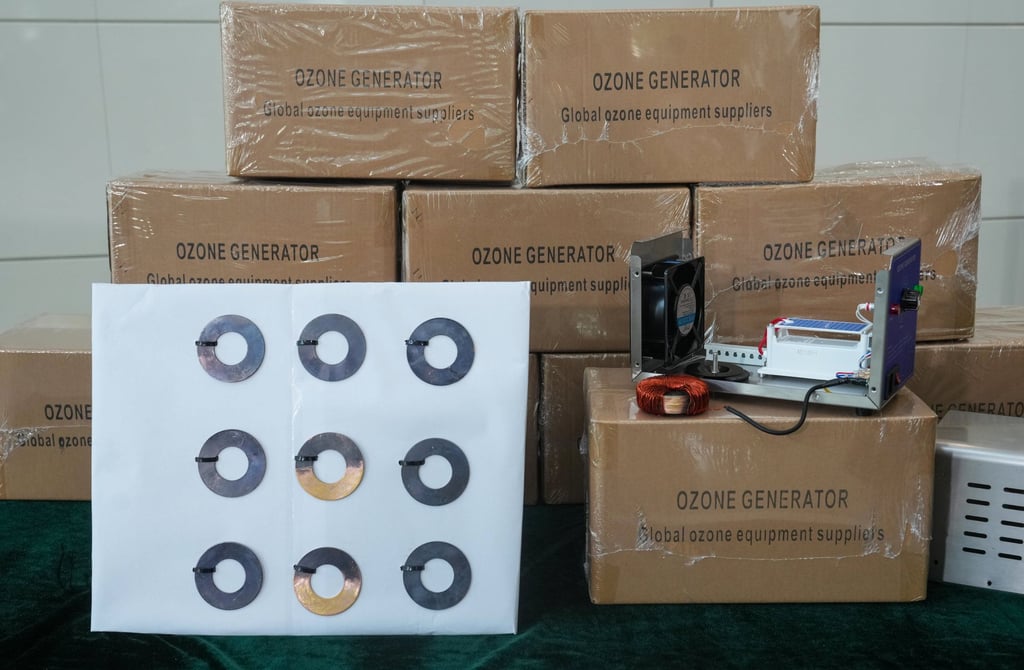
After removing the machine’s casing, he said customs officers discovered unusual traces of glue on the transformer assembled with 11 round-shaped metal plates.
“Upon further inspection, we discovered that nine of the 11 metal plates weighed over twice as much as the other two,” he said. “After scraping off the coating, officers discovered the nine metal plates were made of gold.”
Inspector Davis Kwok Chun-ting of customs’ syndicate crimes investigation bureau said the high cost of air delivery for such machines also drew their attention.
“The machines are worth HK$100 to HK$200 each, but the delivery of the shipment by air costs about one or two times more than the combined value of the machines,” Kwok said.
He said a total of 12kg of gold had been confiscated in the 12 machines and the seized precious metal was worth HK$7.5 million.
“If the consignment had successfully been smuggled into Japan, around HK$800,000 in tariffs could have been evaded,” Kwok said.
The source said the shipment sender was a local firm, adding initial investigations suggested it was a shell company.
So far, no arrests have been made.
Kwok said investigations into the origin of the seized gold were still ongoing.
In July, customs officers discovered HK$13 million worth of gold disguised as metal plates of the transformers in 32 LCD screen separators in a Tokyo-bound air consignment.
On March 27, customs seized HK$84 million of gold disguised as machine parts in two air compressors from a Japan-bound consignment, the biggest smuggling bust of the precious metal in terms of value in the agency’s 115-year history. The director of a local company was arrested.
In Hong Kong, exporting and importing unmanifested cargo is punishable by up to seven years in prison and a HK$2 million fine.