2 Ways Jerome Powell’s Successor, Kevin Warsh, Intends to Alter the Fed — and Both Risk Upsetting a Historically Pricey Stock Market

The big day is nearly here. Tomorrow, May 15, will mark the final day of Jerome Powell’s tenure as Fed chair and the expected beginning of Kevin Warsh’s first term as head of the Fed. Warsh’s five years on the Board of Governors of the Federal Reserve (Feb. 24, 2006 – March 31, 2011) bring experience to this key position.

But a Warsh-led Fed will lead to changes for the central bank — changes that threaten to upend the Dow Jones Industrial Average (^DJI +0.53%), S&P 500 (^GSPC +0.39%), and Nasdaq Composite (^IXIC +0.35%).

Jerome Powell’s final day as Fed chair is May 15. Image source: Official Federal Reserve Photo.

Kevin Warsh intends to deleverage the Fed’s balance sheet

Arguably, Warsh’s biggest critique of the central bank has been the ballooning of its balance sheet. From August 2008 to March 2022, total assets held by Federal Reserve banks grew roughly tenfold to nearly $9 trillion. Though a (now-ended) quantitative tightening cycle helped lower this figure to $6.7 trillion as of May 6, 2026, Powell’s successor wants to meaningfully deleverage the balance sheet.

The issue isn’t whether selling these assets, comprised mainly of U.S. Treasury bonds and mortgage-backed securities, is the right or wrong move. It’s that selling trillions of dollars of long-term Treasury bonds can have unintended consequences for Wall Street.

US Total Assets Held by All Federal Reserve Banks Chart

US Total Assets Held by All Federal Reserve Banks data by YCharts.

Bond prices and yields are inversely related. Selling trillions of dollars of Treasury bonds would weigh on bond prices and push yields higher, thereby increasing borrowing costs on consumers and businesses. Even if Warsh and other members of the Federal Open Market Committee (FOMC) — the 12-person body that sets the nation’s monetary policy — have no intention of raising interest rates, deleveraging the Fed’s balance sheet would effectively do so.

A historically expensive stock market is counting on low(er) interest rates to fuel artificial intelligence data center build-outs, among other costly, growth-trajectory-altering ventures.

A calculator set next to several newspaper clippings that are highlighting inflationary pressures.

Image source: Getty Images.

Powell’s successor wants to change how you think about inflation

In addition to slashing the central bank’s $6.7 trillion balance sheet, Powell’s successor made clear in his testimony to the Senate Banking Committee that he wants to transform the definition of inflation.

The FOMC has maintained a hardline target of 2% long-term inflation since January 2012. But according to Warsh, “price stability should be a change in prices such that no one’s talking about it.”

This desire to seemingly abandon hardline inflation targets in favor of a considerably vaguer definition of price changes should give the Fed greater flexibility to adjust its monetary policy stance or take action. While this might sound favorable on paper, it risks upsetting Wall Street’s rip-roaring bull market.

Since the start of the Iran war on Feb. 28, energy prices have skyrocketed. The closure of the Strait of Hormuz has led to the largest energy supply disruption in modern history and a decisive uptick in trailing 12-month inflation. There’s no question that consumers and businesses are talking about inflationary pressures.

If Warsh is successful in altering how the FOMC thinks about inflation, the price pressures from the Iran war could quickly warrant a shift in stance from the FOMC to a neutral or hiking bias. Although the Dow Jones Industrial Average, S&P 500, and Nasdaq Composite have held up well in light of rapidly rising inflation, a decisive shift from a Warsh-led Fed could quickly change Wall Street’s tune.



Source link

Visited 1 times, 1 visit(s) today

Related Article

Prediction: $150 a Month Invested in Micron Stock Will Be Worth This Much by Year-End 2030

Over the last year, memory chip manufacturers have benefited from extraordinary demand for artificial intelligence (AI). In particular, Micron Technology (NASDAQ: MU) has witnessed its market capitalization propel from just $53 billion at the start of the AI revolution to more than $1 trillion today. MU Market Cap data by YCharts Missed Nvidia in 2009?

Micron Tripled in 2026. Can It Repeat in 2027?

Micron (NASDAQ: MU) stock has more than tripled so far in 2026, making it the fourth-best-performing stock in the S&P 500 (SNPINDEX: ^GSPC) this year. That’s an impressive run, but for investors, the past really doesn’t matter; only the future. So, could Micron repeat this feat in 2027? One metric suggests that the answer to

GM Just Beat Earnings Estimates. Is Ford Still the Better Dividend Stock?

Quick Read Ford (F) yields nearly 5% versus GM’s (GM) sub-1%, making Ford the clear winner for investors who need cash income today. GM’s dividend is covered 18 times by free cash flow versus Ford’s 2.6 times, making GM’s payout far safer for long-term holders. GM’s stock gained 187% over ten years versus Ford’s 62%,

Trumpflation Is Evolving, and There’s a New Twist That Threatens to Sink Stocks

For the better part of the last four years, the stock market has been unstoppable. The artificial intelligence (AI) infrastructure build-out has helped propel the Dow Jones Industrial Average (DJINDICES:^DJI), S&P 500 (SNPINDEX:^GSPC), and Nasdaq Composite (NASDAQINDEX:^IXIC) to several record highs this year. But these gains may prove fleeting, courtesy of Trumpflation — inflation specifically

Old Republic International Earnings: What To Look For From ORI

Old Republic International Earnings: What To Look For From ORI Insurance conglomerate Old Republic International (NYSE:ORI) will be reporting earnings this Thursday before market open. Here’s what investors should know. Old Republic International missed analysts’ revenue expectations last quarter, reporting revenues of $2.33 billion, up 5.2% year on year. It was a softer quarter for

Cathie Wood’s Ark Invest Grew Its Portfolio to $15.4 Billion Last Quarter, With Tesla, AMD, and a New SpaceX Stake Making Up About 18% of ARKK Assets. Is Her Concentrated Bet Paying Off?

Cathie Wood is one of America’s most-watched tech investors, known for her extreme bullishness on Bitcoin and disruptive future technologies like robotics and artificial intelligence (AI). According to her company’s most recent 13F SEC filing, as of the second quarter, Cathie Wood’s Ark Invest portfolio had a total of $15.4 billion of assets under management.

Inflation Is Back. Is A Stock Market Crash Next?

The S&P 500 has gained 12.3% this year. That’s with oil above $100 a barrel, consumer prices climbing 3.7% a year and a 10-year Treasury yielding 5.1%. Stocks are behaving as though none of that counts. So could inflation knock the index down 40%? Can anyone call the market’s next move, whether that’s tomorrow, next

Advice for home sellers: ‘If you’re trying to time the market, you can’t’

Homeowners waiting for a better moment to sell should stop trying to time the market, National Association of Home Builders CEO Jim Tobin said. “If you’re trying to time the market, you can’t do it,” Tobin told Yahoo Finance on Monday. “If you talk to anybody who’s bragged about when they sold their home or

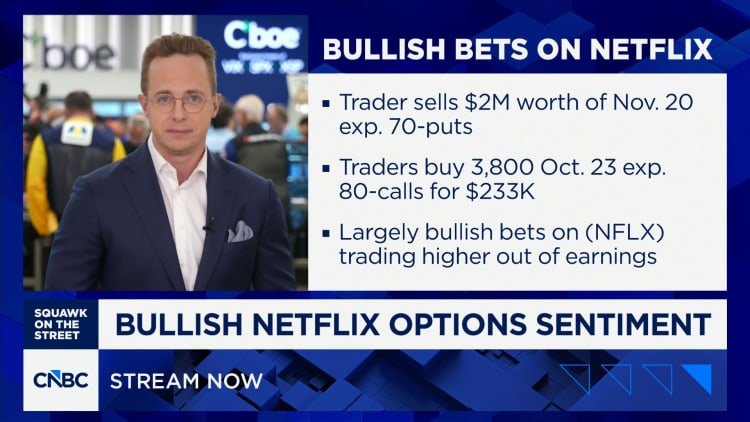
Traders are betting Netflix’s stock drama may be coming to an end

A slumping stock price. C-suit shakeups. Corporate layoffs. A failed takeover bid. It’s not a new drama on Netflix, but rather the drama that has surrounded the streaming giant as it limps into earnings with its stock nearly off 50% from its all time highs. Option traders are betting the drama might be coming to

CEO Elon Musk Just Gave SpaceX Investors Great News

Space Exploration Technologies Corp. (NASDAQ:SPCX) reported its third-quarter earnings after the market closed on Oct. 20, with results that largely topped Wall Street estimates. Here are the key numbers: Missed AI’s “Act 1”? Act 2 Could Be 14x Bigger. Most investors think they missed the AI boat because they didn’t buy Nvidia in 2005. But

2 Dividend Stocks Crushing the Market in 2026 (and Which Ones Can Keep Going)

Broader equities have been fairly resilient this year. However, there remains a very real possibility that macroeconomic problems and geopolitical tensions will eventually lead to a market crash. One way to prepare for that is to invest in dividend stocks with strong underlying businesses. Here are two options investors should consider: Johnson & Johnson (NYSE:

Meta Q3 earnings to test Wall Street’s stomach for AI spending

Meta (META) will kick off Big Tech’s earnings season when it reports its third quarter results after the bell on Wednesday. For the third quarter, Meta is expected to post earnings per share of $3.56 on revenue of $63.3 billion, according to Bloomberg analyst consensus estimates. That’s up from the $1.05 and $51.2 billion the

Prediction: Oct. 21 Will Be a Huge Day for the Stock Market

Artificial intelligence (AI) stocks have led this bull market over the past three years, pushing the S&P 500 to record highs. Investors were eager to get in on this promising technology early on, and in many cases, they’ve already greatly benefited. For example, chip designers such as Nvidia and Advanced Micro Devices, as well as

US Stock Market Today: S&P 500 Futures Climb On Strong Factory And Earnings Hopes

The Morning Bull – US Market Morning Update Tuesday, Oct, 20 2026 US stocks are set for a firmer open, with sentiment leaning risk on as investors focus on a clear upswing in American factory activity. The key driver this morning is stronger than expected industrial and capacity data. Industrial production rose 0.7% month over

0
Would love your thoughts, please comment.x
()
x