LONDON, Dec 2 (Reuters) – As consensus forms around next year’s investment outlook, it’s hard to find many outright stock market bears. Yet an economic mix not seen for more than half a century means few forecasts come without serious qualifiers.
Sign up here.
As economists at JPMorgan insist, the juxtaposition of an AI-led capex explosion and stalling labor market has not been evident in any U.S. expansion for the past 60 years.
AI itself, and the modest productivity gains it has delivered so far, may offer a partial answer to the conundrum. Immigration trends and the halt to the supply of workers have also dragged heavily on new employment.
Many still fear the economy could tip either way. Even so, there’s a tendency to lean on – albeit slowing – capex spending as a reason for optimism about 2026.
Bulls argue that most AI infrastructure spending should be covered by firms’ cash earnings, that stock prices should continue to benefit from that build‑out, and that the “wealth effect” from rising equity values and falling interest rates should help offset any dent to demand from slower real labor incomes.
JPMorgan estimates that U.S. household net wealth has risen by more than $12 trillion, or some 8%, since the start of the year.
As it stands, JPMorgan’s real GDP forecasts for the U.S. and global economies through next year and 2027 are a remarkably serene 2% and 2.9%, respectively, in both years.
‘RISK-ON, WITH HEDGES’
The headline numbers may sound positive, but the “baseline” scenario is also finely balanced on a series of ifs, buts and maybes.
Perhaps it was ever thus. Still, conviction about the economic picture seems weaker than usual.
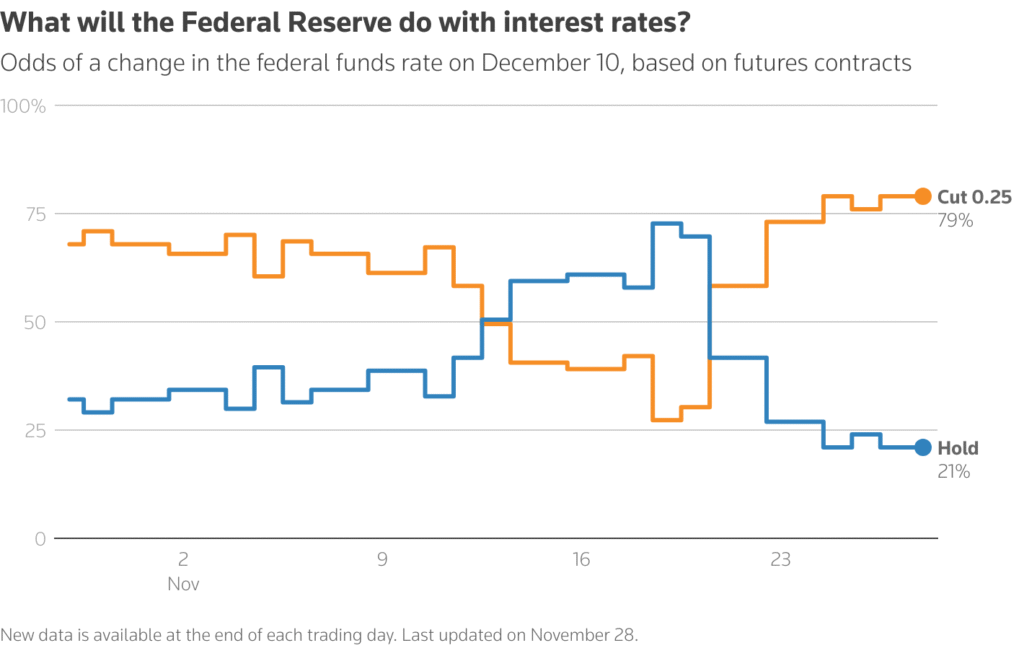
Trump appointees to the Fed board and Chair could well force through easing regardless. But White House pressure for deep rate cuts might be muted if inflation remains this hot while polls show voters fixated on the cost of living heading into November’s mid-term elections.
The result is that many investment outlooks tilt toward another bullish year – but all are tinged with caution.
Societe Generale’s multi-asset strategists sum it up with a year-ahead entitled “Risk-on, with hedges.”
The thrust of their optimism comes from the AI investment cycle and falling interest rates. U.S. tech and communications firms are expected to generate $1.25 trillion of operating cash flow they think will grow faster than capex over the next two years.
Even though price/earnings valuations are stretched on many levels, SocGen sees the equity risk premium over fixed income still well above scarier dot-com bubble troughs of 2000.

SO WHY THE HEDGES?
The French bank frets about the circular nature of AI investments and creeping leverage, the risk of a hawkish Fed turn, and potential volatility in U.S. politics heading into the midterms.

‘$21 TRILLION QUESTION’
Asset managers, meantime, seem reluctant to throw in the towel on stocks or the AI theme – but they all wince at how expensive the dominant U.S. names have become.

Fidelity International’s Chief Investment Officer for Equities Niamh Brodie-Machura poses “the $21 trillion question” – or the market cap of the U.S. tech sector – and concludes that the AI boom may continue but with growing monetization worries and valuation risks.
Her answer is diversification and rotation out of the U.S. toward Europe, Japan or China.

“The AI investment boom is a game-changing trend that will continue to push corporate earnings higher, but the rewards in some areas may not match the exuberance of both real-world and stock market investors,” she wrote.
And yet she, too, returns to the crux issue.
If AI starts to work in full, its promise of higher productivity must dampen hiring and could eventually lift layoffs considerably – good for stock prices, wealth and spending, but lousy for jobs and incomes.
Which way will the economy lean next year? Place your bets now.
The opinions expressed here are those of the author, a columnist for Reuters
by Mike Dolan; Editing by Marguerita Choy
Our Standards: The Thomson Reuters Trust Principles.
Opinions expressed are those of the author. They do not reflect the views of Reuters News, which, under the Trust Principles, is committed to integrity, independence, and freedom from bias.